Chatham Middle School seventh graders, Neal Barker, Kloe Holley and Addy Kitchens all said they enjoyed welding. It might sound a little unusual for middle schoolers to have welding experience, but this is just one of the manufacturing careers that GO TEC has introduced them to.
And don’t worry – it’s just a virtual reality welding simulator.
GO TEC, an acronym for Great Opportunities in Technology and Engineering Careers, is a program that works to introduce middle schoolers to manufacturing skills, equipment, and ultimately, careers.
There are nine focus areas of GO TEC to showcase a variety of career options to students: automation and robotics, IT coding and networking, manufacturing engineering, mechanical engineering, electrical engineering, precision machining, healthcare, metrology, and welding.
This academic year, the program will be in 25 middle schools across Virginia.
In many middle schools, like Chatham Middle, the class is an elective that students can choose from a host of other options like art and band.
“My favorite [part of the class] was the welding tournament,” said Barker, who took the class last year. The class had a competition using the welding simulator, which scores users based on precision and accuracy. “But the thing is, I lost in the first round,” he said.
The class was honest about wages for different careers and how important these jobs are, Barker said.
Middle schools that participate in this program have an in-house GO TEC lab with different types of manufacturing equipment for the students to learn about and interact with. The program is designed to be very hands-on.
In addition to the welding simulator, which can give students experience with MIG, stick and TIG welding, there’s also a Haas computer numerical control machine to teach precision machining and subtractive manufacturing, a 3D printer, a laser cutter, and hydroponic agriculture equipment.
And there’s IT coding tools, metrology tools, electrical engineering tools like digital multimeters, and robotics and automation resources.

At Gretna Middle School, the career connections classroom has 20 computers, 20 desktop robots, two welding simulators, a 3D printer, a laser cutter, and a milling machine. And this is just some of the equipment in the classroom, which serves as the school’s GO TEC lab.
Right now, students at Gretna Middle are using a computer-aided design software called TinkerCad to create 3D-printed keychains with their name on it. When the holidays roll around, they’ll make 3D-printed Christmas ornaments.
Gretna Middle also has a welding tournament. When there’s one student left standing – the welding champion – teacher Christy Shelton gives them a 3D-printed trophy.
The welding simulator is one of the most popular modules among her students, Shelton said, both girls and boys. In fact, the girls are often better welders than the boys.
“They’re more patient,” she said. “They’re more detail-oriented.”

Women make up only 27% of the manufacturing workforce. Getting young girls interested in manufacturing careers is just one of the goals of GO TEC, which started in Danville and Pittsylvania County in 2018.
Over the past year, there have been an average of over 860,000 open manufacturing positions each month, according to data from the Manufacturing Institute. By the end of the decade, more than 2 million manufacturing jobs could go unfilled, costing the economy $1 trillion in 2030 alone.
Higher education leaders in Danville and Pittsylvania County noticed the vacancies in manufacturing jobs back in 2016. Employer partners were telling places like Danville Community College and Patrick & Henry Community College about difficulty finding workers.
And on the education side, there was decreasing enrollment in manufacturing programs.
The programming was there, but the participants weren’t, said Julie Brown, vice president of advanced learning at Danville’s Institute for Advanced Learning and Research.
“Why are we not getting more individuals?” she said. “We know there are good-paying jobs. What’s the disconnect?”
Similarly, career and technical education courses in high schools often have empty seats, said Jake Taylor, GO TEC’s technical and training manager.
“To fill those seats, you’ve got to get to them before they’re an 11th or 12th grader,” Taylor said.
And so, the idea for the GO TEC program was born.
“The idea was to target that middle school level, so that we could flood the market with students that are interested in those talent pathways,” Taylor said.
These conversations, happening around 2016, coincided with the formation of GO Virginia, a business-led economic development initiative that promotes regional collaboration and workforce development.
The organization invested in GO TEC, making it “one of the first projects in our region that was funded by GO Virginia dollars,” Brown said.
GO Virginia funded half of the program initially, with local governments and private foundations kicking in money as well.


It’s not cheap. A welding simulator alone is $15,000. Shelton said the lab at Gretna Middle School has about $200,000 worth of equipment in it. And that’s just one of 25 middle schools with a GO TEC lab.
“Sometimes I ask students why they think people put that kind of money into this middle school,” Shelton said. “I tell them it’s because they’re important and we want them to get excited about this stuff.”
And GO TEC is more than just a financial investment. It’s an investment in the students themselves – and a long-term one at that.
The first students who participated in the program aren’t in the workforce yet. They’re still in high school.

Despite playing the long game, Brown said she is seeing lots of traction and demand for the program in the short term.
Initially, the GO TEC team at IALR had to reach out to school divisions to spread the word about the program and ask for participants. Now, school divisions come to them, Brown said.
In 2018, the two Danville middle schools and Chatham Middle School in Pittsylvania County were the first in the state to have GO TEC labs. Shelton said Gretna Middle School was quick to follow.
GO Virginia separated the state into nine regions. Danville and Pittsylvania County are in Region 3, and so are most of the GO TEC labs.
Almost 75% of the middle schools in Region 3 have labs, making it the region with the most GO TEC programming, Brown said.
But there are also middle schools with labs in several other GO Virginia regions, including places like Grayson County, Wythe County, Carroll County, Franklin County, Emporia, Greensville, Hampton Roads and Newport News.
A school division in Portsmouth is implementing the GO TEC program this school year, Brown said, and there is also interest in Fredericksburg, Colonial Heights and Hopewell.
GO TEC has served over 3,000 students to date, but the IALR expects that number to double in the 2022-2023 school year.
The expansion of GO TEC has dramatically increased the potential workforce for manufacturing jobs in Virginia, especially Region 3, Brown said.
“Before, say there were 20 students in a precision machining program,” she said. “That’s not the story anymore. We’ve got 7,000 middle school students that are touching that Haas milling machine that happens to have the same interface that a company, when they choose to locate here, is using.”
And it’s important to remember that GO TEC is the entire pathway toward manufacturing careers, Brown said. The middle school labs are the most unique part of the program, but GO TEC is invested in following students throughout their high school career and into the workforce as well.
That means that GO TEC also works to connect students with employers in their region, which can sometimes result in an internship.
“We want them to stay in our area, and they need to know what opportunities are here,” Brown said.
To do this, IALR and other sponsors hosted a Career Choice Youth Expo for local middle schoolers. Dozens of regional employers led hands-on activities to expose around 2,500 students to opportunities in different fields.
The event was held in the Olde Dominion Agricultural Complex in Chatham Sept. 28 and Sept. 29. The same event was also held at Hampden-Sydney College Sept. 21 and Sept. 22 to reach students in that area.
Barker, Holley and Kitchens from Chatham Middle all attended. So did Jocelyn Jones and Gabriella Nance, seventh graders from Tunstall Middle School in Pittsylvania.
“It’s fun to learn about the machines,” Nance said about the GO TEC program. “We use TinkerCad to make laser cutouts, and it’s cool to watch the machine make them.”
Jones said she enjoyed coding.
“[The class] walks us through it, so it’s not as hard as you think,” she said.
Haley Loppard, who is in seventh grade at Chatham Middle, said her favorite module was the healthcare module, because she’s interested in nursing as a career. And Madelyn Oliver, another seventh grader at Chatham Middle, said she liked how hands-on the program is.
The interactive element is a huge part of GO TEC, said Shelton. She taught the career connections class before GO TEC equipment got included, about four years ago. Back then, the class was mostly about researching different career options.
Since getting the GO TEC equipment, Shelton said she’s seen a renewed interest among students in thinking about careers.
“They seem to get more excited about it, because it’s more hands-on,” she said. “It’s not just research, like let’s see how much a welder makes. Definitely with the equipment it’s more fun and they’re more interested.”
Shelton said her classes are usually full, even though it’s an elective at Gretna Middle, and most students who choose to take the class have some interest in a manufacturing career.
“They all fall into the categories of liking machines, liking robotics,” Shelton said. “Hopefully they’re choosing vo-tech [in high school].”
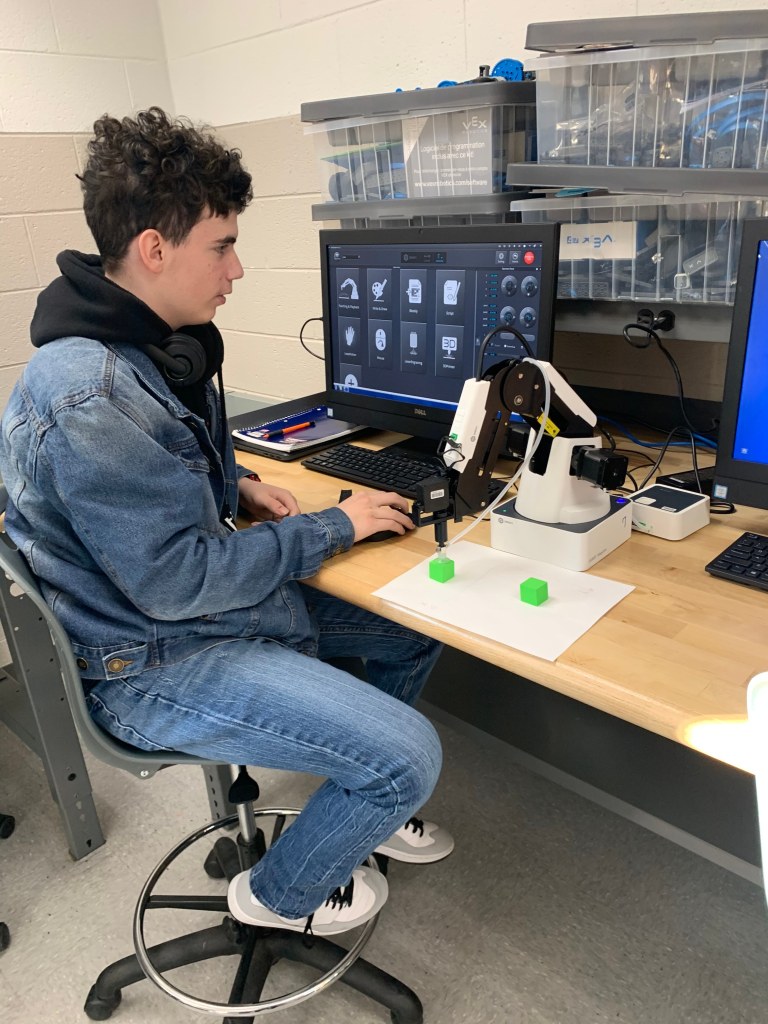
Exposing students to manufacturing careers through GO TEC gives the entire state a competitive advantage when it comes to attracting industry, Brown said.
“Company representatives come through and they realize this is different,” Brown said. “They’re not seeing this in Alabama, or North Carolina, or South Carolina, or other places they’re looking at. They’re not seeing this level of collaboration and partnership.”
The equipment in GO TEC labs is standardized, so each middle school student participating in the program across Virginia has the same experience with the same machines.
This can promote collaboration across schools, Brown said. It also contributes to cost savings, as IALR can order the equipment in bulk.
“That also helps us troubleshoot with schools and teachers,” Taylor said. “If they say they’re having a problem, we know exactly what equipment they have and how to help.”
There is real-time call center support for teachers who have questions about the equipment, he said.
Taylor conducts training sessions for teachers before their middle schools implement GO TEC. The training period is different depending on the timeline for implementing a lab.
“Sometimes we don’t know that an instructor is going to teach this course until maybe two months before school starts,” Taylor said. “We put them on a weeklong training program that kind of gets their feet under them.”
Usually, the teachers have no previous experience with the manufacturing equipment, Taylor said. At the end of the training, teachers will be comfortable with the equipment, but probably not experts.
“Most teachers are used to being the content expert for their students,” he said. “I try to make them comfortable with being uncomfortable. They’re not going to be able to answer every question a student asks, but they’re going to be able to develop that rapport with their students. If they get asked a question, they can say, well, I don’t know, but let’s go find out together.”
Teachers are usually quick to embrace the lifelong learning mentality, despite an initial shock when they see the equipment, he said.
Sometimes, teachers come to the Institute’s GO TEC lab to train. But if they are in other areas of the state, Taylor can go to them in the GO TEC bus.

Taylor got his Class B CDL to drive the bus, a 46-foot-long, 36,000-pound vehicle with Wi-Fi.
The bus can house all of the same equipment as the lab. Some of the equipment stays on the bus permanently, but things like the welding simulator and milling machine can be loaded on and off.
The bus was originally programmed for STEM outreach and branded as the IALR’s Inspiration Lab in 2017. But the pandemic stopped much of the Institute’s outreach programs, so it was rebranded as the GO TEC bus.
IALR has invested $600,000 into the bus, Taylor said.
“We trained our Hampton teacher and our Newport News teacher on the bus,” Taylor said. “We did a two-day new teacher training on here.”


Students get the opportunity to check out the bus and its equipment, too, when Taylor travels to their school. And GO TEC is working to figure out how to introduce students to manufacturing careers even earlier, he said.
“We have pushed around the notion of going prior to middle school,” Taylor said. “What can you do with fourth or fifth grade students to make them want to pursue that at the middle school level?”
Taylor said GO TEC can target schools where the class is an elective and visit their feeder elementary schools “to provide outreach activities before they sign up for classes to make sure that students are aware” of the program.
And even though investing in such young students is a long-term endeavor, the growth of GO TEC is something that Virginia can showcase to employers immediately.
“It’s visible evidence of Virginia’s long-term investment in a talent pipeline at scale,” Brown said. “That’s not something you have to wait years to see the return on investment. That sells today.”