

Virginians are voting this fall on three proposed constitutional amendments. We asked groups on both sides of each question for an opinion piece making their case. Here are the pro and con arguments for Amendment 2, which would guarantee the right to a same-sex marriage in case the U.S. Supreme Court ever reverses its 2015 decision.
You can read the full language of the amendment here.
For more on this year’s election, see our Voter Guide.
The writers
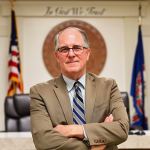
Vote yes, by Roanoke mayor Joe Cobb.
Rev. Dr. Joe Cobb is the mayor of Roanoke and a member of the clergy with the United Methodist Church. He lives in Roanoke with his husband, James.
Vote no, by Phill Kline, former attorney general of Kansas and now a law professor in Virginia
Phill Kline is an associate professor of law at Liberty University. He served as attorney general of Kansas, where his law license was suspended after allegations of ethical misconduct in an investigation of abortion providers. His lawyer has said he did not intentionally lie or mislead others in pursuit of his case.
* * *
I stood with couples the courts told to wait. This November, we make sure that never happens again.
By Joe Cobb

In 2014, I stood outside the courthouse in Roanoke, the day before many same-sex couples hoped to get married. A federal appeals court had just struck down Virginia’s marriage ban, and for a brief window it looked like the wait was finally over. I was planning to be there as clergy, ready to officiate for anyone who wanted it. Then a stay came down from the Supreme Court, and couples who had planned to be married stayed home without licenses.
The next morning, I held a press conference outside that same courthouse because I needed to say out loud what was being done to us. Though the courts had put a stay on us, no one could put a stay on the enduring power of love and the civil rights to protect love in marriage. That morning changed the course of my life. It’s when I stopped only believing in justice and started working for it, and it’s the road that eventually led me to first run for city council in Roanoke.
By then, my now husband James and I had been together for more than a decade and were raising two small children. We met nearly 25 years ago, at a Pride event here in Roanoke. I’d just come out, left the church I’d served for years to move closer to my kids. I’ve never had much patience for long, boring events, but meeting James that night made sticking around to the end easy. We were both immediately smitten, agreed to meet up the next day, and the rest is history.
Like any couple that’s been together as long as we have, we’ve had our own hard stretches, including about three years apart before we found our way back. Over the years, we’ve built a family together — two children born through surrogacy, both of us present for every scraped knee and every college application since. In 2016, James joined me in Italy during my sabbatical. He kept trying to get us on a gondola in Venice, but the weather kept refusing. In the end, he wasn’t able to propose until we were back home at the kitchen table looking through photos from the trip. We married on a rooftop in the center of Roanoke, on Father’s Day weekend, 2017.
I was ordained as clergy in the Metropolitan Community Church in 2006, the same year Virginia voters wrote a marriage ban into our constitution, and the same year my church worked to defeat it. Today, I’ve since been reinstated as United Methodist clergy, and marriage is sacramental to me. More than just two people becoming one, marriage is about placing our love within divine love, transforming us from the inside out and deepening every other relationship we have. James and I have four children between us now, and grandchildren besides, and every one of them has taught me something about what it means to keep choosing a family, not just start one.
But I also know, in ways that are less spiritual and much more practical, that marriage is a set of legal protections. When James and I decided to grow our family, we chose to travel to California for surrogacy for our youngest two, because we didn’t know whether Virginia would recognize us both as their legal parents.
Marriage equality has been the law of the land for over a decade, and many Virginians reasonably assume it’s settled. But the couples I marry today aren’t always so sure. I’ve officiated weddings recently for couples who tell me, plainly, that they’re rushing to get married because they’re afraid they might not have the right to if they wait. Even the possibility of the ban still written into our constitution coming back into force is a terrifying prospect for people.
Virginia has changed. I see it in Roanoke, in the New River Valley, and in my own church. Removing this ban has taken far too long. Amending Virginia’s constitution is a slow and difficult process, but this November, we finally have our chance. Voting “yes” on Question 2 will ensure our constitution reflects the lives of families like mine who call Virginia our home.
I’ve spent my adult life believing marriage is one of the ways we practice showing up for each other, again and again, through everything life throws at us. James and I have been doing that for a very long time now — through a surrogacy journey, a rooftop wedding, four kids, three grandchildren and every ordinary Tuesday in between. I’m asking Virginians to show up too. Vote yes on Question 2 this November.
* * *
Why Question 2 rewrites more than marriage
By Phill Kline

They tell you Question 2 only deletes an unenforceable ban on gay marriage and writes the United States Supreme Court’s decision in Obergefell protecting gay-marriage into the Virginia Constitution. But read the words they want in Virginia’s Bill of Rights:
“This Commonwealth and its political subdivisions shall not deny the issuance of a marriage license to adult persons seeking a lawful marriage on the basis of sex, gender, or race of such persons.”
If the aim was only to protect “same-sex” marriage, the sponsors had a tried and tested phrase. In Obergefell v. Hodges, the Supreme Court asked “whether the Fourteenth Amendment requires a State to license a marriage between two people of the same sex.” The Court used the term sex, not gender. It did not use “gender identity.” It did not use “nonbinary.” The federal Respect for Marriage Act uses “sex,” not “gender.” Virginia’s own Bill of Rights, in Article I, Section 11, already prohibits discrimination on the basis of “sex.” The sponsors could have used the term every court has used in the past — they did not. They added a second, different word.
That word is the experiment.
“Sex” is an objective classification the law has used for centuries: male and female, ascertainable at birth. “Gender,” as now used in advocacy and in Virginia’s Human Rights Act, is “the gender-related identity, appearance, or other gender-related characteristics of an individual, with our without regard to the individual’s designated sex at birth.” It is a self-description. It can change.
Wikipedia’s running list of named gender identities stretches well past 50 entries and keeps growing. The 2025 Gender Census, a voluntary survey of more than 43,000 people who reject the male-female binary, recorded dozens of identity words in a single year — nonbinary, agender, demiboy, demigirl, genderfluid, and so on. Disabled World’s compilation of public lists notes counts of 72, 81 and rising, and correctly warns there is no fixed category. A constitution cannot stabilize a term that its own proponents refuse to stabilize.
When the term is placed in the Bill of Rights, it will not stay in the clerk’s office. Constitutional classes migrate, especially “suspect classes” as gender will become if the “marriage” proposal passes. The requirement that the commonwealth must “treat such marriages equally … regardless of … gender” will be cited in employment disputes, school records, child-custody orders, probate and any statute that still speaks of husband, wife, mother or father. The Virginia Supreme Court has already seen the adjacent fight: in Vlaming v. West Point School Board (2023), a teacher’s compelled use of gender-identity pronouns produced visible claims under the state constitution’s speech, religion and due-process clauses. The legislature can adjust a statute when a new identity appears or when a school policy collides with a parent. A clause in Article I is designed not to be adjusted. Accordingly, it will be litigated.
The Supreme Court has declined to treat “gender” as a suspect class. In United States v. Skrmetti (2025), it applied rational-basis review and refused to freeze a contested medical and social question into heightened constitutional protection requiring strict judicial scrutiny of any state law regarding gender. Question 2 would do in Richmond what the court would not do in Washington: place “gender,” undefined and self-identified, beside race and sex in the marriage clause of the Bill of Rights. Race is an inherited status. Sex is a biological fact. Gender, on this usage, is a claim an individual makes about themselves. A suspect class whose membership the member defines is not a classification. It is a moving target written into the highest law of the commonwealth.
Same-sex marriage is already the law in Virginia under Obergefell and Bostic v. Schaefer. If voters want that result on the face of the state constitution, the honest sentence is the court’s sentence: two people of the same sex. The sponsors chose a different sentence. They chose to experiment with a word whose boundaries they cannot draw, and to let that word travel from the marriage license into every adjacent field of family law.
A constitution is the one document we ask the next generation to live under once all of the political campaigning is over. Perhaps those who seek to alter its wording should be more forthright by only seeking to do what they claim they are seeking to do.
[Note: This page was updated Oct. 21 to provide further information about Kline’s background.]