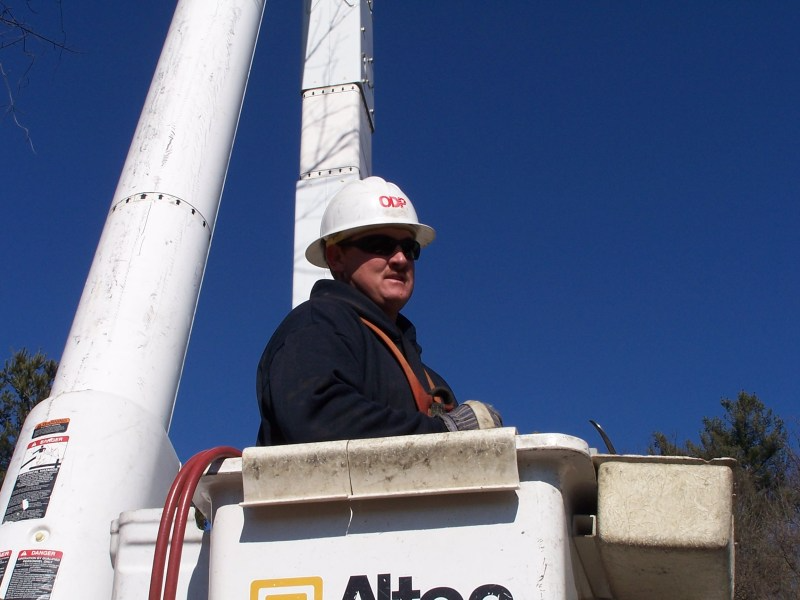
I recently attended the ribbon-cutting for a factory expansion. For the event, the workers were gathered outside — hundreds of them. For a company west of the Blue Ridge, where the population is overwhelmingly white (this particular county is 92% white), I was struck by the diversity that I saw gathered in the parking lot and an adjacent hillside — lots of Black and Latino workers. Later, while touring the inside of the plant, I saw several Latino women who were installing some sort of electrical gear on the factory’s product. I asked the company for demographics and was told that 53.3% of the workers were non-white, the biggest group of those being Latino — 41.3%.
In short, this seemed the kind of workforce that Democrats usually claim to represent.
There’s just one catch, though: These workers at the Munters plant in Botetourt County make heating, ventilation and air-conditioning equipment for data centers.
Both parties have been racing to express their concern about data centers, although Democrats have gotten there first and tend to be the most vocal. Beth Macy, the Democratic candidate in the 6th District, has been among the first to call for a moratorium on data center construction. There may well be good reasons for this: Data centers are driving up demand for energy and drinking lots of water. However, for better or for worse, they are also driving the economy.
ING Global Market Research, a Dutch financial multinational, issued a report this summer that concluded that AI now represents one-third of the U.S. economic growth in 2026. Likewise, an economic forecast issued recently by the University of Virginia’s Weldon Cooper Center for Public Service also highlighted AI’s role in the economy. “The national economy enters the middle of 2026 with growth and slightly stronger momentum than earlier in the year,” the report said. “The stronger outlook reflects increased artificial intelligence-related investment, particularly in information technology, software, and data centers.”
“Economic growth” is often a vague phrase and one that doesn’t always translate into benefiting everyone. The beneficiaries of data center growth are popularly (and not incorrectly) assumed to be tech billionaires. However, there are also lots of working-class tradespeople who are seeing unprecedented growth in their fields due to data centers. In political terms, this is called “cross-pressure,” where political coalitions find themselves pulled in opposite directions. We’ve seen this before: When Virginia was roiled by proposed natural gas pipelines (such as the Mountain Valley Pipeline), environmental groups — a key part of the Democratic coalition — opposed the pipelines. However, many labor unions — another key part of the Democratic coalition — backed them.

As politicians, especially Democrats, rush to slow down data center growth, I have to wonder whether they will encounter some of the same cross-pressures — and what the economic implications of slowing down data centers will be. More broadly, I wonder how much of the controversy over data centers is, or will be, a class conflict where Democrats find themselves aligned against the blue-collar workers who are benefiting directly from the data center boom.
We may not be at that point yet, and we may never get there. However, it’s demonstrably true that the data center boom is driving employment — and wages — in certain fields and in certain places. That employment is not necessarily with data centers themselves (which average about 50 workers per site, according to a state study) but in the data center supply chain, where the jobs show up in the hundreds and hundreds, such as Munters.

Tom Perriello, the Democratic candidate in the 5th District, recently criticized Republican incumbent John McGuire for voting for a particular tax deduction that tech companies have been making use of. Perriello’s campaign cited a Politico story that reported: “ The tech world is pouring oceans of money into chips, data centers, power supplies and other components of the artificial intelligence infrastructure. And that’s eligible for generous tax breaks on investments Republicans included in their 2025 tax cuts.”
The Democratic criticism of that vote is that tech companies didn’t need this tax break, that they’d be making these investments anyway, so all the Republicans did was vote for a tax break that has reduced revenue and driven up the deficit.
That seems a worthy debate to have, but let’s go back to the first sentence: “The tech world is pouring oceans of money into chips, data centers, power supplies and other components of the artificial intelligence infrastructure …”
That’s where the job growth is happening. Data centers themselves generally don’t create a lot of jobs — a 2024 study by the Joint Legislative Audit and Review Commission put the average employment at about 50 jobs for each 250,000-square-foot facility. By contrast, employment at Munters in Botetourt has tripled over the past four years and now stands at 827. Business is so strong that the company just added a new production building.
This is part of a larger ripple effect of job growth emanating from data centers.
A study by the consulting firm PwC found that data supply chain jobs in the country add up to about 4.5 million, about 4.5 times as many as employed in data centers themselves. That’s almost the same size as the nation’s hospital workforce and more than the number of truck drivers in the country, according to the Bureau of Labor Statistics and the American Trucking Association. In short, that seems like a lot of people.
A report this year by the Randstad human resources company found that an “analysis of over 50 million job postings found that, since late 2022 — marking the mainstream introduction of generative AI and large language models (LLMs) — vacancies for HVAC engineers — critical for installing and maintaining data center cooling systems — have increased by 67%. Demand for robotics technicians has risen 107%, while industrial automation technicians are up 51%.”
Both political parties over the years have vowed to revive American manufacturing, and both have failed. Manufacturing jobs have declined under the second Trump administration, according to the Bureau of Labor Statistics. And yet here is a sector within manufacturing that is growing. Goldman Sachs issued a report last year that said the U.S. needed 510,000 more workers in the power industry to handle AI-related demands — 300,000 of those in manufacturing, 210,000 in installation-related jobs.
Data centers are also driving wage growth for certain types of trades jobs. Recruiting companies say that the data center boom is pushing wages for electricians — needed to both build and maintain data centers — well above six figures. “In regions like Northern Virginia and Texas, specialized electricians are commanding salaries up to $280,000 as hyperscalers outpace the rest of the market,” reports The Agency, a job recruitment company. (There’s also an unforeseen consequence to this that has other public policy implications: The data center industry and its high wages are pulling workers away from home construction in many markets, The Agency says.)
Earlier this summer, a former Joe Biden economic adviser, Josh Zoffer, wrote in the Financial Times that data centers represent “a key test of U.S. industrial resolve.” Short version: This isn’t necessarily the manufacturing renaissance we wanted, but it’s the one we’re getting.
“They sit at the intersection of supply chains and technologies vital for America’s economic future,” he wrote about data centers. “They require sophisticated electronics like transformers to manage the flow of power and incorporate cutting-edge technology, such as optical links that use light to transmit information.” These are technologies where, he said, the U.S. has lagged behind other countries. Data centers, he wrote, are changing that. “Happily, demand from data centers is already catalysing billions in foreign direct investment from companies such as Hitachi and Siemens to build U.S. manufacturing capacity for advanced electrical equipment. The data center bonanza is a special kind of opportunity: one where deep-pocketed buyers like Silicon Valley’s hyperscalers are willing to open their wallets to pay for fast, reliable access to industrial technology. It offers a chance for the U.S. to get ahead in the next key technologies and to build domestic supply chains based on demand rather than subsidies and tariffs.”
We’re seeing some of that play out here in Virginia. In June, Hitachi broke ground for an expansion of its plant in Halifax County, which will create about 825 jobs in a rural part of the state that has been working for decades to reinvent its economy — and part of the district that Perriello hopes to represent. That’s part of $1.5 billion the company is spending across the U.S. A Siemens contractor, Jabil, announced plans in May to open a construction plant for power distribution systems in Prince George County — 350 jobs.
The point here isn’t that we should just wave data centers on through to build whenever and wherever they want. However, this is intended to point out that some of these issues are more complicated than a bumper sticker slogan. If we were to freeze all data center construction now with a moratorium, that would inevitably have consequences for factory workers in some of these supply-chain industries. How do their interests balance against other concerns?
That’s where we bring this back to the political question I started with: While Democrats profess to claim “workers” as part of their coalition, the reality is that working-class voters in recent years have largely voted Republican. The three communities in Virginia with the most obvious job growth related to the data center supply chain — Botetourt County, Halifax County and Prince George County — are all strongly Republican, so maybe the concerns of workers there aren’t foremost among the concerns that Democrats have. Still, the fact remains: The jobs there are very much connected to the data centers that some Democrats are now running against.
We asked all the candidates across Virginia who are running for the U.S. House and Senate about data centers and artificial intelligence. Most haven’t answered, but you can read the answers of those who did reply on our Voter Guide.
For more political news and insights, see West of the Capital, our weekly political newsletter that goes out on Fridays: