The sales tax dedicated to school construction on the ballot this fall could generate more than $1.27 billion over the next three years, if it’s approved in all 47 counties and cities that are considering it this year.
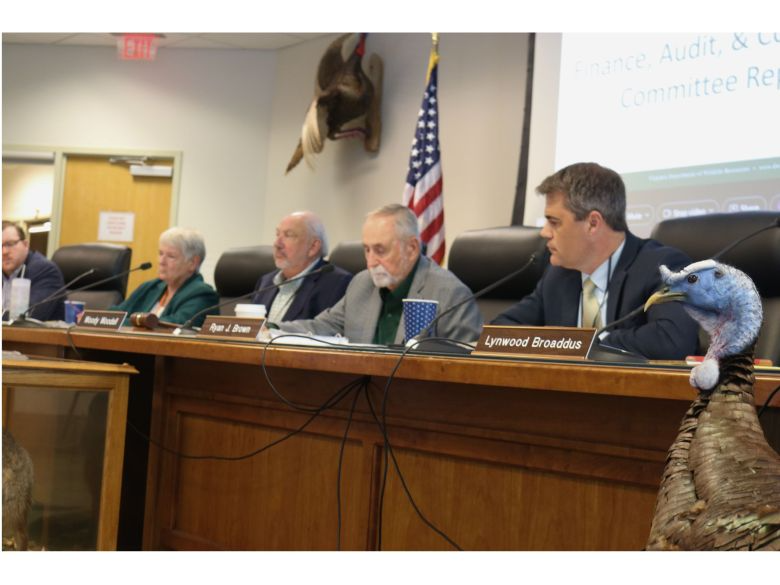
These estimated revenue projections come from the Virginia Municipal League, based on data from the Virginia Department of Taxation. The estimates were provided Tuesday to members of the state’s Commission on School Construction and Modernization during its first meeting in more than three years.
Revenue would vary widely by locality and would still not fully address the nearly $25 billion needed, as of a 2021 report, to modernize the state’s schoolhouses.
The city of Buena Vista, for example, would likely raise around half a million dollars annually through the dedicated sales and use tax, according to the data. Giles County is projected to raise about $2.3 million each year through the 2028 fiscal year, whereas Franklin County could likely raise at least $7.2 million, according to the estimates.
“For some localities, we’re talking about several hundreds of thousands of dollars annually, and for others we’re looking at several million dollars annually,” Josette Bulova, policy communications coordinator for the Virginia Municipal League, told commission members.
“Although this is a wide range, even $1 [million] or $2 million in recurring revenue can make a meaningful difference for local governments when determining the ability to pay for a project, finance it, manage future debts or begin major renovations.”
This is the first year that all Virginia counties and cities could consider implementing a 1% sales tax and use tax specifically for school construction projects. The issue will be on the ballot as a referendum in November in 47 localities.
Under a 2020 law, nine localities previously had the authority to levy the additional sales tax.
Since then, those cities and counties, which include Henry County, Danville and Pittsylvania County, have raised more than $119 million through the tax, according to reporting by the Virginia Mercury.
The Danville school division has completed or is in the process of several capital improvement projects, thanks in part to revenue collected through the sales tax. The work includes an $88 million renovation project at George Washington High School that was completed in August 2025.
“These projects would’ve been years out had we not had [the sales tax increase],” Danville schools superintendent Angela Hairston said last October.
Jeremy Bennett, director of intergovernmental affairs for the Virginia Association of Counties, who helped lobby for the law change, said the number of localities considering the tax “says something about the scale of the need” when it comes to school facilities across the commonwealth.
The condition of Virginia’s school buildings
In 2021, a report to the Commission on School Construction and Modernization found that more than half of the public school buildings surveyed were at least a half-century old. It estimated that nearly $25 billion was needed at that time to fully replace these aging facilities.
Christina Berta, chief operations officer for the Virginia Department of Education, said Tuesday that not much has changed since then.
Even though some communities have renovated, consolidated or built new schools, 1,070 of the state’s 1,924 K-12 school buildings — or 56% — are still more than 50 years old.
Each year since 2023, the department has gathered data on the age and condition of school facilities across the state and has calculated the estimated “useful life” left of the building.
In Southwest Virginia, or the Education Department’s Region 7, the average school facility is 33 years old. Berta said the department considers the lifespan of a building to be 50 years, which means that a 33-year-old building would need to be renovated or rebuilt in 17 years.
In some areas of the state, such as Tidewater and the Shenandoah Valley, the average age of a school building is closer to 40 years.
The department is conducting 60 school facility assessments across 30 high-need school divisions. The project will conclude with the development of a database and a virtual building condition assessment tool that should help divisions develop capital improvement plans and document how much funding they need for those projects, she said.
The communities undergoing such assessments include Alleghany, Buchanan, Carroll, Dickenson, Henry, Lee, Patrick, Pittsylvania, Rockbridge, Russell, Scott, Smyth, Tazewell and Wise counties and the cities of Bristol, Danville, Galax, Martinsville and Norton.
Those assessments should be completed by February 2027, according to Berta.
Other funding sources
Since 2022, the Education Department has awarded more than $750 million to communities through the School Construction Assistance Program, which has helped fund projects such as the new Arnett Hills Elementary in Danville and a classroom addition at Ridgeview Elementary in Dickenson County.

More programs like these, not increased local sales taxes, is what Del. Sam Rasoul, D-Roanoke and chair of the House of Delegates Education Committee, would like to see.
Rasoul championed the bill that eventually gave every city or county the authority to put a dedicated sales tax for school construction up for referendum.
But he said that was about ensuring fairness for local governments. Such a sales tax is harder on lower-income residents, he argues.
“I was happy to see it passed to give localities another tool with regard to school construction. However I don’t think it’s the primary tool that we should use or can use for capital needs in education for two reasons,” Rasoul said last week.
“A sales tax is inherently regressive. It disproportionately impacts those with lower incomes and with a lot of these rural localities, they simply won’t generate the sales tax revenues needed to fund school construction.”
Locally, real estate property and income taxes should be the main sources of tax revenue for such capital projects, he said. But even more, Rasoul said he’d like to see the state step up, such as by expanding the School Construction Assistance Program and offering localities zero-interest loans to pay for school facilities.