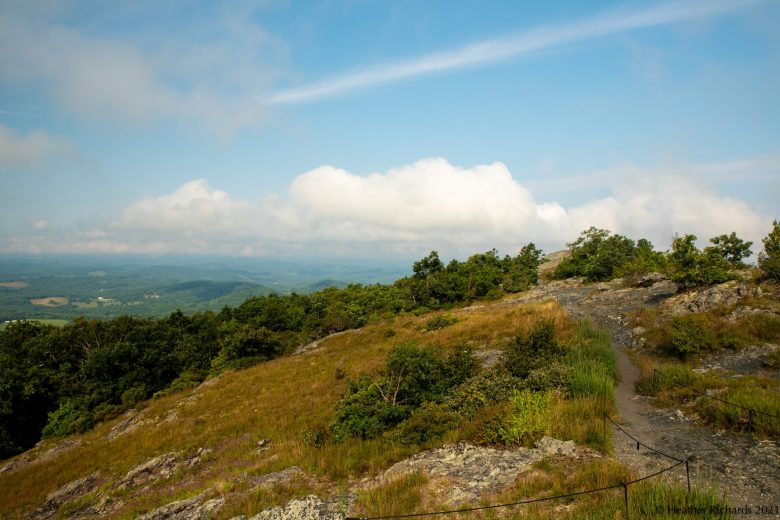
Donna Barkley has been hiking Southwest Virginia’s alpine meadows and lush river valleys for more than a decade.
She goes to connect with the land, Barkley said by phone, and she pictures the Virginians who walked the same trails hundreds of years ago as she hikes. It’s an escape from the usual bustle of town life in Abingdon.
On her most recent trip to Grayson Highlands, with friends in October, the main topic of discussion was not the colors of fall beginning to peak or the grazing ponies. It was a federal policy change that Barkley believes could threaten the peace of the Southwest Virginia wilderness, she said.
The U.S. Forest Service officially filed a proposal over the summer to rescind a protection that prevents logging, roadbuilding and other development on tracts of public land that are designated as inventoried roadless areas. The protection is often referred to as the “roadless rule,” preserving 59 million acres of national forest land across the country.
Local advocates for the rule say Southwest Virginia needs its designated roadless areas to protect the habitats of endangered species, ensure drinking water sources remain clean and maintain the tourism that comes from hiking, hunting and fishing.

Opponents of the roadless rule say rescinding it would bring more logging business to the area and better land management for wildfires.
Logging is what Barkley is afraid of.
“When you get to a viewpoint and you feel so lucky and happy to get a clear view of the mountains that surround you, the worst thing that you can see is where somebody clear-cut the land somewhere across the range,” she said. “It’s ugly. It really puts a scar on your experience.”
About a fifth of Jefferson National Forest’s lands are roadless areas. The forest’s largest roadless tract, known as the Bear Creek area, makes up over 18,000 acres across Walker Mountain, Brushy Mountain and Little Brushy Mountain. It spans Wythe and Smyth counties. The Appalachian Trail runs through it.
Other big tracts blanket Chestnut Mountain in Pulaski County and the Broad Run Mountain ridge system, north of Roanoke, alongside many smaller tracts across the region. Just south of where Barkley was hiking in a state park, a 750-acre tract called the Lewis Fork Addition is a roadless area where brook trout breed.
George Washington National Forest, managed jointly with Jefferson National Forest, is about a quarter roadless designated areas. Its largest tract, called Little River, is about 27,000 acres and spans multiple ridgelines in Augusta County.
Reasoning for rescission
The public comment period for the Forest Service’s proposal closed in early October. It drew more than 1 million submissions, with a Sierra Club analysis saying the vast majority were in support of keeping the roadless rule in place. The Forest Service will have to review those comments and produce a finalized environmental impact report as part of its decision.
Several national conservation nonprofits have released statements saying they expect the federal government to release its decision on whether the rule will stay in place by next spring.
Rescinding the roadless rule would allow the Forest Service better access to areas that need management, according to federal officials. Agriculture Secretary Brooke Rollins has said brush buildup in roadless areas leads to wildfires, and the Forest Service should be able to build roads to reach those places and bring in equipment to properly clear it.
“Our forests can’t afford another decade of inaction. Across the country, we’ve watched preventable conditions — overgrown stands, insect outbreaks and disease — turn healthy landscapes into tinderboxes,” Rollins said in an August news release. “For too long, outdated restrictions have kept tens of millions of forested acres off limits to the very treatments that improve forest health and reduce wildfire risk to our communities.”
Removing the protection would return the lands to local management, according to the release.
Republican governors in western states like Utah, Montana and Wyoming have come out in support of the rescission. On the other hand, Virginia Gov. Abigail Spanberger, a Democrat, came out against stripping the rule in early October. She wrote a letter to President Donald Trump’s administration saying it would harm Virginia’s wildlife corridors and drinking water supply.
U.S. Rep. Morgan Griffith, R-Salem, said in a statement, provided by a spokesperson, that he supports rescinding the rule. In his view, the Forest Service needs to do a better job of working with local governments to manage land and ensure public safety, he said.
In several counties across the Southwest Virginia district he represents, the federal government owns a significant portion of the land, he said.
“This overarching control generates considerable economic stress for local rural communities,” he said in the statement. “I believe that the Forest Service needs to be more open to beneficial economic use in its policies towards national forests, particularly for timbering and recreational activities.”
If the roadless rule is dissolved, there would be more economic activity on public forest land, he said, and localities in his district would gain from it.
‘Pristine and isolated’
Roadless areas allow hunting, fishing and horseback riding. They also allow bikes and, in some cases, ATVs. What they specifically prohibit is timber harvesting and road construction.
For Wally Smith, the rollback of protections seems like a thinly veiled attempt to promote logging on public lands, he said by phone.
Smith is a professor at the University of Virginia’s College at Wise and a conservation biologist. He frequently studies wildlife in the region’s roadless areas, he said, often traveling up to a 4,700-acre designated roadless area tucked against Pine Mountain on the Kentucky border.
When he’s studying various salamanders and frogs, the quality of nature in roadless areas is noticeable, he said. Depending on the species, wildlife populations can reach higher numbers without human disturbance, he said.
“You really get a much more pristine and isolated experience,” Smith said. “You get a lot of bang for your buck in terms of conservation. … The solitude, the natural character you get along places like the Appalachian Trail really owes itself to roadless areas.”
Going on his first hike in his youth through a roadless area in North Georgia is the reason why he works in the field now, Smith said.
The logic for getting rid of them doesn’t add up, he said. When it comes to local management, Smith has seen the Forest Service in action in roadless areas. He knows the service has done well managing the Pine Mountain tract he frequents, often performing prescribed burns to clear out brush, he said.
Most wildfires in public lands that aren’t caused by people camping start on roadsides through sparks from cars, Smith said, so building more roads for wildfire management just doesn’t make sense to him.
The Jefferson National Forest’s management plan hasn’t been updated since the early 2000s. Smith thinks it needs another look, he said — but there’s already an extensive public engagement process in place to do so. Deregulating by removing roadless rule protections isn’t necessary to ensure that, he said.
“I struggle, as someone who works in the field and has spent a lot of time in these areas, with understanding the justification for this,” Smith said. “It certainly feels to me like the subtext of repealing the rule is really just to try and open up more resource extraction.”
But opening up roadless areas to logging is not as simple as lifting one protection, said Ray Sullivan, a member of the Virginia Loggers Association board.
Sullivan lives in Washington County and has worked in the logging industry for several decades. He said in areas where logging is already allowed, regulations already make it so hard that opening up more land wouldn’t make much difference. In Sullivan’s experience, companies are typically deterred from logging because of strict rules that slow down the process and cost valuable time, he said. For example, a rule requiring that leftover debris be less than 2 feet long adds extra hours of chopping.
The Forest Service takes a costly deposit from companies who are approved to log on public land and won’t return it unless the rules are followed. Most mom-and-pop logging operations in Southwest Virginia can’t afford the time and money it takes to dip into public timber, Sullivan said.
The rule’s rescission likely would not have a significant impact in the region, he said.
“It’s just a piece of paper,” Sullivan said. “It’s not going to help us. There’s so many other restrictions and other loopholes you’ve got to go through. Everything you’ve got to do to get that tract of timber — it’s nonprofitable.”
With local sawmills shutting down over the years and demand low for Appalachian hardwood, there aren’t a lot of large-scale logging companies in the region, he said.
He said he could see the roadless rule rescission having an impact in western states, where the industry is bigger — but not in Southwest Virginia, where it’s contracting.
“We’ve lost our markets,” he said. “I’m guessing rescinding the roadless rule is maybe a step in trying to ease that. But no matter how easy you make it, how cheap you make that stuff, you’ve got nowhere to sell it. There’s no need in doing it.”
Environmental impact report
Nationally, rescinding the rule could bring a 4% to 10% increase in timber harvesting across public forest lands, according to an August draft of an environmental impact report by the Forest Service. Those timber activities would likely generate the highest need for permanent and temporary roads on the landscape if the roadless rule is dissolved, according to the report, and an increase in logging revenue could benefit local communities.
Timber harvesting on public land is especially important “to rural economies where there may not be other opportunities,” according to the report.
At the same time, the report says extra logging revenue from taxes and permitting likely wouldn’t cover the costs of building new roads. The Forest Service has a $7 billion maintenance backlog on its existing roads and bridges, according to a 2026 deferred maintenance report.
The report also produced a list of more than 300 threatened or endangered species that could be negatively affected by removing roadless rule protections — either by increased construction, logging or both. On the list were five bat species that call Southwest Virginia roadless areas home, as well as the hellbender salamander, the rusty patched bumblebee and a type of catfish called the yellowfin madtom.
The Carolina flying squirrel, found in the Mount Rogers area, was also on the report’s list.

National forests out west make up the largest roadless area footprints. That makes protecting the smaller ones on the East Coast all the more important, said Ellen Stuart-Haentjens, executive director of the Virginia Wilderness Committee.
The majority of brook trout in Virginia breed in roadless areas, she said, due to how clean and cold remote mountain stream water is. Road construction can disrupt sediment and reduce drainage, muddying stream habitats.
Like Smith, she finds it hard to believe the rule change would simply better manage wildfires, she said.
She thinks it would be used as an avenue to increase logging on public lands, she said. She pointed to Trump’s executive order in early 2025 directing federal agencies to increase logging on public lands by 25%.
After reading through the 333-page draft of the environmental impact report, she said the Forest Service came up with more reasons against rescinding the rule than for, she said.
“I often had to stop and remind myself as I was reading these documents that they were supposed to be advocating for rescinding the rule,” Stuart-Haentjens said. “Almost the entire thing actually shows you why we should not rescind the rule. They actually talk about how the risk of wildfire is likely to increase if they put in more roads.”
On top of the impact report, she was also referring to a cost-benefit analysis produced by the Forest Service in August, outlining the finances of getting rid of the roadless rule.
The analysis described increased wildfire risk as a “particular concern” of rescinding the rule, due to increased road construction and more human activity in previously remote areas — though it also said more roads would provide better access for wildfire mitigation on the whole.
It found that there would be a $6 million loss in recreation benefits across the country, which includes jobs and tourism. There would also be a $9 million shift out of spending on recreation into other markets, according to the analysis.
It also calculated that up to $11 million in “forgone passive use value” — an environmental law term that quantifies a loss of a natural resource by how much the surrounding community would pay to preserve it.
The analysis found there would be a $10 million to $22 million increase in the economic value of timber harvesting, including revenue to the Forest Service.
If the rule is dissolved, any changes made to the Jefferson National Forest’s management plan would be developed with public involvement, according to Julie Clark, a California-based Forest Service spokesperson.
There is overlap with roadless areas and designated wilderness areas — which are voted on by Congress — in the Jefferson National Forest, and those areas would remain protected, Clark wrote. For example, the majority of a roadless tract on Garden Mountain in Bland County was also designated national wilderness by Congress in 2009.
Most of that kind of overlap occurs in the Mount Rogers Recreation Area, according to Forest Service maps, though the exact acreage of overlap across the Jefferson National Forest’s roadless areas and national wilderness areas has not been disclosed.

About a third of the large Bear Creek tract is designated a national scenic area by Congress, preventing commercial logging and new road construction by law rather than national forest policy. The remaining 12,771 acres do not have legislative protections.
The roadless rule’s environmental impact report and the cost-benefit analysis operate on the assumption that other environmental protections will be in place for public lands, Stuart-Haentjens said. But the expansion of public lands resource extraction leases on a federal level and cuts to the Forest Service staff by about 15% are not encouraging to her.
“Taking these national safeguards away when we don’t have a strong Forest Service to handle it, to me, is very silly,” she said. “Silly is the nice word.”
She’s unsure if other stopgaps would still be in place to hold back deforestation and other forms of environmental disruption on public lands by the time the roadless rule is gone, she said.
She added that the Virginia Wilderness Committee and other organizations are prepared to take legal action against the rescission if it goes through.