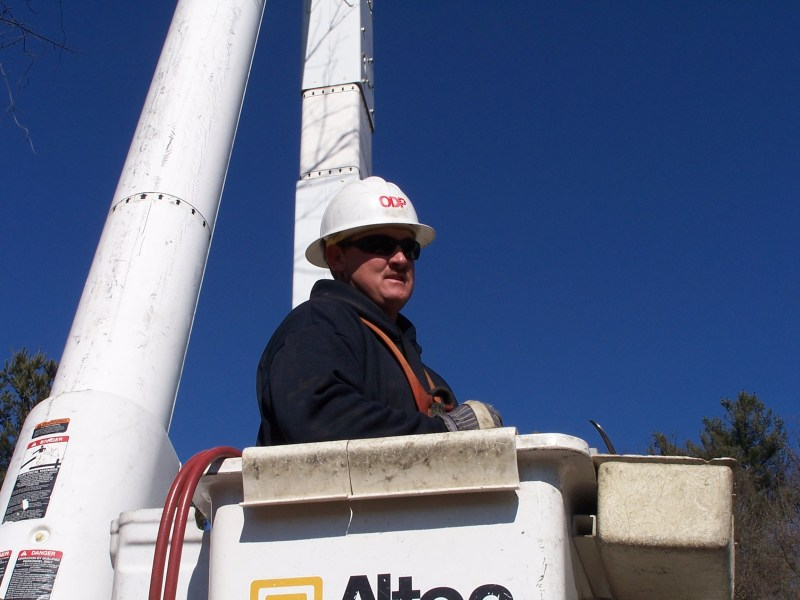
Appalachian Power Co.’s residential customers would see no increase in their electric rates for a year beginning March 1 and would see an increase of 92 cents on the average monthly bill the year after that under a proposed compromise pending before state regulators.
That contrasts with the power company’s request from May that would have increased the average 1,000-kilowatt-hour residential monthly bill by $9.10, or about $109 per year, beginning March 1.
Virginia’s State Corporation Commission will have the final say on whether to approve the proposal. It held public hearings this week with representatives from the electric utility, consumer advocates and other stakeholders.
Another takeaway from the proposal is that the residential customer charge, a fixed monthly fee, will remain $7.96 instead of increasing to $9.
“The settlement terms evidence the company’s commitment to providing affordable and reliable service for all of its customers and to meeting the needs of new large-load customers while protecting its existing customers,” Elisabeth Bruce, an attorney representing APCo, said Tuesday in Richmond during a hearing before the commission.
The compromise calls for no increase in APCo’s base rate revenue, whereas previously the company had sought regulatory permission to earn $61 million more in revenue, citing inflation and other factors.
Nonetheless, it still has “various offsetting increases and decreases among the different classes” of customers, Bruce said.
Those increases and decreases would have resulted in residential customers paying more, but APCo will absorb the increase just for residents in the first year, Bruce said.
“The company is very aware of the financial difficulties facing its customers and the economic conditions leading to increased cost of living,” she said.
A large part of why electric rates wouldn’t go up under the compromise is because certain costs would move out of APCo’s base rates and into separate future charges, called riders, for which APCo will seek regulatory permission.
Base rates cover operations and maintenance and are separate from fuel charges and from riders that pay for transmission infrastructure, environmental compliance and other expenses.
One example of a rider that regulators are currently evaluating in a separate regulatory case would, if approved, raise the average monthly residential bill by $3.99 beginning March 1 so the utility could recover expenses associated with renewable energy projects.
Under the compromise, which was filed with the commission Oct. 14, among the costs that APCo would move out of base rates is what it pays to trim trees and other vegetation away from power lines to improve service reliability.
Will Reisinger, an attorney representing the Virginia Poverty Law Center and Virginia Organizing, said Tuesday that moving costs from base rates to riders still would eventually put them on customers’ bills.
“They feel that bill increase the same way,” regardless of where it comes from, Reisinger said.
John Farmer, with Virginia Attorney General Jay Jones’ Office of Consumer Counsel, noted that the compromise does not guarantee that the new riders will be approved and that stakeholders will be able to “evaluate the reasonableness and prudence” of those charges during future regulatory proceedings.
Return on equity will increase slightly
Also under the compromise, APCo would be allowed to earn a return on equity of 9.8%, up from its currently authorized 9.75% but below the 10.5% it had requested.
For a regulated utility, return on equity is essentially its ability to earn money for investors up to the amount authorized by regulators.
The financial research firm S&P Global said in a September report that regulated electric utilities nationwide that had rate cases decided in the first half of 2026 were authorized to have a return on equity of 9.84% on average.
In its May application, APCo said that its actual return on equity in 2024 and 2025 was 4.655%, “well below” its authorized 9.75%.
Participants in the regulatory case had recommended various levels of return on equity.
A finance professor who submitted written testimony on behalf of the attorney general’s consumer counsel office said that a return of 9.325% would reflect the relatively low investment risk of the electric utility industry and of Appalachian Power in particular.
Walmart, which was one of several large businesses involved in the regulatory case, recommended not increasing the return on equity above its current 9.75%.
Del. Sam Rasoul, D-Roanoke, was the lone person to testify during Monday’s public comment hearing, which was briefly held ahead of Tuesday’s hearing in which representatives from APCo and other case participants spoke. Rasoul recommended a return on equity no higher than 9%.
Although Rasoul was the only person to testify Monday, more than 50 people submitted written comments in the regulatory proceeding, and they overwhelmingly opposed a rate increase.
APCo will create a new rate class for largest customers
Under the compromise, APCo intends to file for regulatory permission to create a new rate class for its largest customers, which would be those who require 100 megawatts or more of power capacity.
While some large manufacturers need that much power — such as a 450-megawatt steel plant coming online in APCo’s West Virginia territory — most new customers of that size are data centers.
APCo has said it’s seeing “explosive” demand in Virginia from potential large-load customers, “primarily” data centers, the buildings full of computer servers that power the online world.
“This is part of the company’s continued commitment to ensuring that our other customers are reasonably protected from the costs associated with serving new large-load customers,” Bruce said of the new rate class.
APCo, a subsidiary of American Electric Power, serves about 540,000 customers in western Virginia, of which about 466,000 are residential customers.
It’s the second-largest electric utility in Virginia, behind Dominion Energy, which has 2.5 million customers in Virginia, including in Central and Southside Virginia and the Alleghany Highlands.
[Disclosure: Dominion is one of our donors, but donors have no say in news decisions; see our policy.]
In November 2025, the State Corporation Commission approved the creation of a new separate rate class for Dominion’s largest customers requiring 25 megawatts of power or more, effective Jan. 1, 2027.
Some issues remain unresolved
The compromise also includes changes to the company’s design of its rate classes and approval of pilot programs for electric vehicle chargers and solar installations for qualifying low-income customers.
The agreement was endorsed by APCo, the staff of the State Corporation Commission, Google, Kroger, Walmart and other stakeholders in the regulatory case.
The attorney general’s office, Virginia Poverty Law Center, Virginia Organizing and the steel manufacturer Steel Dynamics Inc., who were all parties in the regulatory case, did not sign on to the agreement but did not oppose it.
Some issues that arose in the case were not covered by the compromise.
These include the company’s proposals for alternative and seasonal billing options and whether to reduce or eliminate reconnection fees for customers whose power has been shut off.
State Corporation Commission Judge Samuel Towell ordered interested parties in the case to submit written briefs to the commission by Nov. 24.
By state law, the commission must issue its final order in the case by Jan. 15, and any changes in rates couldn’t take effect before March 1.
APCo is required by Virginia law to submit its rates for review every two years.
Its last rate case was decided in November 2024, when the commission approved an increase that raised the average monthly residential bill by about $1.39. APCo had sought an increase of about $10.