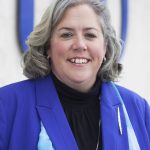

When we talk about the future of public safety in our community, we must remember who has the most to lose and include their voices in those conversations. There is a whole community being left out of the conversation. I’ve spent more than 30 years working with victims of violence. For 20 of them, I wore a badge myself, serving with the City of Salem Police Department, where I investigated crimes against women and children. Today, I lead the Roanoke domestic violence services team at Total Action for Progress (TAP), supporting survivors and their families as they rebuild their lives.
I’ve been paying close attention to the conversation in Roanoke about license plate reader camera technology, and I understand the questions and concerns posed around privacy. I believe we should ask hard questions like these whenever our city leaders consider new public safety practices. I know first-hand why accountability matters in policing and how it protects our most vulnerable community members.
I’ve also seen what it looks like when an abuser is stalking a victim. I know what it’s like to investigate a human trafficking case and discover only fragments of evidence. I’ve felt the panic families go through when a child is missing. Crimes like these often happen behind closed doors, with few witnesses and little physical evidence to find.
The most dangerous time for many victims isn’t when they’re living with an abuser, but when they make the difficult decision to leave. Public safety officials are also increasingly working against offenders who are using sophisticated technology themselves. If we take away the technology that helps public safety officials locate and prosecute dangerous offenders, we’re not making victims safer. We’re making offenders’ jobs easier.
For the past decade, I’ve worked alongside survivors while leading TAP’s Domestic Violence Services and TAP’s Sabrina’s Place Safe Exchange and Supervised Visitation Center. I’ve seen the courage it takes to escape abuse and how fragile that safety can be for victims who are just starting to rebuild their lives.
That’s why I urge my Roanoke neighbors to ask themselves a simple question: How does this affect the people whose lives are at risk?
It’s a perspective that is too often missing from debates like these: survivors of domestic violence, parents who know what it’s like to search for missing children or victims whose cases depend on finding one critical piece of evidence before it’s too late. I believe we can protect both privacy and public safety, with strict safeguards on the use of new technology, regular audits and clear accountability. I believe technology gives officers the tools they need to protect our communities from violence.
Roanoke Police Chief Scott Booth confirmed that city LPR camera data is not shared with federal agencies and that, in fact, Virginia law prohibits local police from doing so. He has shared that the city’s system is governed by strict access rules and regular audits and that officers who use the technology incorrectly will be prosecuted themselves. Promises like that matter to me and to the vulnerable community members I serve.
I firmly believe that with any technology platform, there should be safety in each and every piece. Guardrails placed to keep people from straying from the road on the straight and narrow. Tech-safety is a priority as we evolve in this ever-changing world. We expect cameras at our shopping locations, at stoplights, even body cameras worn by law enforcement, and so on. Why then can we not use these same technology advances to benefit survivors? Most would probably agree that if you were the victim of a crime, all available resources should be used to solve the crime. Our technological advances and opportunities need to keep people safe, not help those who hurt them. That discussion has many facets and will evolve as quickly as technology changes, but there should be one goal, and having clear, transparent, measurable and public discussion about how we will not tolerate domestic violence as a society is nothing less than our moral duty.
As we move forward, let’s remember the people whose voices speak quietly but yet highlight the devastating impact violence has on families and communities. These survivors deserve dignity and an opportunity for a new and better future. And they deserve a voice in the conversation, too.
Stacey Sheppard retired as a police sergeant after serving for 20 years. She currently oversees TAP’s Domestic Violence Services and Sabrina’s Place Safe Exchange/Supervised Visitation programs and helped form the Roanoke Valley Domestic Fatality Review Team.