In 1958, a 14-year-old English lad in a small city south of London heard a new song blasting out of a jukebox — and it changed his life.
Until then, he’d been playing some skiffle songs on guitar, a mix of folk, country and blues. After he heard the song coming out of the jukebox — “totally unique in its mystery, imagination and execution,” he later said — the teenager set out to imitate those exotic sounds.
The boy went by James Page then. The world knows him today as Jimmy Page, the founder of Led Zeppelin.
On the west side of London that year, a 13-year-old boy heard the same song and was likewise mesmerized by the strange sound.
His name was Peter Dennis Blandford Townshend and the world knows him today as Pete Townshend, the guitarist of The Who.
The song they were so entranced by, and which changed the trajectory of their lives but our musical culture, was one that first came to life, quite by accident, in Virginia.
This week the Virginia Department of Historic Resources approved a historical marker to the song. This is the story of “Rumble,” a song with no words that was deemed so dangerous it was banned from some airwaves — but made musical history anyway.
* * *
Fred Lincoln Wray Jr. — he went by the nickname “Link” — never really fit in. He grew up in North Carolina in the 1930s where his family identified as white on census forms even though they were of Native American heritage — Shawnee on one side of his family, Cherokee on the other. His mother refused to teach her sons the Shawnee language for fear they’d get caught speaking it; Wray later told stories of hiding from the Klan.
He also learned how to play the guitar from a Black neighbor he knew only as “Hambone.”
In the 1940s, the family moved to Portsmouth, Virginia, and Wray — by then a teenager — started playing in bands. He served in the Army during the Korean War but contracted tuberculosis. Doctors removed a lung and told him he’d never sing again. Wray tried anyway.
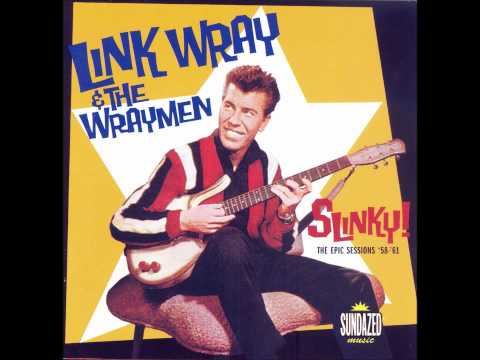
By 1957, he was pushing 30, still trying to eke out a living as a musician. One night in late 1957 (the details of the exact date are hazy), his band (Link Wray & His Ray Men, or possibly the Wraymen or possibly the Raymen, those details are hazy, too) had a gig at the Fredericksburg Armory. A sock hop, really. A dance for teenagers. The emcee was Milt Grant, a well-known Washington, D.C., disc jockey who had a television program. Think of him as the Dick Clark of D.C.
The hit song of the day was “The Stroll,” by The Diamonds, a Canadian vocal quartet. It inspired a dance craze. Grant asked Wray to play the song — or something close to it. Wray didn’t know the song, though. Here’s how the Library of Congress — yes, that Library of Congress — described what happened that night in Fredericksburg: “Not knowing the chords to the recent song of the same name by the Diamonds, Wray began to improvise on his guitar. Then, when someone grabbed one of the mikes and stuck it up to one of the amps, creating the tune’s signature distortion, a modern classic was born.”
“The kids went ape,” Wray later said. They kept shouting “play that weird song!” So he did. Four times.
Wray was encouraged to record the song. “When we went to record it, I didn’t get that live sound like I did in Fredericksburg,” he later said in the Library of Congress account. “I got a pen and started punchin’ holds in the tweeters. I didn’t mess with the big speaker. So I started playing and got that distorted sound, plus I had a tremolo. I used a combination of that at the end.”
He called the song “Oddball” because it was. It used a musical technique that wasn’t new but also wasn’t in vogue at the time: the power chord.
The DJ helped Wray send the song out to record companies. The big ones weren’t interested. A smaller one was, and in March 1958 the song was released — with a new title. The record company executive’s daughter thought the song reminded her of the street fights in the musical “West Side Story.” Some accounts say she renamed it “Rumble.” Others say Phil Everly of the Everly Brothers did; he was on the same label. What is certain is that Grant claimed half the songwriting royalties, as was common at the times.
Before long, the song was an improbable hit — No. 16 on the Billboard charts. Some stations thought the aggressive riff was incendiary and refused to play it. “The nation at that time, anxious over sudden spikes in juvenile delinquency, was eager to drum out anything that could be cited as an instigator,” the Library of Congress says. “Industry charts of the time show that ‘Rumble’ scored just as strongly, if not more so, with young black audiences, as it did with white teenagers, no doubt adding further to the furor.”
No matter. On the other side of the Atlantic, a rising generation of British teenagers heard it — and were moved. “I remember being made very uneasy the first time I heard ‘Rumble,’ and yet very excited by the guitar sound,” Townshend later said.
Page remembered it “roaring” from the jukebox. “It had a profound effect on me.”
They weren’t the only ones. So were others with names like Jeff Beck, Eric Clapton, Ray Davies, Jimi Hendrix, Paul McCartney and Neil Young. So did James Newell Osterberg Jr., who heard the song in a University of Michigan student union building. “I left school emotionally at the moment I heard ‘Rumble,’” Osterberg later said. We know him now as Iggy Pop.
Wray’s improvised two minutes and 25 seconds of sound changed the course of rock’n’roll. It used power chords. It used distortion — “two qualities roughly akin to being one of the first paintings to feature paint,” Slate magazine later wrote.
“He is the king,” Townshend once said. “If it hadn’t been for Link Wray and “’Rumble,’” I would have never picked up a guitar.” That’s a bit of hyperbole; Townshend was already playing guitar by the time he heard the song, but “Rumble” clearly made an impression.
There had been rock’n’roll before “Rumble” but by the late ’50s it was somewhat in decline. Then all those British teenagers who had heard the song formed bands and we know the rest of the story. Rock music exploded onto the scene with renewed force in the 1960s.
It also left Wray behind. He was never able to replicate his hit. Record labels dropped him when sales were poor, although there always seemed to be another one willing to offer him a contract. Wray spent the rest of his life as something of a cult figure for music aficionados (Townshend wrote the liner notes for one album), but he was never a star. Wray wound up moving to Denmark. That’s where he died in 2005.
Nearly two decades would pass before Wray’s song was inducted into the Rock and Roll Hall of Fame in a new category of singles. Page played at the induction ceremony. Today, “Rumble” is a staple for soundtracks. You can hear it in “Top Gun,” “Pulp Fiction,” “Independence Day,” “The Sopranos” and even “SpongeBob Squarepants.” Bob Dylan has called it “the best instrumental ever.” When Wray died, Dylan opened five straight shows with a cover of “Rumble.”
Now, at last, a historical marker is bound for Fredericksburg to mark the site of the song’s debut. The Armory whose walls first shook with it is long gone, but the echoes continue around the world to this day.
Other historical markers approved
Here’s the text of the 11 historical markers that the Department of Historic Resources approved:
Spanish Jesuit Mission, 1570-1571
Late in the summer of 1570, eight Spanish Jesuit missionaries and a Spanish boy traveled without a military escort from present-day South Carolina to the Chesapeake Bay to begin the evangelization of Virginia’s native people. With them was Don Luís, a Virginia Indian who had spent time in Spain and Mexico and had been baptized. After making landfall, likely near Newport News, the Jesuits celebrated Mass before traveling farther and erecting a house and chapel, possibly near the Town of Kiskiak at what is now the Yorktown Naval Weapons Station. In Feb. 1571, Don Luís led an attack on the missionaries. All were killed except for the boy, who was rescued by a Spanish relief expedition in 1572.
Sponsor: Douglas Domenech
Locality: York County
Proposed Location: Penniman Road near the Cheatham Annex gateway
The Rev. Robert Hunt (ca. 1569-1608)
The Rev. Robert Hunt was serving as vicar of Heathfield, Sussex Co., England, when he was appointed chaplain of the Virginia Company’s expedition to establish a colony in North America. Arriving with the first settlers in the spring of 1607, he played a crucial role in settling disputes among the colony’s leaders and provided spiritual support amid Jamestown’s early hardships. Under the shade of a sailcloth spread between trees, he conducted daily services from the Book of Common Prayer. On 21 June 1607, he assembled the company for the first documented Protestant Communion in what became the U.S. His contributions reflect the importance of the Anglican Church in England’s colonial enterprise.
Sponsor: James City County Historical Commission
Locality: James City County
Proposed Location: Jamestown Road service road, just east of intersection with Route 31
Mary Marshall Tabb Bolling (ca. 1737-1814)
Mary M. Tabb, born into a wealthy family, married the prosperous merchant Robert Bolling in 1758. Upon his death in 1775, she took over management of a vast estate, including lots and tobacco warehouses in Petersburg and plantations in Amelia Co. Since she never remarried, she was able to control her property. She bought and sold land, invested in banks, initiated lawsuits, engaged in philanthropy, and helped develop Petersburg. By 1790, she was paying taxes on more than 10 percent of the city’s total taxable wealth. Many of her enterprises relied on enslaved labor. A patriot during the Revolutionary War, she refused to leave her home, East Hill (Bollingbrook), when the British seized it in 1781.
Sponsor: The Bolling Family Association
Locality: City of Petersburg
Proposed Location: N. Madison Street near YMCA
Religious Liberty and the Constitution
Many Baptists in Orange Co., including the ministers John Leland, Aaron Bledsoe, and Nathaniel Saunders, opposed ratification of the U.S. Constitution in 1788 because it did not explicitly protect religious liberty. James Madison, principal architect of the Constitution and candidate to represent Orange at VA’s ratification convention, needed Baptists’ political support. Leland and Madison, likely at a meeting near here in March, reached an understanding that Madison would address the issue in the future. Madison was elected to the convention, played a pivotal role in securing VA’s ratification, and later introduced the Bill of Rights, including the First Amendment guaranteeing religious freedom.
Sponsor: Goshen Baptist Association
Locality: Orange County
Proposed Location: Constitution Highway and intersection with Clifton Road
History of Dawn
Native Americans resided in this area before European settlement. A major north-south route passed through here in the 18th century, and American and French troops used it to travel north after defeating the British at Yorktown. In 1800, several enslaved men from nearby plantations participated in Gabriel’s Conspiracy, a foiled plan to rise against slavery by attacking Richmond. During the Civil War, local men served in the Confederate military and in the U.S. Colored Troops. Area schools in the 20th century included Old Dawn School for Black students, just west of here. Grooms from Dawn worked at nearby Meadow Farm and played a vital role in the development of champion racehorse Secretariat.
Sponsor: Preservation Virginia
Locality: Caroline County
Proposed Location: Baylor Road
Hampstead
Just to the west is Hampstead, built ca. 1825-27 for planter Conrade Webb. One of VA’s foremost architectural works of its era, the mansion contains Federal and Greek Revival features and reflects the influence of Asher Benjamin’s American Builder’s Companion (1806). Its central hall features a rare free-standing spiral staircase. Webb was a grandson of George Webb, author of the influential law manual known as “Webb’s Justice” (1736), and was a grandson-in-law of Carter Braxton, a signer of the Declaration of Independence. Enslaved laborers, numbering 130 by the mid-1800s, sustained the plantation’s agricultural and industrial operations. Five were killed in a steam boiler explosion in 1859.
Sponsor: Tidewater and Big Bend Foundation
Locality: New Kent County
Proposed Location: 5101 Hampstead Lane
Hickory Hill School
A series of schools, including one the Freedmen’s Bureau opened in 1869, served African Americans in Hickory Hill. In 1915 Chesterfield Co. built an elementary school here on land donated by Black patrons. The county training school was moved here in 1925 after two new buildings were erected with support from the Julius Rosenwald Fund, the Black community, and the county. In 1938, after Black activism resulted in a new brick building, the training school became Hickory Hill High. Principal James P. Spencer was a local Civil Rights leader, and three teachers pursued legal action that led to federal court decisions in 1948 requiring the county to equalize salaries for Black and White teachers.
Sponsor: Renewal of Life Land Trust
Locality: City of Richmond
Proposed Location: 3000 East Belt Boulevard
Rumble
During a performance at the Fredericksburg Arena near here, guitarist Link Wray (1929-2005) improvised “Rumble,” a raw instrumental tune that shaped the development of Rock & Roll. A “stroll” had been requested, but Wray instead delivered an edgy improvisation featuring power chords and distortion. After he recorded and released “Rumble” early in 1958, some disc jockeys refused to play it for fear of promoting juvenile delinquency. “Rumble” popularized distortion and the power chord, influenced many guitarists, and was inducted as a single into the Rock & Roll Hall of Fame in 2018. Wray, a North Carolina native who highlighted his Shawnee Indian heritage, was inducted in 2023.
Sponsor: City of Fredericksburg
Locality: City of Fredericksburg
Proposed Location: Fall Hill Road east of the intersection with Route 1
Gay Alliance of Students
In Sept. 1974, a group of students at Virginia Commonwealth University founded the Gay Alliance of Students, the university’s first openly LGBTQ+ student organization. VCU rejected the Alliance’s application for official recognition, prompting a legal battle that attracted local and national support for the group. In Oct. 1976, the U.S. Court of Appeals for the Fourth Circuit ruled in Gay Alliance of Students v. Matthews that VCU’s refusal to recognize the organization violated the First and Fourteenth Amendments. The decision set a legal precedent, extending protections to similar student groups in Virginia, Maryland, North Carolina, South Carolina, and West Virginia.
Sponsor: Virginia Commonwealth University, Development & Alumni Relations
Locality: City of Richmond (VCU)
Proposed Location: Grassy area outside of VCU’s University Student Commons
Peter Bland Lynched
Peter Bland, an African American husband and father about 40 years old, was convicted of assaulting and injuring his White employer/landlord and was sentenced to 14 years in prison. On 4 Feb. 1884, he was being held here in the King William County jail along with his wife, who was awaiting trial on charges from the same incident. About 15 armed men threatened the assistant jailer, obtained the keys, and took Bland outside, where they shot and hanged him on the courthouse grounds. The case received widespread newspaper coverage. Although Gov. William E. Cameron issued a proclamation offering a $100 reward for the arrest of the perpetrators, no one was held accountable for Bland’s murder.
Locality: King William County
Proposed Location: 351 Courthouse Road
Pinkney Murphy Lynched
Pinkney Murphy, an African American husband and soon-to-be father, was lynched near here on 14 Sept. 1900. A young White woman had accused him of assaulting and choking her as she walked through the woods earlier that day. After searchers captured him in Arrington, his accuser identified him and he reportedly confessed. A magistrate ordered that he be taken to the county jail in Lovingston. On the way, a crowd detained the buggy in which he was riding, took him from his two guards, hanged him from a tree, and shot him dozens of times. A coroner’s jury was convened, but no arrests were made. From 1866 until well into the 20th century, more than 100 people, primarily Black men, were lynched in VA.
Locality: Nelson County
Proposed Location: Oak Ridge Road, Arrington