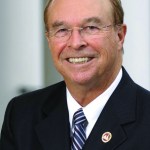
Editor’s note: This is one in a series of periodic commentaries by retired college presidents on the subject of civility. They are based on the book “Rules of Civility for a Modern Society,” by Jim Davis, the former president of Shenandoah University.
President Jim Davis 35th Rule of Civility: Getting outside one’s limited experience and delving into the wealth of knowledge that exists will more than often provide potential solutions or routes of compromise that, when given a chance in conflict, will broaden the avenues of discourse that will lead to meaningful compromise and solution.
Tuesday, Jan. 28, 1986, was expected to be pivotal day for the NASA space program. Among the seven astronauts on board the Challenger space shuttle was Christa McAuliffe, the first “teacher in space,” whose successful flight would be a major step in proving the safety of NASA space shuttle flights. This project was strongly supported by President Ronald Reagan, as would be further demonstrated on this day of the launch when he was scheduled to link in with Challenger during his scheduled State of the Union speech.
This morning of the launch was bright and sunny — but colder than usual. In fact, it was 15 degrees colder than next coldest shuttle launch. It was so cold that icicles had to be knocked off the external tank that carried the liquid oxygen and liquid hydrogen, which provided fuel for the main shuttle engines.
Liftoff occurred at 11:38 a.m. ET. At that time, 4 puffs/second of a mixture of hot propellent gasses, vaporized sealing grease, and eroded rubber were seen coming out of the right-hand solid rocket booster at the aft field joint. The tragedy had just begun.
Here are five of the approximately 50 final recorded astronauts’ comments over a period of 2 minutes, 43 seconds.
At T -1.33 (1 minute and 33 seconds prior to liftoff), Judith Resnik, Mission Specialist, asks of others, “Got your harnesses locked? “
At T -6 seconds as they rockets ignite, Dick Scobee, Commander, says “There they go guys.“
At T +60 seconds (1 minute after liftoff), Pilot Michael John Smith says, “Feel that mother go” and “WhoooHoooo.”
At T +1 minute and two seconds, Smith says, “35,000 going through 1.5.“
At 70 seconds, Scobee says, “Roger, go at throttle up.“
Final transmission was heard at an altitude of 43,000 feet and T +73 seconds as Pilot Smith says “Uhoh…” At this point, all communications and all data information from Challenger were lost.
Seven astronauts were about to die.
Five seconds after Smith’s final words, published NASA pictures show the orbiter’s left wing, the main engine of the shuttle, and the forward fuselage containing the seven astronauts, as three distinct objects, disconnected from each other and streaking along separate but almost parallel paths. NASA believes that the initial separation of these objects was survivable by the crew, and proof exists that at least several survived that separation; in any case, their time to live would be measured in minutes. Falling from a final altitude of 65,000 feet, the forward fuselage would impact the water at more than 200 miles per hour, resulting in an unsurvivable impact.
Was it possible for the space shuttle to fly down to Earth? No. Unlike the Apollo Launch Abort systems*, there was no Launch Abort System for the space shuttles, other than a system to abort just prior to liftoff.
What had happened? The O-ring seals in the left field joint in the right solid motor rocket had failed. Burning rocket fuel spurted out and fatally impacted the main rocket. Why had the O-rings failed? The O-rings were designed to work when the temperature was 53° or higher. How cold was it at this point? It was 36°F. Thanks especially to the efforts of astronaut Sally Ride, Air Force MG Donald Kutyna, and Nobel Physics Professor Richard Feynman, these facts were brought to the full attention of the Rogers Commission.
Who were some of the major decision makers for initiating this flight? Lawrence Mulloy was manager of the Solid Rocket Booster (SRB) Project at the NASA Marshall Space Flight Center. Robert Lund was Vice President for Engineering at Thiokol, the company that who had manufactured the two solid (fuel) booster rockets and performed tests to determine safe temperatures for their use.
Lund requested that the flight be delayed until the temperature was considerably warmer. Mulloy, however, was quite unhappy with this recommendation and insisted on proceeding with the mission. Mulloy had said to Lund, “My God, Thiokol, when do you want me to launch, next April? He later said to Lund, “Take off your engineer hat and put on your manager’s hat.” Lund certainly wished to protect his company’s position with NASA and eventually acquiesced. What was the pressure on Mulloy? For one thing, NASA was having difficulty keeping its promise to Congress about the planned frequency of space shuttle launches. Another was the President’s State of the Union message for later that day, part of which was for President Reagan to directly connect with the space shuttle and communicate with the “teacher in space.” Reagan strongly supported this particular program so as to help prove that space shuttle travel was safe.
Ultimately, the Rogers Commission concluded that “If the decision-makers had known all of the facts, it is highly unlikely that they would have decided to launch 51–L on January 28, 1986.”
A more accurate statement might be that if Mulloy, the ultimate NASA decision maker on site, had delved into the knowledge of Gordon Lund, the rocket manufacturer, and the other supporting Thiokol engineers on site, the result could have created a safer compromise in delaying the flight for a warmer and safer day, a successful Challenger flight, and allowed NASA to return seven brave astronauts to their spouses, to their parents, and to their children.
But none of this happened…
Kenneth Garren is the retired president of the University of Lynchburg. He is also the
second of three authors of NASA TN-3466, Manual Control of High-Altitude Apollo Abort Launch, June 1966, written during his employment in the Guidance & Control Branch, Space Mechanics Division, Langley Research Center, Hampton, VA.