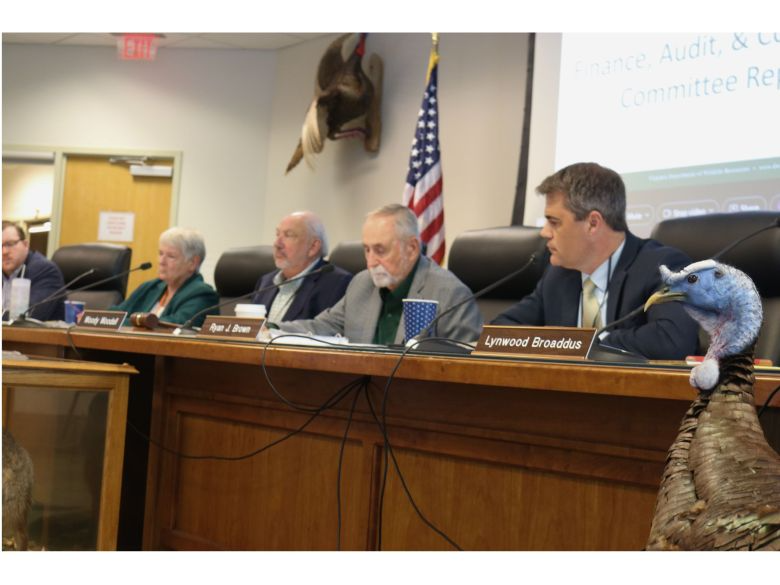
The state Senate presented a new budget proposal Tuesday that takes a significant step away from ending data center tax exemptions early — a major point of contention in biennial budget negotiations.
Instead the Senate introduced a new state impact fee for data centers which, if adopted, could generate $1.7 billion over the biennium.
The new proposal was presented to the Senate Finance Committee on Tuesday morning, just before the House of Delegates and state Senate conferees were scheduled to meet to negotiate each chamber’s budget update.
“The Senate conferees and I have been working towards a compromise with our House counterparts,” said Senate Finance chair Louise Lucas, D-Portsmouth, who has been the most vocal in advocating for abolition of the data center tax exemption. “We’ve also listened to the governor’s input.”

Later on Tuesday, House Speaker Don Scott told House Clerk Paul Nardo to rescind a prior call for the full chamber to return for the special session on Thursday. As of Tuesday afternoon it was unclear when the House will meet to take up the budget. The speaker will need to give at least 48 hours’ notice to House members ahead of the next full chamber meeting. The state Senate plans to meet on Monday.
“No budget agreement has been reached yet, so there is no reason for members to show up Thursday. The House is firmly committed to passing a full, balanced budget, and we will not return until we have one ready to vote on,” Scott said in a statement.
He added that, as soon as an agreement is reached, he will notify members to return to Richmond.
New budget proposals from both chambers
The House and Senate unveiled new spending proposals on Friday and Tuesday respectively, after months of stalled negotiations. An effort by the state Senate to end the tax exemptions for data centers in 2027, eight years earlier than their current expiration, has been a wrench in the machine that propels the legislature down its track toward a budget agreement since February.
The new House proposal, presented during a press conference on Friday, did not include ending the data center tax exemptions early. The new Senate proposal, presented during Tuesday’s Senate Finance Committee meeting, would establish a tiered state impact fee that would incentivize data centers to mitigate the environmental effects of the infrastructure, Finance Committee Chair Louise Lucas said.

She added that, in the Senate’s latest proposal, she met certain requirements of the House and the governor, specifically that efforts to change the tax exemptions for data centers be done outside of the current memorandums of understanding established between the commonwealth and technology companies.
A tiered state impact fee for data centers, proposed by the Senate, would generate about $1.7 billion in revenue over the biennium if adopted. The state would impose the fee on every data center generator that the Department of Environmental Quality has permitted, based on a generator’s maximum power output and its exhaust emissions.
The fee would begin in January 2027.
Nicole Riley, director of government affairs for the Data Center Coalition, called the impact fees in the Senate’s new proposal a “new name for the same bad approach” in a statement on Tuesday.
“Virginia’s data centers generated more than $5 billion in taxes in the last two years, but the Senate now insists on billions more that its own staff admits will be passed on to businesses and consumers,” she said. “It’s time to abandon these hastily and poorly conceived tax hikes and pass a budget that protects Virginia’s economy and avoids an unprecedented government shutdown.”
Don Slaiman, who heads the International Brotherhood of Electrical Workers 26, also expressed disappointment with the Senate plan. “It is perplexing and disappointing that there is a fixation on targeting an industry that has invested so much and created so many jobs in the Commonwealth,” he said in a statement. “There is a misconception that the data center industry is getting special favors when in fact the same sales tax exemption applies to other industries. Why should there be punitive taxes relating to generators that are rarely used by data centers, but not generators used by other industries? It is irresponsible to take actions aimed at driving away this industry . . .
“What is most striking is that in all the commentary from anti-data center proponents in both parties, there is zero importance or consideration given to the fact that data centers have created tens of thousands of high-paying union jobs for blue collar workers in construction, upgrading, retrofitting, and monitoring, as well as in the pre-fab factories that are opening around the state. This blatant indifference to Virginians’ careers and well being is a very sad testament to the political class’s indifference to the working class.”
A quick summary of the data center tax exemptions and background on the battle over them
In Virginia, data centers that meet certain requirements, including investing at least $150 million and creating at least 50 jobs — or, in economically distressed localities, $70 million and 10 jobs — are exempt from paying state retail sales and use tax on computers and other equipment.
The state Senate’s initial budget proposal, which was presented in February, included a clause to end those exemptions in 2027. The House’s initial budget proposal, which was also presented in February, included no such clause, creating a difference of more than $1 billion between the two proposals.

Lucas, D-Portsmouth, has been a strong proponent of ending the exemptions early. Del. Luke Torian, D-Prince William County, who chairs the House Finance Committee, has said that he believes Virginia must honor memorandums of understanding that it signed with the tech companies — a position shared by the governor.
Torian said Tuesday afternoon that he was unable to comment on the Senate’s latest proposal, which dropped the early expiration of the tax incentives and instead adopted an impact fee, based on data center generator power output and exhaust emissions.
Funding for the current biennium is scheduled to run out on June 30 at 11:59 p.m. Virginia could face a government shutdown if a spending bill for the biennium is not signed by then.