Greensville County, a rural county along the state line where Interstate 95 passes into North Carolina, has had more than its share of hard luck.
For a long time, it was known mostly as the place where criminals went to die: Until Virginia abolished the death penalty, those executions were carried out at the Greensville Correctional Center.
Greensville sits in Virginia’s timber industry belt. The Georgia-Pacific paper company once had a large presence here, which declined piece by piece until last year, when the plywood mill in Emporia shut down altogether. The empty building might have been a candidate for a successor company — except that it burned over the winter.
In the most recent unemployment reports, Greensville County has one of the highest jobless rates in Virginia: 6.6%, more than double the state average of 3.2%. Emporia, the independent city that sits within Greensville, has the state’s highest unemployment rate: 8.8%.
Now there’s more bad news — and bad luck — for Greensville County: State Secretary of Finance Mark Sickles says that a multinational company that would have brought jobs paying significantly more than the median household income in Greensville has scratched the county off its list.
Why? Because of uncertainty about Virginia’s future tax policy.
The catch: We’re talking here about data centers.

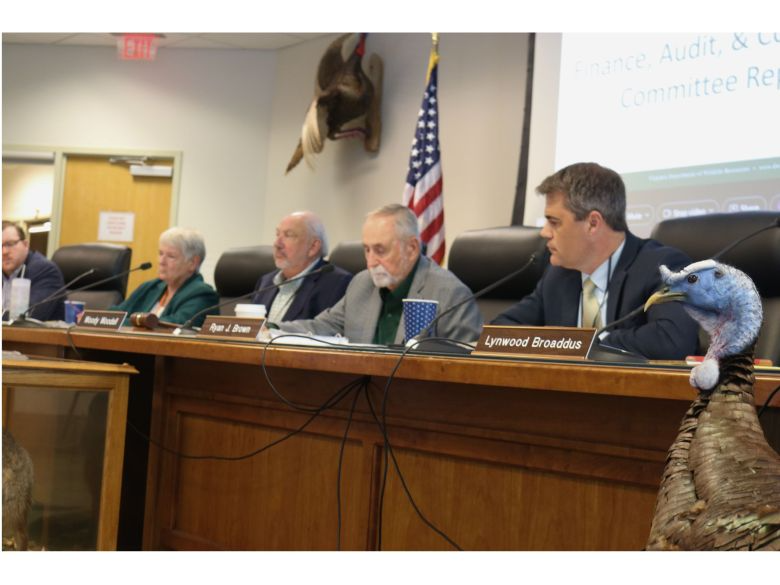
On Tuesday, Sickles appeared before the Senate Finance Committee to deliver a periodic update on state finances. He said that Virginia had lost 41,900 jobs this fiscal year, although state revenues remain $850 million ahead of what’s forecast. He warned that inflation is rising and consumer confidence is falling. He talked about how Gov. Abigail Spanberger has ordered a revised revenue forecast so the state could get a better handle on an uncertain economy.
All that made news, as it should have.
There was one other thing he said that did not get so much attention: Sickles said that due to questions over whether Virginia will continue its tax abatements for data centers, Compass Datacenters, a Texas-based company, had halted its search for two data center sites in Greensville County and/or Emporia.
This came in the context of a legislative stalemate over how data centers should be taxed. Virginia has a tax break for data centers that runs through 2035. Senate Finance Committee Chair Louise Lucas, D-Portsmouth, has insisted that this incentive be eliminated eight years early, meaning next year. House budget negotiators — led by House Appropriations chair Luke Torian, D-Prince William County — have likewise insisted that Virginia should keep its word and continue the incentive through the 2035 date Virginia has pledged, lest the state send an unwelcome signal to other business sectors that Virginia can’t be trusted.

The result is that the General Assembly did not produce a budget by the time it adjourned in early March. Here it is late May, and there have still been no real budget negotiations, raising the specter that Virginia won’t have a budget in time for the start of the new fiscal year on July 1. Lucas said Wednesday we would, but she also held fast to her position that this tax break needs to go.
These are easy positions for some legislators — and many activists — to take. After all, the demand for energy is one of the most pressing issues in the state, and the rapid growth of data centers is behind that — and that rapid growth is aided by the state’s tax incentives. If we did away with those, we’d slow down data center growth and maybe be in a better position to deal with the energy issues. Now come the harder complications.
The biggest of those has been known for some time, since the last time Sickles briefed the Senate Finance Committee. The Stack data center company is planning a major development at the Southern Virginia Megasite in Pittsylvania County — major as in 2,500 jobs over 30 years. Sickles warned before that the development depended on the tax abatement remaining in place. He repeated that warning this week. “They’ve said they’re not going to go forward without this tax abatement,” Sickles said. (This is also part of the performance agreement between the local industrial authority and the company.)
Lucas and state Sen. Creigh Deeds, D-Charlottesville, pushed back against Sickles’ contention that 2,500 jobs in Southside might be at risk. They didn’t dispute that those jobs may, indeed, not happen if the state changes the rules, but they pointed out that the 2,500 jobs have to be weighed against other considerations — such as how much energy would have to be produced to service the development. If that figure is known, it hasn’t been publicly disclosed, not by Stack and not by Appalachian Power, which would be the utility providing the power. In any case, the point Deeds and Lucas are making is that those jobs wouldn’t be free — as a policy matter, the state has to decide whether the costs of providing power and other infrastructure outweigh the benefits. That’s hard math for those in Pittsylvania County who just see 2,500 jobs with promised salaries of $80,500; this in a county where employment has fallen by 16.9% over the past quarter-century and where the median household income is $54,115. Pittsylvania is also at the epicenter of solar energy growth in Virginia. It’s got more megawatts of solar panels than all but two other counties, according to the Virginia Solar Database, The once-green farmland around the Climax neighborhood of the county now glistens black with solar panels; county leaders are right to think that they’ve done their part to supply the state with power with few jobs to show for it, so why can’t they now take advantage of some of that power and cash in with what would be the biggest jobs announcement in that part of the state for generations?
Then Sickles noted that a different data center company was “looking at sites in southern Virginia — in Greensville, the Emporia area — and they quit that.” He said this involved a search to locate two data centers for Compass Datacenters.
“That hurts Greensville County,” Gov. Abigail Spanberger said during an interview Thursday. “That hurts local revenues. That hurts local services.”
Compass did not respond to inquiries about the size of the intended projects; economic development officials say that discussions weren’t far enough along to determine a specific size. However, one thing is clear: Many officials in that part of Virginia aren’t very happy. While other — often more affluent — parts of Virginia now recoil from data centers, these rural counties in one of the most economically distressed parts of Virginia see an opportunity being taken away from them by legislators who want to shut down the tax incentives.
Keith Boswell is president of Virginia Gateway Region, the economic development group that covers a swath of eastern Southside, from Colonial Heights and Petersburg down to Emporia and Greensville County. “You’re talking down in my neck of the woods, a lot of communities are struggling to get by,” he said in an interview. These communities see a data center not as a problem to be regulated or refused but an opportunity to be secured. “That is something all nine communities in the Gateway Region have said: ‘If you can go out and bring us a data center, we want it.’”
For years, that seemed an impossible goal. No technology companies were interested in a rural part of the state. Now, as Northern Virginia essentially fills up with data centers, rural communities are starting to see more interest from data centers. “I’ve got five significant data center projects” that are interested in the Virginia Gateway Region, Boswell said. “Some are more significant than others but all of them are big, big data centers.” If changes to state tax law cause data center companies to go to other states, he said, “you’re talking about taking away an opportunity that other communities have had.” Many of the localities in the Virginia Gateway Region are also part of that solar growth zone; one of them, Brunswick County, has more solar megawatts than any other part of the state. Another, Surry County, is home to a nuclear plant, something that other communities might not want to have anything to do with. These counties are now starting to see themselves as a power-producing region and wonder why they can’t also tap into some of that power for job growth.

Del. Otto Wachsmann Jr., R-Sussex County and a legislator whose district includes much of the Virginia Gateway Region, sees a double standard: “It is apparent the rest of the state wants to push solar on our farm and forested lands to power Northern Virginia’s data centers while taking that same prospect off the table for our rural localities to consider.”
This illustrates the challenges that state legislators face in governing such a diverse state. Some localities feel they have more than enough data centers and might be happy to never see another; some don’t have any but want some. However, the energy needs that data centers have touch everyone, so the rural counties that are clamoring for data centers would be adding to the problem. It may not be a problem they created, but it’s one that they could exacerbate by insisting on their share of data center riches. When Boswell touts the prospect of landing “big, big data centers,” some hear “big, big energy demands.” Data center skeptics see an unsustainable demand for energy that needs to be restrained; some rural localities see the state’s “haves” telling the “have-nots” that they’re not allowed to pursue the same economic opportunities they have. How can these things be reconciled? Even some compromise solution — the tax incentives stay in place, but only for economically distressed localities (which was how the law was originally written) — would still add demands to the power grid.
This seems a classic case of two sides talking past each other. We will not resolve that today.
The energy issues associated with data centers seem well understood — they may be complex, but everyone has at least a baseline understanding that data centers require a lot of energy. We also all understand that those energy requirements are driving the construction of energy projects (often in rural areas where they aren’t always welcomed) and transmission lines (which nobody ever wants nearby).
What seems less understood — especially by those in metro areas — is the economic impact of data centers in a rural community. At the Senate Finance meeting, Deeds and Lucas asked how many data centers would be going into Berry Hill to hit that 2,500-job target — they estimated as many as 40, although no one has ever said. The legislators’ math was based on the widespread belief that data centers don’t produce many jobs, relative to their size. That was true at one time, Sickles said, although data centers that deal with artificial intelligence require more workers, perhaps up to 300 or so. (This is the flip side of the two-sided coin of how AI will impact the workplace: It will eliminate some jobs but will create others, just as other technological innovations that have come before it. We really shouldn’t talk about one without talking about the other.)
Whether 50 jobs for a single, traditional data center or 300 for a larger, more AI-focused complex, those numbers are still relatively small in Northern Virginia. They are not in a rural community. The Virginia Economic Development Partnership’s job announcement database says that since 1990, the largest jobs announcement in Greensville County was 250 jobs — and that was back in 1995. Some Virginia legislators weren’t even born when that happened.
Since the Compass projects never got to fruition, we don’t know what they would have paid, but a Joint Legislative Audit and Review Commission study in 2024 said that data center jobs in Virginia earn about $100,000 a year. The median household income in Greensville County is $56,759; in Emporia, it’s $49,375.

And then there is the tax revenue that a data center would generate. Where some see data centers as a problem industry that drives up energy consumption, localities often see them as solutions for revenue generation. Natalie Slate, economic development director for Greensville County, listed multiple needs her county faces: “new schools, courthouse renovations, upgraded equipment for first responders, and the replacement of aging water and sewer infrastructure. Without the tax revenue generated by data centers, the community would likely be forced to increase taxes on residents who are already facing substantial economic hardship to fund these essential projects.”
Probably every locality in the state could cite similar needs; what makes the difference in rural communities is their small size — and small base of taxable resources — so the scale is a lot different. “For a community such as Sussex County that has a budget of $30 to $35 million — one data center in Sussex would double their revenue,” Boswell said. “So it really is transformative. …You’re going to shut the gate and not let them compete for the things that all these rich counties have?”
Spanberger told Cardinal that she’s open to discussion about whether the tax abatements should continue past their expiration date in 2035, but that ending them early would have repercussions beyond the immediate tax question. “It’s not just data centers. It’s advanced manufacturing,” she said. “There are companies within the supply chain for data centers that are looking to invest in Virginia” — but now don’t know if they should.
Data center critics rightly focus on the energy demands.
However, these are some of the questions that some rural localities would like legislators to think about as they ponder the future of data center taxation.
Statements from Southside officials
Natalie Slate, director of economic development for Greensville County:
While I am not at liberty to discuss any unannounced projects in Greensville County, I can speak to the significant impact a data center development would have on a rural community. The loss of such a project would also mean the loss of a critical source of revenue for urgently needed investments, including new schools, courthouse renovations, upgraded equipment for first responders, and the replacement of aging water and sewer infrastructure. Without the tax revenue generated by data centers, the community would likely be forced to increase taxes on residents who are already facing substantial economic hardship to fund these essential projects.
In addition to the substantial financial benefits a data center project would provide, the community would also lose valuable opportunities for high-wage employment close to home. Many residents currently commute up to an hour each way to access skilled jobs. A single data center building can create approximately 50 permanent positions, while a full scale project consisting of multiple buildings could generate more than 300 high-paying jobs for the region.
The loss of data center projects in rural areas of Virginia could significantly limit opportunities for economic growth and long-term prosperity for communities that are working to strengthen their local economies. These projects represent meaningful investments in infrastructure, employment, and public services, and many communities, including Greensville County, welcome the opportunity to partner with and support such development efforts. It is important that future policy decisions carefully consider the potential impact on rural residents and local economic development initiatives.
Del. Otto Wachsmann Jr., R-Sussex County:
“It is quite discouraging that our state has not been able to come together on the budget. Having the data center sales tax incentive being the sticking point is especially concerning. Our Commonwealth made a commitment to this industry and we need to honor that commitment. Should we end this incentive early, I fear that will send the wrong message to other large businesses looking at coming to Virginia. We need to honor our commitments. This is especially troublesome as this industry was working with localities in the district. Localities which have plenty of open land to buffer noise levels, existing energy generation and in desperate need of a financial infusion. It is apparent the rest of the state wants to push solar on our farm and forested lands to power Northern Virginia’s data centers while taking that same prospect off the table for our rural localities to consider.”
We have more political news and analysis every Friday afternoon in West of the Capital, our weekly political newsletter: