Virginia is likely to have some vacancies to be filled, not in political offices, but in the form of statues on the grounds of Capitol Square.
Sen. Adam Ebbin, D-Alexandria (who has since left the legislature to join the Spanberger administration) sponsored a bill in the most recent session to take down the three Confederate statues outside the state Capitol: of Gen. Stonewall Jackson, Gen. (and later Gov.) William “Extra Billy” Smith and physician Hunter McGuire, who served as a Confederate doctor before going on to a post-war career in medicine. That bill appeared headed for passage when the House Appropriations Committee set it aside amid budget negotiations with the Senate. However, the provision is in the Senate version of the budget and it would be quite surprising if a Democratic legislature passed up the opportunity to remove those three statues.
That raises the question of which statues (if any) should replace them. The budget that then-Gov. Glenn Youngkin introduced included money for a statue to former Gov. Douglas Wilder, the first Black governor in the country who was elected (there were two Black lieutenant governors during Reconstruction who rose to office to fill a vacancy). The legislature also passed a measure to create a Booker T. Washington Commemorative Commission with a proviso that the commission recommend a place on Capitol Square to erect a statue to the early 20th-century civil rights leader, who was born in Franklin County.
That’s three statues potentially on the way out and two on the way in, which gives us room for at least one more replacement (although there are certainly other places on Capitol Square to put more). I wrote a column about this a few weeks ago (this was before the Booker T. Washington Commission measure passed), in which I asked readers who they would recommend for these slots.
Here’s what readers had to say.
Vicki Ward of Richmond didn’t think we should put up any: “I think we should stop erecting statues honoring people. People are fallible and we tend to judge the past by the standards of the present.”
Sharon Meagher of Berryville agreed. “No person because eventually we will find out they did something bad. Horses are always nice.”
That triggered a thought: When I offered some possible suggestions, I left out one prominent Virginia native who went on to international fame: Secretariat.
A few readers thought the whole exercise silly — or worse. “I don’t agree with moving the ones there or anywhere else. It’s our history,” wrote Cindy Walker of Danville. “I think it’s all childish. People need to grow up.”
The statue for former Gov. and Sen. Harry F. Byrd Sr. was removed in 2021 because Byrd had been the architect of the state’s Massive Resistance to integration. David Beiler of Stafford County thought Byrd should be returned to his pedestal. “He profoundly changed the commonwealth, including introducing fiscal responsibility to those who had not made the acquaintance,” Beiler wrote. “Time to quit the orgy of pandering, posturing and pre-fab piety.”
Henry Rodes of Spotsylvania County proposed Robert E. Lee on the grounds that he was a Virginian and an “honorable man” who “always worked [for] Virginians.” I’ll gently suggest that none of those fit the spirit in which the General Assembly is creating those statuary vacancies.
That leaves us with 15 proposals, which I’ll present in alphabetical order.
Maybelle Carter
Beth Harper, Fairfax County

Harper writes: “Mother Maybelle moved Appalachian music and Appalachian people into the consciousness of America and gave hope to so many folks during the Depression. She was truly a pioneer, both artistically and socially.”
To which I’ll add this for the uninitiated: Born in Nickelsville in Scott County, Carter (nee Addington) started playing banjo and autoharp as a child as part of family performances. At 13, she acquired her first guitar and wound up inventing a unique style of picking that today is known as the Carter Lick or Carter Scratch. Carter was present at what many consider the birth of country music: the Bristol Sessions of 1927. Her recordings number in the hundreds and, of course, she wound up having a famous son-in-law named Johnny Cash, but that’s almost a side note to her influential career. Music historians Holly George-Warren and Laura Levine write in “Honky-Tonk Heroes and Hillbilly Angels: The Pioneers of Country and Western Music” that Carter “helped to turn the guitar into a lead instrument,” which means her influence extends well beyond her traditional title of “the Mother of Country Music” to every axe-shredder in the rock world today.
Patsy Cline
Carolyn Caywood, Virginia Beach

This is the first of two music-related nominations from Caywood, who writes: “We should honor Virginia’s contributions to music.” Cline was one of the first country artists who had crossover appeal on the pop charts. She also fits into the category of influential singers who died way too young. Born in Winchester, Cline started singing professionally at age 15. By 22, she had her first recording contract and in time was charting No. 1 hits. One of her most popular songs was “Crazy,” written by a young songwriter named Willie Nelson. Other hits you may have heard of: “Walking After Midnight” and “I Fall to Pieces.”
In March 1963, Cline performed to a sold-out show in Kansas City. It was to be her last performance. On March 5, her flight back to Tennessee went down 90 miles from Nashville in Camden, Tennessee. Cline was a barrier-breaker who inspired a generation of singers to come. Artists as diverse as Loretta Lynn, Cyndi Lauper and Linda Ronstadt have cited Cline as an influence. Music historian Kurt Wolff has written that “she swaggered her way past stereotypes and other forces of resistance, showing the men in charge — and the public in general — that women were more than capable of singing about such hard subjects as divorce and drinking as well as love and understanding.” Two other music historians, Mary Bufwack and Robert K. Oermann, have written that Cline “transformed what it meant to be a female country star.”
Fred Cherry
Brian Campbell, Gloucester County

I had suggested Cherry in my original column although, in the spirit of full disclosure, I must point out that it was Campbell who alerted me to Cherry’s story. He was an Air Force pilot from Suffolk who was shot down over North Vietnam. Cherry was the highest-ranking Black officer captured during the war. When the North Vietnamese wanted to release him for propaganda purposes, Cherry famously refused. The North Vietnamese wanted Cherry to make propaganda videos to denounce racism in the United States; he refused. To punish him for his refusals, Cherry spent 702 days in solitary confinement and was tortured for 93 days in a row, often beaten three times a day. He wound up spending eight years in captivity. If you’re looking for an example of courage, here it is. Cherry Elementary School in Suffolk is named in his honor. There’s currently an effort underway to erect a historical marker to Cherry on the grounds of Virginia Union University, his alma mater. Why not an actual statue at the State Capitol?
Jonathan Daniels
Linda Larsen, Lexington

Larsen writes about Daniels: “He was a VMI graduate who was going to divinity school in the fall after graduation. He became a Freedom Rider and was attacked when walking past a country store with a group of people including a 12 year old girl. The attacker aimed a rifle at the girl who I believe is named Ruby Sales. [Editor’s note: She’s right.] Daniels moved between Ruby and the attacker and was hit by the shot which killed him. He is now a martyr in the Episcopal church for demonstrating Christian selflessness and love. There is a plaque and a wall honoring him at VMI but I feel he deserves far greater recognition.”
I can’t say it any better than that.

Ella Fitzgerald
Carolyn Caywood, Virginia Beach
Fitzgerald’s nicknames may make the case for her better than I ever can: “The First Lady of Song.” “Queen of Jazz.” She dominated for more than 60 years, winning 14 Grammys and performing with the likes of Louis Armstrong and Duke Ellington. Her Virginia connection: She was born in Newport News before moving to New York before she started school.
Mills Godwin
Wes Morgan, Richmond

Morgan writes to make this case for Godwin: “While having the distinction of being the only Virginia governor to serve two terms (with two different parties), Governor Godwin helped modernize and transform Virginia post-World War II. Governor Godwin reversed prior policy by issuing state bonds to improve and expand transportation infrastructure in a rapidly growing state, he cleaned up the James River and signed into law many of the conservation statutes (e.g. the Open Space Land Act) that makes Virginia admired by the conservation/preservation community, he established our community college system, among other achievements. Seeing the need to appeal and be inclusive of new black voters, Governor Godwin was the first Democratic governor to strongly appeal to Black voters in his 1965 campaign, something that was quite unusual for a Southern Democratic candidate. To my knowledge there are no statues to Governor Godwin and scant memorialization of him.”
Godwin was one of Virginia’s most influential governors, and an important transitional figure in Virginia politics. In the 1950s, as a key lieutenant in the Byrd Machine, he was one of those pushing Massive Resistance to integration, which probably disqualifies him in the eyes of many. Unlike others, though, Godwin did make the transition to a new era. The community college system may be his single biggest legacy and it was no easy feat. Some universities had started two-year branch campuses and were reluctant to part with those, particularly the University of Virginia. Godwin, a master negotiator, strong-armed them into doing so.
Linwood Holton
Beth Harper, Fairfax County
Norman Wayne Tripp, Roanoke County

I also floated Holton’s name in my original column but two readers proposed him as well. Holton, elected in 1969, was the first Republican governor since Reconstruction but more notably was a civil rights governor who declared “the era of defiance is over.” Harper writes: “I lived through Massive Resistance and I know what kind of courage it took to push back against the legacy of the Byrd Machine. He was a remarkable leader!”
Holton, who grew up in Big Stone Gap, practiced law in Roanoke at the time he was elected. Roanoke has a Holton Plaza downtown named in his honor but no statue — which I’ve always thought was a missing piece. Roanoke could commission a statue even if Holton doesn’t make the cut for Capitol Square.
Norvel Lee
Ken Conklin, Daleville

Lee grew up in Botetourt County and went on to win a gold medal in the 1952 Olympic Games in Helsinki — the first Black Virginian to win an Olympic gold. He also did it in dramatic fashion. When another boxer had to drop out, Lee took his place but needed to lose 15 pounds in two weeks to qualify for that weight class. He got by only on water for the last 24 hours before the weigh-in. He came in 2 pounds under the limit. Despite losing all that weight, Lee was in good enough shape that he promptly boxed his way to victory in four different fights.
Lee also scored a different type of victory in court. Seven years before Rosa Parks became famous for refusing to give up her bus seat in Alabama to a white passenger, Lee did the same on a train in Covington. He was arrested, convicted and fined. He also appealed that fine all the way to the Virginia Supreme Court, which, to the surprise of many, overturned his conviction. The ruling may have come on what may seem technical grounds — the court ruled that the state could not enforce local segregation ordinances on an interstate train — but it turned out to be one of many blows that undermined the legal foundations of segregation in the years leading up to Brown v. Board of Education. Lee didn’t just knock out opponents in the ring, he helped knock down American apartheid.
Conklin has written a novel about Lee, called “Norvel.”
William Mahone
Wes Morgan, Richmond

Here’s an unusual nomination — well, at least unusual for those of us who grew up with Virginia textbooks that depicted Mahone as a vain, power-hungry instigator of race riots. The vanity and power-hungry parts of that are certainly true, but also don’t distinguish him from many other politicians. Mahone was important enough in his day that he merits an entire chapter in Virginius Dabney’s landmark history “Virginia: The New Dominion,” and long after his death his opponents campaigned against “Mahoneism.” So just who was Mahone?
Mahone, born in Southampton County, came to fame during the Civil War as a Confederate general — one who broke with other Confederates after the war. He founded a post-war railroad, the Atlantic, Mississippi and Ohio Railroad, which connected Norfolk with Bristol by way of Petersburg, Lynchburg and Salem. Mahone and his wife, Otelia, named some of the towns that sprang up along the route; it’s said that Disputanta in Prince George County has its name because the couple couldn’t agree on what to call it. Wags at the time joked that “AM&O” stood for “All Mine and Otelia’s.” Then came the Panic of 1873, and Mahone lost the railroad, which became the basis for the Norfolk & Western, which today is part of Norfolk Southern.
That’s not why we remember Mahone today, though. Politically, he was the leader of the Readjuster Party, a short-lived party unique to Virginia that wanted to “readjust” the state’s debt so the state could afford other things. That Readjuster Party (which later evolved into the Republican Party in Virginia) was the reformist party in the 1880s, pitted against the former Confederate establishment in the Democratic Party. For a time, the Readjusters came to power and ran the state. It was a biracial party that appointed Black men to public office, founded Black schools, eliminated the poll tax and the whipping post. According to Encyclopedia Virginia, the Readjusters “reduced the state debt by a third and the interest rate from 6 to 3 percent; restored public schools; spent more on hospitals, penitentiaries, and higher education; and reformed the tax code in favor of farmers and small-businessmen and against the railroads.”
That also provoked a conservative backlash that drove the Readjusters from power. Unfortunately, Mahone was also widely accused of corruption. How much of that is true is difficult to say, but Dabney wrote that Mahone’s political motives “were by no means immaculate. He was anxious to build a machine that would maintain a steely grip on the state for an indefinite period. His political methods, furthermore, were slippery.” Nonetheless, he was the leading reformist of his day until he was outmaneuvered by those who wanted to restore as much of the Confederate legacy as they could.
Morgan makes this case for Mahone: “He was a Confederate general but later Readjuster U.S. Senator, this can appeal to all Virginians by honoring Virginia’s Civil War legacy while also honoring someone who sought reconciliation among the races and unification of the country after the Civil War. To my knowledge, we currently have zero statues to Senator Mahone. While some may decry the fact he fought for the Confederacy, if you read a small portion of history, you’ll know he was definitely not admired by white supremacists. As mentioned above, this would appeal to those supportive of honoring Virginia’s Southern heritage, while honoring someone who was radical in his time for supporting equality for blacks and whites and supporting black education and commerce post-Civil War.”
A statue of Mahone could come with an explanatory display that would educate a lot of Virginians about a complex period of their history they know little about.
George Mason
Jason Crutchfield, Richmond

Crutchfield writes: “George Mason would fit the capitol grounds nicely.” Mason is one of our “forgotten” founding fathers, although a university in Northern Virginia that bears his name does help make up for that. He was involved in drafting many of the documents that were key to the revolution, such as the Virginia Declaration of Rights and Virginia’s first constitution. James Madison gets the credit for being “Father of the Constitution” but Mason was also influential in the drafting of our founding law — but was so unhappy about the lack of a Bill of Rights that he ultimately opposed ratification. That opposition ended his long friendship with his neighbor George Washington and dimmed Mason’s political star. When he died in 1792, his passing was little noticed at the time.
Over the years, Mason’s legacy has been rescued from obscurity. Mason was a complicated man. He owned slaves, yet denounced the practice, calling it “that slow Poison, which is daily contaminating the Minds & Morals of our People. Every Gentlemen here is born a petty Tyrant.” He called for an end to the international slave trade. Washington’s will called for freeing his slaves once his wife passed; Mason could have done the same but did not. It’s impossible to fully understand the politics of our founding without understanding Mason and others like him.
Robert Pleasants
James Jones, Springfield
Pleasants might be the most obscure name on this list, although obscurity doesn’t diminish importance — it only indicts history for making poor choices in who it chooses to elevate in our memory.
Pleasants was a plantation owner in Henrico County who ran a tobacco exporting business in the 1700s. He was no different from many well-to-do men of his era except for one thing: He was a Quaker and that led him to oppose slavery. In time, he founded Virginia’s first abolitionist society and once hired future Chief Justice John Marshall to argue a legal case to force his relatives to free their slaves.
If that intrigues you, read on: In 1771, Pleasants persuaded his father and several relatives to write provisions into their wills to free their slaves. Manumission was illegal in Virginia at the time (only the legislature could free slaves, which it rarely did), but the political tides were turning against slavery (slightly) and Pleasants expected the legislature to change the law. The American Revolution delayed that legislation but not his father’s death. With John Pleasants’ passing, some of his slaves went to Robert Pleasants, who freed them, settling them on the Gravelly Hills plantation he owned in Henrico. Encyclopedia Virginia writes: “He shielded them from hostile neighbors but was eventually fined by local authorities for allowing putatively enslaved people to live unsupervised.”
In 1782, the General Assembly finally allowed slave owners to free their slaves and as a result “there was a short-term surge of manumissions in the 1780s,” Encyclopedia Virginia says. Then interest faded. It especially faded among some of Pleasants’ relatives, who held some of his father’s former slaves — and refused to free them. Pleasants sued them. He won at the trial level, but his relatives appealed. For the appeal, Pleasants hired Marshall — and won. In all, more than 400 people won their freedom. “Pleasants v. Pleasants is the largest legal case in U.S. history involving the manumission of enslaved people,” Encyclopedia Virginia says.
Jones makes this for Pleasants: “A simple man trying to help his fellow Virginians in the face of their continued systemic oppression.”
Wendell Scott
Harlan Lustgarten, Christiansburg

An auto racer from Danville, Scott made history as the first Black driver and team owner in NASCAR.
Scott started racing in 1951 when the Dixie Circuit was looking for a Black driver as a gimmick. When he won his first race — in Lynchburg — he went searching for other tracks to run. NASCAR initially refused to allow him to race (you can imagine why), but he found non-NASCAR races to run in. In 1954 a local NASCAR official in Richmond let him run, breaking the color barrier in the top circuit. Scott was the Jackie Robinson of auto racing, except he never had a powerful white figure backing him the way Robinson did with Branch Rickey.
Throughout his career, Scott endured racism. Some drivers intentionally tried to wreck him; others became his bodyguards on the track. He only finished first once — in Jacksonville, Florida, in 1963 — and even then the track didn’t acknowledge him as the winner. Accounts of that dispute differ. The Florida Times-Union wrote in 2010 that there was a “two-hour scoring dispute” in which it was discovered that Scott, who appeared to be behind, had actually passed the leader and ran extra laps. USA Today in 2014 gave a different account: “Track promoters didn’t want a black driver with a white trophy girl,” USA Today wrote in 2014. Either way, the trophy didn’t arrive until after Scott died, decades later.
Scott never attracted much sponsorship, so always had to run on a low budget. Nonetheless, “Scott finished in the top 20 in nearly 80% of races, and that brought in enough money to feed his family and put all of his kids through college,” USA Today reported.
George Henry Thomas
J.R. Cover, Williamsburg

For a state that has long venerated Civil War generals, there’s one who has never gotten his due: Thomas, who grew up in Southampton County. There’s a simple reason for this: He was a Union general.
Thomas’ early career mirrors that of many Confederate officers: West Point grad, veteran of the Mexican War. When war broke out, many Southern officers resigned from the U.S. Army and sided with the Confederacy. Thomas simply reported for duty. Encyclopedia Virginia says of him: “After the war, he explained that he felt his oath as an army officer to uphold the United States Constitution and to protect the national government left him no other choice. Thomas’s Virginia relatives refused to speak to him after he sided with the Union, and while he later reconciled with his brothers, his sisters remained estranged from him until his death.”
Most of Thomas’ Civil War service came in the western theater, mostly Kentucky and Tennessee. He is particularly known for his service at Chickamauga, where Encyclopedia Virginia says, “Thomas improvised a defensive line and held off repeated attacks from a numerically superior opponent. He led several counterattacks in person, at great risk, and his stand held the Confederate army at bay until nightfall, preventing them from pursuing and destroying the rest of the Union army.” President Abraham Lincoln praised Thomas, saying “it is doubtful whether his heroism and skill … has ever been surpassed in this world” and Thomas earned the nickname “the Rock of Chickamauga.” (He also earned some less flattering nicknames for his deliberative way of doing things: “Slow Trot Thomas” and “Old Slow Trot.”)
The war changed Thomas’ views on race. Before the war, he’d been a slave owner. After commanding Black troops in Tennessee, Thomas spent much of his post-war military career trying to stamp out the rising power of the Ku Klux Klan. “When local courts refused to prosecute whites for attacking blacks, Thomas tried them in military tribunals,” Encyclopedia Virginia says. “When local city officials adopted discriminatory racial policies, he threatened them with military detention.” In 1869, Thomas was sent to California for military service; that’s where he died. “He was the first major Union general to die after the Civil War, and his coffin was greeted by crowds throughout its transfer back to the East,” Encyclopedia Virginia says.

Curtis Turner
Harlan Lustgarten, Christiansburg
Here’s another auto racing pioneer from Virginia. Born in Floyd County, Turner had the classic upbringing for a stock car driver in the 1950s: He originally ran moonshine. Turner dominated the sport in the 1950s and ’60s and was the first NASCAR driver to make the cover of Time magazine. He also tried to unionize the sport, which temporarily got him banned for life.
For more on Turner, see this story we published in 2024, on the 100th anniversary of his birth.

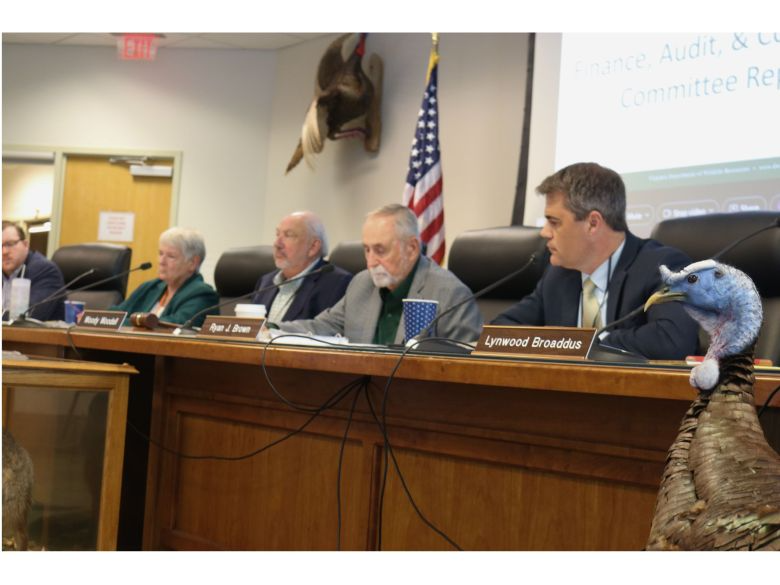
A wild turkey
Mike Grove, Salem
Finally, we have this suggestion. Grove writes: “As a proud VT alum, it would be nice to see a bird enshrined in Richmond. It pays homage to the poultry farmers in the Commonwealth and the popular story of Benjamin Franklin suggesting it as the national bird. A cardinal wouldn’t be a bad idea either. Also, neither of the birds are ever going to say or do something regrettable.”
Do you have suggestions? You can let us know here. I have no idea if any of these will be taken seriously, but at the very least it’s an interesting walk through Virginia’s history, which is often more complex than we were taught in school.
The latest on redistricting

If you read all this way looking for something on redistricting, don’t worry, we’ve got you covered. Our latest Cardinal podcast deals with redistricting. Find it here or wherever you get your podcasts.
For basic information, see our Voter Guide. Got questions about redistricting? Let us know here.
I’ll discuss the latest early voting trends in this week’s edition of West of the Capital, our weekly political newsletter that goes out on Friday afternoons. Sign up here: