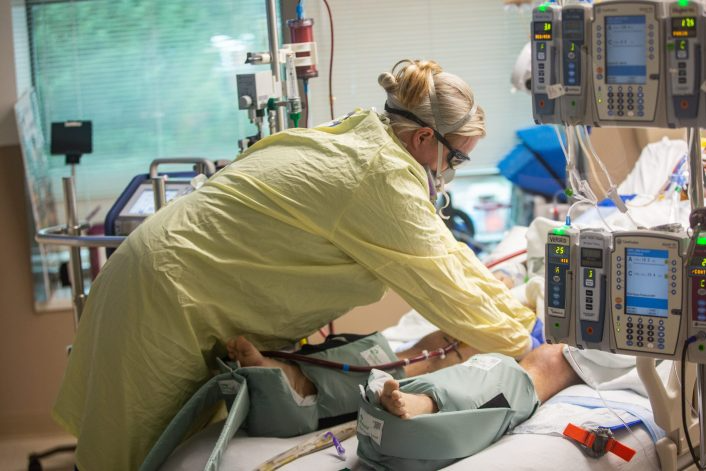
Welcome to The Pulse, a weekly roundup of health-focused news. Each Thursday, we bring you updates on health policy, community surveys, new clinical studies, programs and services in Southwest and Southside Virginia.
Got a tip or story idea? Email me at emily@cardinalnews.org.
Community Resource Center opens in Roanoke
Navigating the health care system remains a major barrier for many patients. The new Community Resource Center opening in Roanoke on Saturday aims to help the public find and access the care they need.
Aetna Better Health of Virginia, a suite of Medicaid managed-care plans and a CVS Health company, launched the center to help individuals and families navigate health care benefits, connect to local resources and manage their health. Staffed by Aetna community engagement professionals, the center will offer support for maternal health, chronic conditions and social care needs, according to a press release.
The center is open to the public, and all services are free.
The new space includes computers with teleconferencing capabilities and private areas for medical conversations. It operates out of the EnVision Center, a community resource hub managed by the Roanoke Redevelopment and Housing Authority in collaboration with the U.S. Department of Housing and Urban Development.
The center will open Saturday alongside the EnVision Center’s annual spring cookout, where the Aetna Wellness on Wheels mobile unit will offer free health screenings for attendees.
The EnVision center, at 2607 Salem Turnpike N.W., is open to the public and offers services to support people seeking educational advancement, economic development, leadership and health, according to its website.
New dental hygienist expands care in Patrick County, Martinsville
Connect Health and Wellness, a health center with locations in Martinsville and Patrick County, has expanded its dental services by hiring a hygienist who will work at both locations.
The Virginia Health Care Foundation provided a $63,000 grant to the clinic for one year to support the salary of the dental hygienist. The foundation is a public-private partnership focused on expanding health care access to Virginians.
This marks the first hygienist hire in the history of the clinic, Brittany Anthony, marketing director for Connect Health and Wellness, said by email Wednesday. Previously, dental services were provided through a team of dentists and dental assistants with additional support from dental training programs and student dentists.
“The addition of our first Dental Hygienist marks an important step in expanding preventive services and enhancing the overall scope of care we’re able to offer our patients,” Anthony said.
The clinic is a federally qualified health center, meaning it receives federal support to provide services to patients who are uninsured or underinsured or are covered by Medicaid. These centers offer care on a sliding-fee scale based on household income.
The newly funded dental hygienist will provide services including cleanings, screenings and preventive education.
Access to dental care remains a significant challenge in Southwest Virginia, especially for Medicaid recipients and people who don’t have insurance. Many dentists in Virginia have historically declined to accept Medicaid because reimbursement rates are lower than the cost of delivering services, meaning dentists often lose money when treating Medicaid patients.
“With support from the Virginia Health Care Foundation, this expansion strengthens our mission by increasing access to essential preventive services and improving health outcomes across the Patrick County community,” Marcus Stone, CEO of Connect Health and Wellness, said in a press release. “Strategic partnerships like this are critical to extending our reach and ensuring more individuals and families receive the care they need.”
Patients can call 276-638-0787 or visit ConnectHealthVa.org to schedule an appointment or learn more about the services available.
UVa researchers raise safety concerns related to kratom use
A new analysis by the University of Virginia found a significant rise in kratom-related calls to poison centers across the United States over the past decade. The report highlights the rapidly evolving kratom market and underscores the role of poison centers as an early warning system to identify emerging trends.
Kratom, an unregulated herbal supplement derived from a tropical evergreen tree in Southeast Asia, is widely solid in vape shops and gas stations across the United States. Researchers warn that modern products often contain high-potency formulations and may include undisclosed ingredients, raising concerns about toxicity, according to a press release from UVa.
Kratom can act as both a stimulant and a sedative, producing increased energy and making users feel less anxious and more relaxed. Some people use it to ease opioid withdrawal symptoms, though the effectiveness of this application has not been thoroughly studied, according to the press release.
From 2015 to 2025, poison center calls related to kratom increased from 258 to 3,434 nationwide. Calls increased steadily from 2015 to 2019, plateaued between 2020 and 2024, and surged in 2025.
Hospitalizations linked solely to kratom also increased, rising from 43 in 2015 to 538 in 2025. Cases involving multiple substances climbed as well, from about 40 to 549 over the 10-year period, according to the press release.
Combining kratom with alcohol, opioids, stimulants and antidepressants significantly increases the risk of harmful effects on the central nervous system. Of the 233 kratom-associated deaths during the study period, 184 involved other substances. Opioids were reported in 62% of fatalities, followed by benzodiazepines at 20% and stimulants at 20%.
“The data reflects a concerning trend,” said Dr. Chris Holstege, director of UVa Health’s Blue Ridge Poison Center, in the press release. “This trend found in the national data is also occurring in our local clinical practice, with more patients presenting to UVA Health following serious complications associated with kratom products.”
The findings were published in the Centers for Disease Control and Prevention’s Morbidity and Mortality Weekly Report.