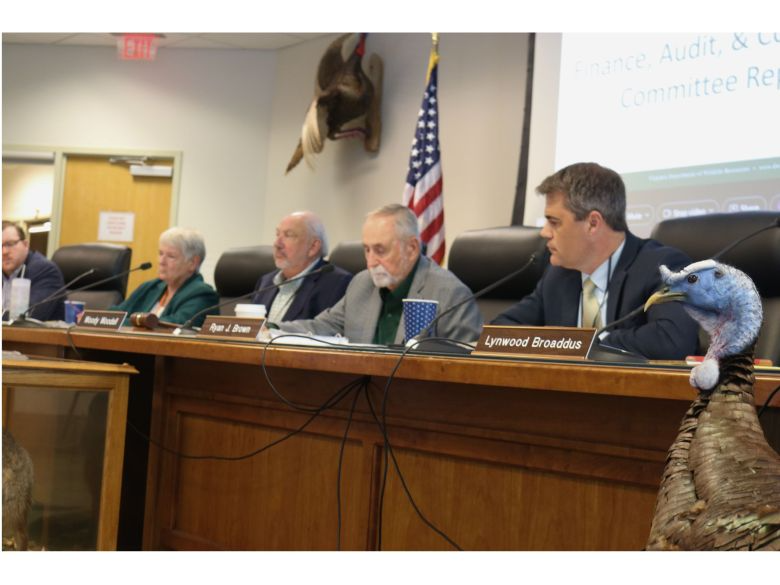

Tuesday night, another motion was on the floor that would accelerate efforts to end Pound’s status as an incorporated town.
Mayor John Cauthorne called for the vote.
Council members Clifton Cauthorne and Garry Hall voted yes, to no one’s surprise in the audience of about 40 people. Members Leabern Kennedy and Doris Mullins voted no, again to no one’s surprise.

It came down to Lyndon Powers’ swing vote.
He said no. The audience gasped.
That 3-2 vote defeated a proposed resolution spelling out the steps toward eliminating Pound’s town charter. Its defeat means disincorporation efforts might be frozen until January 2027 — emphasis on “might.”
Powers — who joined a 3-2 vote in January to begin disincorporation talks with Wise County — said he counted seven audience members who’d spoken earlier Tuesday night in favor of preserving the town. Between the January vote and Tuesday’s meeting, six other people had urged him to vote against disincorporating the town, he said.
Powers said residents are not being fully informed of what they would lose if Pound ceases to be a town. Those who spoke to him were told only that they would no longer have to pay town taxes, he said.
Clifton Cauthorne, who leads the push to disincorporate, said it’s valid for him to tell residents that their town property tax bills would go away.
Powers replied that those residents would no longer have a voice if Pound becomes one more unincorporated community under the purview of the county board of supervisors.
Tuesday’s action is the latest development in a series of town struggles over financial woes, management controversies and divided council factions, going back at least five years.

Tuesday vote is a reversal from January vote
The 3-2 January vote directed town attorney Kevin Dotson to start talks with Karen Mullins, the county attorney and interim county administrator, about the terms under which Wise County would receive Pound’s assets and take on the town’s liabilities if it gives up its charter.
Mayor John Cauthorne — Clifton Cauthorne’s son — was elected separately from council and does not vote except to break a tie.
Clifton Cauthorne appeared before county supervisors Feb. 12 to reiterate that a majority of the town council had voted to resume disincorporation talks and to ask county officials to consider the terms of an agreement.
But Kennedy spoke after him, telling supervisors that Cauthorne was overreaching; she said the council had voted in January only to have the attorneys talk, and Cauthorne was not authorized to approach the county board.
Doris Mullins also spoke, saying she takes offense at any perception that all of the council members are on board with disincorporation.
When the topic came back for council discussion Tuesday night, Clifton Cauthorne moved to pass a resolution further spelling out what the town seeks: a formal agreement on terms for the county to take on the town’s assets and debts, with a county pledge not to create a special debt district, and a November referendum asking residents to vote on disincorporation.
Under state law, a county can create a special debt district to manage and repay a town’s debt after charter annulment. It could include a higher property tax for up to 20 years to cover specific debts.
Cauthorne’s motion was met with the 3-2 no vote that hinged on Powers’ change of heart.
Dotson later said he doesn’t think Tuesday’s vote supersedes the January vote. He confirmed that he and the county attorney had spoken briefly to get discussions going.
But since the majority opinion on the council appears to have changed, Dotson said, he suspects it’s now up to county officials to make further overtures or not.
The seats held by Kennedy and Mullins will be on the November election ballot, meaning the council might not revisit disincorporation until January, depending on the election’s outcome.

How the town got to this point
Pound, on the north end of Wise County and a few miles from the Kentucky border, has fewer than 900 residents.
The town has a three-member police force and a four-member paid administrative staff, bolstered by unpaid administrative help from Kennedy and Mullins. But residents and businesses get water and sewer service from the county’s public service authority, which took over the utilities a few years ago as the town faced severe financial struggles.
Clifton Cauthorne, a central Virginia native who has been elected to the council twice, moved to Pound in 2011. He says he first ran for a council seat not long after buying his house and receiving a town real estate tax bill.
The threat of disincorporation was first raised in 2022, when state Del. Terry Kilgore, R-Scott County, introduced legislation to dissolve the charter. Kilgore’s goal was to jolt town government into fixing a mounting list of troubles that included dysfunction on the council, the 2021 embezzlement conviction of a town employee and serious problems with the water system, which was still under town control.
One year later, after seeing significant progress from town hall, Kilgore filed legislation to revoke the 2022 bill.
In November 2024, Cauthorne was elected to the council for the second time, with Hall and Powers elected for the first time and John Cauthorne elected mayor.
In January 2025, Clifton Cauthorne said he wanted Pound residents to vote in a referendum on whether to annul the charter. He moved to have the town and county attorneys start discussions. Kennedy made a substitute motion to table the matter for one year, saying Hall and Powers were new to the council and needed to learn more about what the town government was doing. Kennedy, Mullins and Powers voted to postpone discussions for a year.
While Cauthorne argues that residents have to pay town taxes but get few services, Kennedy and Mullins assert that the town has made substantial progress since 2022 to improve its finances, and has obtained several grants to fix infrastructure problems and improve its residents’ quality of life.
A spreadsheet Kennedy provided to Cardinal News shows that in December 2021, the town had only about $154,000 in the bank. One year later, the total was more than $373,000. As of December 2025, the town had more than $415,400 in the bank; that included more than $209,700 in its general fund and the rest in funds dedicated for specific projects and Virginia funding assistance dollars for local law enforcement.
According to another document Kennedy provided, Pound’s recent experience with grant-funded projects and grant proposals includes:
- $491,000 from the Virginia Department of Emergency Management toward fixing a downtown landslide on Church Street, including construction of a retaining wall. The town awaits Federal Emergency Management Agency approval for the design.
- $217,000 from the Monuments Across Appalachian Virginia program through Virginia Tech to build a monument to the region’s labor history, the downtown retaining wall and other upgrades.
- $500,000 in federal Abandoned Mine Land Economic Revitalization funds toward building a small park around the labor monument.
- $175,000 from the Virginia Brownfields Assistance Fund to demolish an old bank building near the landslide area.
- More than $49,900 over two years from the Appalachian Regional Commission to pay most of the town treasurer’s salary.
- Nearly $42,900 from the state Department of Criminal Justice Services for police equipment.
Kennedy noted that two other federal funding proposals were killed last year by President Donald Trump’s Department of Government Efficiency, led by Elon Musk: a Building Resilience, Infrastructure and Communities grant toward flood mitigation technical assistance, and an Environmental Justice Collaborative Problem Solving grant toward flood mitigation and creating a riverwalk.
The latter grant proposal came through the Appalachian Voices regional advocacy organization, which has been working with the town to address the problem of dilapidated structures. In May 2024, that effort classified 20 buildings as “in poor condition” and under consideration for demolition.
One of those urging the council Tuesday to maintain the town charter was Emma Kelly, Appalachian Voices’ New Economy Program manager.
State agencies have gained respect for Pound’s efforts to rebuild itself over the last three years and want to continue working with the town, Kelly said, calling the progress “slow but undeniable.”
Many of the resources Pound has obtained through grants would not be available to unincorporated communities because they lack the infrastructure to manage projects, she said.
Another factor that could affect downtown Pound was introduced Tuesday by Jonathan Belcher, executive director of the Virginia Coalfields Expressway Authority. That group advocates for completing construction of the four-lane highway that will improve travel access across the Virginia coalfield region into West Virginia.
The original expressway design would have the highway run along ridgetops north of Pound and the Dickenson County seat of Clintwood — a hugely expensive construction project. Belcher explained to the council that Virginia advocates now seek grants for preliminary design of a less costly route that would upgrade sections of U.S. 23 as it enters Pound and Virginia 83 between Pound and Clintwood — routing expressway traffic through the towns.
Clifton Cauthorne said eliminating the proposed route north of Pound and bringing traffic through town would be good for businesses.
At Belcher’s request, the council agreed to send letters of support for the grant applications.
There are three access points from four-lane U.S. 23 into Pound. The intersection with Virginia 83 is downtown.
According to a Wednesday press release, the expressway authority will seek two U.S. Department of Transportation grants totaling $30.5 million. The goals include restricting large trucks to enter Pound only from the northern access point headed to Virginia 83; building new right-turn lanes on U.S. 23 and on Business U.S. 23 downtown; making curb, gutter, sidewalk and drainage improvements along the downtown corridor; and making upgrades to the mostly two-lane stretch of Virginia 83 between Pound and Clintwood.