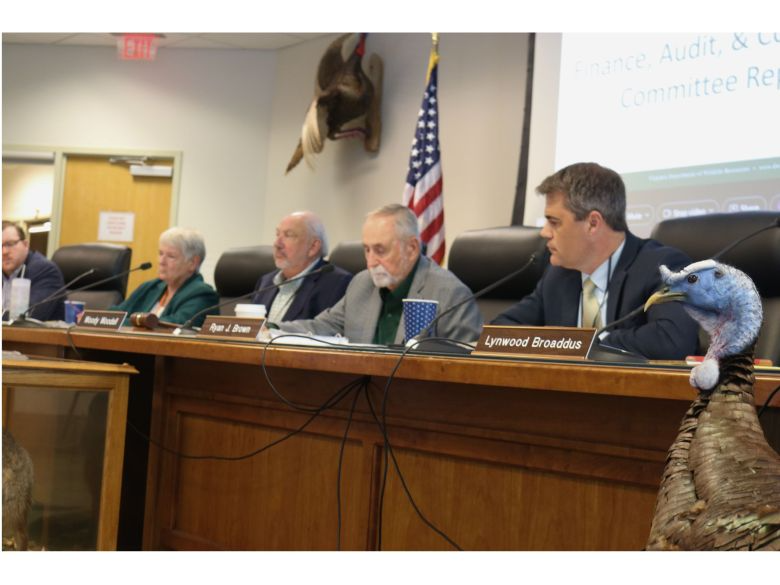
Sixteen applications for state highway makers are coming before a Virginia Department of Historic Resources board at its Thursday meeting, each vying for one of only five coveted spots. Four of those applications relate to historic landmarks or figures in Danville or Pittsylvania County.
Additionally, two other Danville- and Pittsylvania-related markers have already been approved, and the marker text will be finalized at this meeting: Gilbert’s Restaurant in Chatham and the Danville Canal.
Getting a marker is an intense process, said Danville historian Karice Luck-Brimmer, who submitted one of the four local applications and has worked on several others over the years.
“You really have to do your due diligence,” she said. Luck-Brimmer used to be a member of the Board of Historic Resources, which votes on the marker applications.
Applications have to be very thoroughly researched, with documented primary and secondary sources.
“It’s not meant to be honorary, to honor a person or place,” she said. “It’s meant to raise awareness and educate the public on something or someone significant.”
Less than 20% of the over 2,700 state highway markers in Virginia focus on Black history, though DHR is working to remedy this. Three of the four Danville and Pittsylvania applications up for consideration this week relate to Black history.
Other applications in this cycle range in topic and in locality. Only five will be approved at the meeting, though applicants can resubmit their applications for the next cycle if not accepted this time.
Here’s a roundup of the four applications from Danville and Pittsylvania County.
Northside High School
Northside High School and Southside High School were once the only two high schools in Pittsylvania County where Black students could attend.
In 2020, Southside High School was added to the Virginia Landmarks Register and the National Register of Historic Places.

Now, Luck-Brimmer is working to get a state highway marker for Northside.
“Northside High School was the first high school in Pittsylvania for Black students, and it actually predates Southside, which has already been recognized,” Luck-Brimmer said.
The school was established in present-day Gretna over 100 years ago, before school integration and the Freedom of Choice era. It opened with 52 pupils in 1903.
It went through many names throughout the years, Luck-Brimmer said, first opening as a private boarding school for Black students — one of the first of its kind in Southside Virginia — called the Pittsylvania County Industrial and Normal Collegiate Institute.
In the 1930s, it became a public school for Black students, and in 1949, it was renamed Northside High School.
It closed after county public schools integrated in 1969. Since then, part of the campus has been demolished, and the remaining buildings have been repurposed for private and public use.
Part of the campus is now transitioning into a community center, Luck-Brimmer said.
Though the building is no longer a functional school, the alumni of Northside remain proud of its legacy and their education, Luck-Brimmer said. Many prominent ministers and leaders in the county’s Black community over the years were alumni of Northside, she said.
“They just adored their school,” Luck-Brimmer said. “And they’re proud of the school’s history and their fellow students who have gone on to do great things.”

Mojo Nixon
Danville Vice Mayor and local Realtor James Buckner has been a fan of the recording artist Mojo Nixon for years, he said. When the family of Mojo Nixon, who grew up in Danville as Neill Kirby McMillan Jr., reached out to him about preserving his legacy, Buckner was on board.
He worked with the McMillan family to do family research and put together an application for a state highway marker recognizing Nixon, whose unique musical style and pop culture influence started in Danville’s Woodberry Hills neighborhood. If approved, the marker would go in that part of the city, Buckner said.
Over the course of his career, Nixon released several Top 10 College Radio albums in the 1980s and 1990s, including the song he’s best known for, “Elvis is Everywhere.”
He died just over a year ago, in February 2024, at 66 years old.
“He shaped pop culture through film, television, and more than two decades as host of SiriusXM Outlaw Country,” the marker application reads.
Ruben McMillan, Nixon’s son, said that his father’s career and legacy have been celebrated across the country. The marker is an opportunity to bring that recognition back to his hometown.
In Ohio, where McMillan lives, legislation was passed last year to designate a Mojo Nixon Day, he said. The McMillan family has also worked with the Rock and Roll Hall of Fame to create an installation on Nixon’s career.
“We’ve done memorials in Austin, Texas, where his band is from, and in San Diego, California, where he lived,” McMillan said. “But we haven’t done anything in Danville. He was extremely proud of where he came from, and his roots and his ties there. … It just felt right to do something long-lasting in Danville.”
Nixon would come back to visit his family members, some of whom still live in the city, whenever he was on tour near Danville, Buckner said.
“I always kind of looked up to Mojo because he was a Danville guy,” Buckner said. “He was just an electric human being, I mean he was just wide open. That’s how he performed and that’s how he lived his life.
“Kirby McMillan was his real name, but when the Mojo Nixon hat went on, he was a totally different animal, and it was always really fun to listen to him and know that that guy’s from Danville.”
A music lover himself, Buckner once owned a nightclub in Danville called the Temple, located on the ground floor of the downtown Masonic Temple, he said.
“We had tons of bands that came in to play,” Buckner said. “[Mojo] knew of the club, but we were just small fries. We had a few really cool artists come through there, but we probably couldn’t have afforded him when he was playing.”
Still, Nixon was “friends with everybody in the music industry from every genre of music you could imagine,” Buckner said, and personally knew some of the bands that played at the Temple.
Nixon’s father, Neill McMillan, was also well-known in the Danville community for his soul radio station WILA and his advocacy for the city’s civil rights movement in the 1960s.
The McMillan family wrote the language for the marker application, Buckner said. If the application is approved, the text will be finalized along with the other approved markers at DHR’s December meeting.
Buckner said that having this marker in Danville would illustrate to the community that dreams are achievable and that people from Danville can do great things.
“Lots of times folks think of a dream, and think, ‘That’s cool that somebody can do that, but nobody from here is going to pull that off,’” he said. “But Mojo was inducted into the Rock and Roll Hall of Fame. That’s a Danville, Virginia, native in the Rock and Roll Hall of fame. He’s made an impression all over the world with his music and it’s remarkable to think that it started right here.”
The Hippodrome Theater
After seeing his first state highway marker application on the Danville Riot of 1883 erected and his second application on the Danville Canal accepted, local historian Jonathan Hackworth submitted a third application focused on the Hippodrome Theater.

The Hippodrome Theater was the first theater in Danville built specifically for a Black audience and Black performers, Hackworth said.
Other early theaters in Danville had partitions to separate the Black and white attendees, he said, but the Hippodrome “was the first one built from scratch, foundation-up,” for the Black community.
It provided a “dignified and dedicated space” for Black audiences and performers during the era of segregation, when their other options were limited or denied, he said.
The theater opened in 1917 and stood on North Union Street in downtown Danville. And though it was built for the Black community, it did draw mixed-race audiences.
It was also the first Danville theater to appear on an exclusively Black national circuit of entertainers at the time, called the Theatre Owners Booking Association under the S.H. Dudley circuit, Hackworth said.

Dudley was a Black vaudeville performer and theater entrepreneur. His circuit connected Danville to much larger cities, like Atlanta, Durham and Richmond.
“The circuit provided a lot of your early blues and jazz entertainers,” Hackworth said. “And there was a very vibrant blues and jazz scene in Danville.”
Count Basie, Gonzell White and other jazz musicians passed through the Hippodrome, connecting Danville to formative stages of African American pop culture, he said.
The shows became so popular in Danville that they started to cause friction with local churches, which saw attendance drop on Sunday mornings after late-night performances called “midnight rambles” at the Hippodrome on Saturday evenings, Hackworth said.
Still, the circuit wasn’t without its problems for performers, he said.
“It was a grueling schedule with little pay, and it was the early 1920s, so of course the Jim Crow era in the South, where performers were traveling,” he said. “It wasn’t a safe environment for a lot of the female performers, and you had to have thick skin in the early entertainment industry as an African American.”
The theater closed in the 1930s, and the building was later destroyed in a 1962 fire.
Hackworth became interested in the Hippodrome while doing research on former local theaters, which come up a lot in his work as a historian, he said.
“As a historian, especially one that posts a lot about local history on social media, I hear a lot of great stories,” he said. “One thing that stands out to me is people’s memories of old theaters. But what struck me as odd is that I almost never heard about the African American theaters.”
A few years ago, he began researching local theaters, collecting blueprints and other records, and came across a reference to the Hippodrome.
Hackworth said he hadn’t heard of the theater and always wanted to get back around to doing more research on it.
He collaborated with Luck-Brimmer, who is the sponsor for the marker application. The pair also worked together on the Danville Riot marker, unveiled earlier this year.
The Hippodrome and the Theatre Owners Booking Association circuit have enduring historical significance, Hackworth said.
“They embody the struggle for cultural autonomy in the face of segregation, highlight Danville’s role in the evolution of Black performance, and connect local history to the national story of African American creativity and resilience,” he said.
Clarence 13X
Growing up in Danville in the 1980s and 1990s, Luck-Brimmer experienced the cultural ripple effects of the Five-Percent Nation without realizing it, she said.
She had no idea that the cultural movement was founded by a Danville native.
Clarence 13X was born in Danville as Clarence Smith. In 1963 in New York City, he founded the Five-Percent Nation, sometimes known as the Nation of Gods and Earths, after leaving the Nation of Islam.
The Five-Percent Nation champions “self-knowledge, empowerment and the belief in the divinity of the Black Man,” according to the marker application for Clarence 13X.
Luck-Brimmer, while not involved in this application, talks about Clarence 13X on her Black history tours of Danville.
The applicants and sponsor for this application did not respond to requests for an interview.
The Five-Percent Nation had an influence on Black culture and hip-hop and rap music throughout the rest of the 20th century, Luck-Brimmer said.
“Coming up in Danville, we used to wear what we called these door-knocker earrings, and we used to wear the big African medallions,” she said. “We didn’t know where all this stuff was coming from. We didn’t know that phrases like ‘Word is bond’ came from Clarence 13X. We were a part of the fad, but we didn’t know it was born in our own hometown.”
Artists throughout the decades — Big Daddy Kane, Busta Rhymes, the Wu-Tang Clan and Jay-Z — have associated themselves with the ideas of the Five-Percent Nation.
Danville’s Black history goes beyond Rosenwald schools and historic churches, Luck-Brimmer said.
“Those things are sacred to us, but there’s so much more to our history,” Luck-Brimmer said. “You have to think about culture and music and sports and all of those other things.”