I recently read a wonderful piece of fiction.
It was futuristic, but while a lot of futuristic fiction these days is dystopian, what I read was practically utopian. It also had an unexpected local angle: It told the story of a day when someone could ride a passenger train from New York to Houston and back again — and take part of that ride through Lynchburg, Roanoke and Bristol. It’s not every day that Southwest Virginia turns up in a work of fiction.
My only criticism is that this uplifting tale was told in the dry bureaucratic prose of a government report: “Amtrak Long-Distance Service Study Report to Congress.”
This 133-page report was required as part of the Infrastructure Investment and Jobs Act of 2021, often called the Bipartisan Infrastructure Act, although it was really only bipartisan in the Senate, not the House. As the name says, it’s a report on Amtrak’s long-distance service and identifies ways and places to expand such routes. Two of the report’s recommendations involve routes through the western part of Virginia: increasing the frequency of the three-times-a-week Cardinal route that goes through Staunton and Clifton Forge and establishing a New York-to-Houston route that would run through Southwest Virginia and create the long-sought passenger service to Bristol.
I call this report fiction because:
a) All this would be expensive and would be difficult even under a free-spending Democratic government but seems impossible under Republicans intent on cutting federal spending.
b) The report was delivered in the final hours of the Biden administration (it came out Monday morning).
c) The incoming Trump administration has not shown the warm feelings toward passenger rail that famed Amtrak rider Joe Biden did. During his first term, Trump wanted to cut funding for Amtrak.
I would not try to book that train to Houston right now. Still, there are sound reasons why the Trump administration ought to take a look at this report. Here’s the big one: Most of the expansion that the report recommends would serve Republican-voting parts of the country, particularly rural America.
The way some of this report is written, you’d think the authors at the Federal Railroad Administration might have had a Trump appointee in mind as a target reader.
Let’s take a look at what it says.
Sorry, no east-west train from Norfolk to Bluefield

The infrastructure act mandated the study take a special look at all the passenger routes that existed in April 1971, just before Amtrak was created, but were eventually discontinued, either when Amtrak took over or soon thereafter. Rhetorically speaking, if Trump wants to focus on the last word of “make America great again,” then the question is: How were we doing then?

One of those discontinued routes that Amtrak had for a while in the 1970s ran from Norfolk through Petersburg, Farmville, Lynchburg, Roanoke and Christiansburg on its way to Bluefield, West Virginia, and eventually to Chicago. For a time, this train was called the Mountaineer; later the route was shortened to start in Petersburg and was called the Hilltopper until it got to Catlettsburg, Kentucky, when it became something else. Whatever the name, the Carter administration axed this route and four others in 1979. At the time, the Hilltopper had abysmally low ridership and, like many Amtrak routes, lost money — just more than usual. When Roanoke lost Amtrak service, this was why. That service has since been restored, with a north-south route that goes on to Washington, New York and Boston, and is doing quite well. But the report does not recommend renewing the east-west route. There’s been some long-range talk in Virginia of a state-supported east-west route. If anyone wants that, look to Richmond, not Washington.
Daily service through Staunton and Clifton Forge on the Cardinal?

Cardinal News is branching out in many ways. We’ve added podcasts. Later this year, we’ll add a reporting position in Lynchburg. Train service, though, is not our thing. Just so we’re clear, for the purposes of the next section, Cardinal refers to the Amtrak passenger route, not us. We also get no government funding; Amtrak does. We depend on readers; here’s how. Now, let’s get on board with the rail Cardinal.

Amtrak operates 15 long-distance routes. Of those, 13 have daily service. The only two that are non-daily are the Cardinal and the Sunset Limited. The latter runs from New Orleans to Los Angeles, the former from New York to Chicago, by way of Washington, Cincinnati and Indianapolis — and, for our purposes, Alexandria, Manassas, Charlottesville, Staunton and Clifton Forge before crossing the state line and stopping next at White Sulphur Springs, West Virginia. Those first three Virginia cities are also served by other Amtrak routes but for Staunton and Clifton Forge, the Cardinal is the only Amtrak service.

The report recommends expanding service on both the Cardinal and the Sunset Limited from three days a week to all seven days. The other long-distance routes had ridership in 2023 that ranged from 126,309 (on the Capitol Limited between Chicago and Washington, D.C.) to 351,728 on the Silver Star (from Miami to New York, which takes it through Richmond and other stops in the eastern part of Virginia). The Cardinal had 82,698 riders, a recovery from the pandemic levels but not yet back to the pre-pandemic 108,900 in 2019. The report projected that expanding frequency would add another 110,000 riders. (Reality check: That would still leave the Cardinal with the next-to-lowest ridership of any of Amtrak’s long-distance routes.) The report points out that this would bring daily service to a lot of rural areas in Appalachia and the Midwest, as well as to some major metros: Cincinnati and Indianapolis.
You’re probably waiting for what this would cost (I know I was), so here it is. First, some philosophy.
The Cardinal currently loses $19.57 million a year (by contrast, the Sunset Limited loses $44.65 million). Before you ask why we don’t just stop service altogether, consider this: We shouldn’t expect passenger rail to make money. If it did, railroad companies wouldn’t have stopped pulling passenger trains. We subsidize Amtrak because it’s a service, particularly for rural communities that don’t have many transportation options. The realistic goal should be not to lose too much. The question, of course, is how much is too much. We won’t resolve that here. Just understand that’s why the government operates Amtrak. Expanding Cardinal to daily service would add $11 million in revenue, the report says, so notice that Cardinal would still require a subsidy, just a bigger one. The cost of operating the train three days a week is put at $31 million; the cost of operating it daily would be $70 million to $75 million, the report says.
The report doesn’t do the math (probably intentionally), but I did. It appears right now that Cardinal costs $31 million and generates $11.43 million, hence that $19.57 million gap. If Cardinal went daily, it would cost at least $70 million and generate $22.43 million, leaving a $47.57 million gap. I’d love to take the Cardinal to see the Cincinnati Reds play, but I’m not counting on it going daily. (Disclosure: I love riding Amtrak because I can do things other than grip the wheel and dodge 18-wheelers when I travel. Over the past two years, I’ve taken multiple trips out of Roanoke to concerts, to Washington to see The Beaches, to Philadelphia to see Charlotte Cornfield. But even I have a hard time making the case for a daily Cardinal train after seeing those numbers.)
A Houston-to-New York train through Southwest Virginia?

Amtrak currently goes to Roanoke. It’s in the process of expanding that route to Christiansburg. The state’s goal is to expand that service to Bristol with state-support service, but that’s a pretty ephemeral goal until we get the train to Christiansburg. The notable thing about this report is that it lays out a national context for running a passenger train through Southwest Virginia.
The report looked at 15 possible new long-distance routes. The one that matters to us is the proposed Houston-to-New York route. Part of the rationale is Houston’s explosive population growth: It’s now the nation’s fifth-biggest metro area. It’s also the biggest city without daily Amtrak service. Upgrading the Sunset Limited to daily would fix that, but this report also looks at other possible routes in and out of Houston. One proposed route would go from Houston to Dallas to Denver. The other would go from Houston to New York. This route, the report said, would add Amtrak service to 16 new communities and “could provide rural accessibility by more directly connecting unserved rural markets in Alabama, Tennessee, and Virginia.” That’s bureaucratic language for Southwest Virginia.
A proposed schedule for this Houston-to-New York train envisions stops in Chattanooga, Knoxville and Johnson City, Tennessee — but then none until Roanoke. So no stops in Bristol or Abingdon or Marion or Wytheville or Radford or Christiansburg or anywhere else. Before the mayors of those places start writing letters, keep in mind this is all very hypothetical.
As for cost estimates, again, keep in mind that none of this is likely to happen. The cost of the actual train cars and engines are put at $740 million to $960 million. Station maintenance and other facility costs are put at $1.52 billion to $1.98 billion. Rail upgrades and other infrastructure costs are put at $1.58 billion to just over $2 billion.
All that is just to get the train and tracks ready. For the Houston-to-New York route, it adds up to $3.8 billion to $4.94 billion. Houston, we have a problem.
The actual operation of the train, on a daily basis, would be $98 million to $138 million per year.
If you’re like me, you’re probably groaning at these costs. Here, finally, is some good news. The report ranks these 15 possible new routes … and Houston-to-New York ranked first, scoring 14 of 15 possible points. (Second place went to a Chicago-to-Miami train, which scored 11.)
Maybe someday this will happen. Then again, maybe someday we will go to Mars.
The New Space Economy website estimated the cost of a crewed mission to Mars (and back) at somewhere between $100 billion and $500 million.
It’s 1,841 miles from Houston to New York, so those startup costs of $3.8 billion to $4.94 billion work out to somewhere between $2 million and $2.6 million per mile.
It’s 140 million miles from Earth to Mars, and presumably we’d want to get back home, so that’s a 280-million mile trip at $100 billion to $500 billion — or $357 to $1,785 per mile.
So, yes, it’s cheaper per mile to get to Mars and back than it would be to start up a Houston-to-New York passenger train. If we want to get passenger rail service from Roanoke to Bristol, this report may not be the train to ride.
Fast balls in both Richmond and Washington

This week’s West of the Capital, our weekly political newsletter, wraps up a busy week in both the state capital and the nation’s capital. Among the items:
- Who voted which way in Richmond on proposed constitutional amendments.
- State Sen. Travis Hackworth, R-Tazewell County, becomes emotional while telling a family story.
- Sen. Tim Kaine takes the offensive against the Trump administration.
- What the candidates for governor did this week.
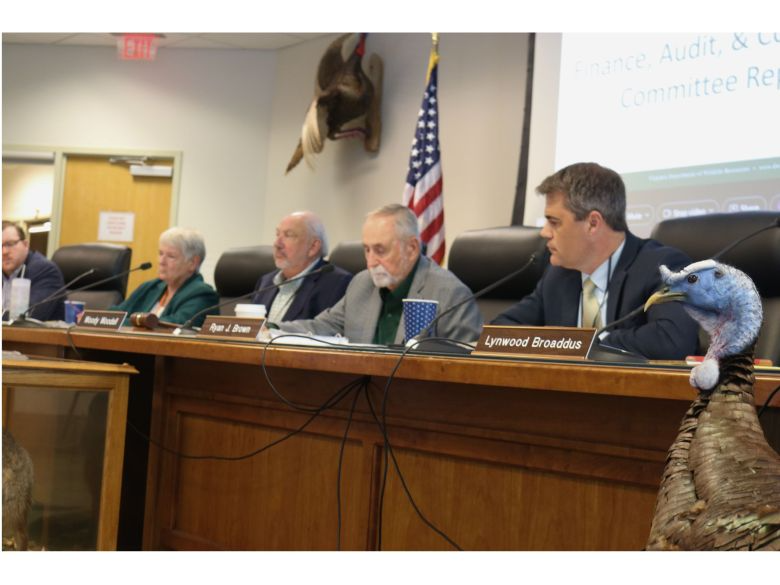
- Why the most closely watched vote this week may not have been in either Richmond or Washington. (The photo above is a clue).
West of the Capital goes out on Friday afternoons. You can sign up for that or any of our other free newsletters below: