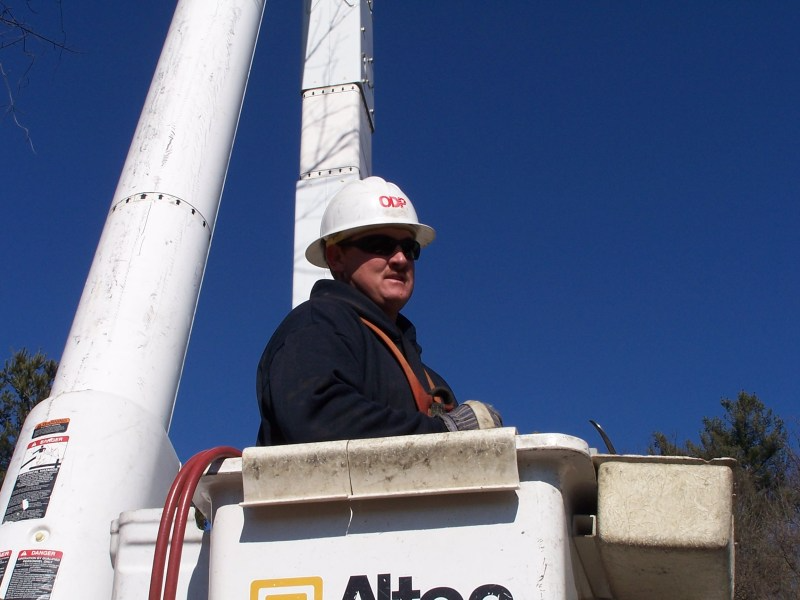
In the pursuit of lowering costs and expanding its energy supply options, the city of Radford now receives its electricity through a new wholesale power agreement that started June 1.
The city — which is under an unusual “fiscal distress” designation issued by the state — found itself in the predicament in part because of how it had been providing and paying for power to its residents and businesses.
No longer does the city contract directly with Appalachian Power Company (AEP), which it did for two decades.
But upon an open records request, key details in both current and past contracts were redacted by the city, limiting comparison.
The city is now in an agreement with CMS Energy Resource Management Company.
“The city wanted to take control, to have more diversity in their power supply. That’s the big reason,” said Tim Logwood, the city’s director of electrical utilities. “At some point, we may get some long term solar. We were not able to do that with the Appalachian Power.”
As Cardinal News has previously reported, an unbalanced budget in recent years — without the general fund revenue to meet its obligations — caused Radford to fall six months behind on electricity payments. It owed $6.5 million to AEP under the former contract, according to a Virginia Auditor of Public Accounts notice sent to the city in March. Radford had just two payments to make to AEP at the end of the past fiscal year to catch up, according to a June Facebook post from Vice Mayor Seth Gillespie.
The search for a new energy supplier began years prior — in August 2023, Radford, along with the city of Salem, Craig-Botetourt Electrical Cooperative, and Virginia Tech Electrical Services, jointly submitted a request for proposals through the Blue Ridge Power Agency, a nonprofit group which pursues the most reliable and lowest cost wholesale electric power supplies possible for its members.
“The RFP was conducted jointly, so that the city benefited from the economies of scale, in sharing the costs for the RFP, and because we also tend to see better pricing when we’re doing it as a group,” said Alice Wolfe, general manager for BRPA. Radford’s agreement was executed on a trade date of Dec. 19, 2024, with terms set from June 1, 2026, through Dec. 31, 2028.
Radford will receive about 80 percent of its energy requirements through what’s known as a “fixed load shape product,” in which a supplier agrees to deliver predetermined amounts of energy daily, based on a customer’s predicted demand, Logwood said. If more energy is required, it will then be purchased on the wholesale market.
“So it essentially says that the supplier will supply X amount of energy on X day and time for Y price,” said Wolfe.
The city approved the agreement without considering Radford University’s electricity demand because the university planned to begin generating its own power at the same time the previous contract expired, Logwood said. The university’s interconnection agreement, which would remove its necessity to purchase power from the city, has been delayed, meaning the city is still obligated to provide that supply — at daily market prices rather than the contract’s fixed rates.
The contract differs from the city’s former agreement with AEP in that it gives more flexibility to take advantage of price swings.
The cost of the city’s energy purchases and its distribution is passed on to the city’s customers, and those costs have gone up in recent years.
“We’ve seen probably a 45 percent increase in our power supply over the last four years or so,” said Logwood.
But the redacted key details in the new contract are unknown. Cardinal News received the current and former contracts from the city and the total quantity of energy, measured in megawatt-hour, and at what price ranges the city purchases it is redacted from the current contract.
The best estimate publicly available is from a pricing table attached to the resolution documents from when the contract was approved, which states that if a fixed load shape product is selected, the cost shall not exceed more than $55.66 megawatt hour. Although the city considered proposals from five wholesale electricity suppliers, it selected CMS Energy’s fixed load shape product because it offered the lowest price, Logwood said.
Salem’s fixed load shape threshold was slightly higher in comparison, not to exceed a price higher than $59.72 megawatt-hour, according to its resolution document.
The previous AEP contract followed a “load-following product,” which is when the supplier fully provides the energy requirements on a given day, but those exact details are redacted in sections including estimated generation demand, generation energy, and generation fuel charges, fuel adjustment charge, cost of service formulas and determination of monthly bills.
The city said it redacted large parts of the contracts because it is proprietary information.
“Well the market is still a competitive market, so, you know, their one supplier doesn’t want to give their pricing openly to another supplier,” said Logwood.
It is not yet clear whether the new contracts will result in lower costs, but residents are currently faced with rising electricity prices. In April, city council approved a five percent increase in power bills, among other tax and rate increases — the third straight year that the city raised multiple rates at once. For fiscal year 2026, the last year under the AEP contract, the average monthly electric bill was $156.42, based on 900 kilowatt-hours consumed, according to Logwood, which he says is closer to Radford’s average. That has increased to $164.27 for fiscal year 2027.
City leaders have heard from concerned residents about their electric bills, including several who spoke at a budget hearing in April.
Others are taking a longer-term view.
“We are conservative in the way we use electricity. So, no, it hasn’t really affected our style of living,” said Connie Wohlford, a Radford resident. She said that the cost of her bill has increased over time for her home and others, but remains confident in city officials to improve the fiscal situation in a place she has called home since birth.
The city is “having to make hard decisions, and I’m just trusting that they will make the right decisions, and I pray for them on a regular basis, and I know they’re in a hard spot,” she said.
It’s “possible the costs can go down next year,” Logwood said, when asked about how the new power contract will impact bills. “Some of the balanced energy is weather-driven. Weather spikes can increase the pile up of energy. The desire is to give the city flexibility in their power options, and hopefully save money, but it’s not guaranteed.”
Meanwhile, the state auditor of public accounts recommended in March that the city contract with state services to help it resolve its financial problems.
In a recent email, Staci Henshaw, the state auditor, wrote that she has heard nothing further since the recommendation — requiring the governor’s and other certain legislative approval — was made.