I grew up in Virginia, which means I learned about Virginia history a lot.
We had Virginia history in fourth grade. We had it again in fifth grade as part of U.S. history. Then we learned it all over again in seventh grade and eleventh grade. It’s hard to remember now which was Virginia history and which was U.S. history because so much of U.S. history pre-1820 is Virginia history.
Just because we learned about Virginia history a lot doesn’t mean that we learned a lot about Virginia history, though.
The history we’re taught is, by definition, a shorthand version, but there were large parts of Virginia history that we simply weren’t taught at all — sometimes by design.
The version of Virginia’s role in American independence that we learned was almost entirely the story of wealthy men in white wigs. You certainly can’t tell the story of July 4, and how we got there, without talking about Thomas Jefferson or George Washington or Patrick Henry. However, there are large parts of Virginia’s history from that era that are still new to me, and I consider myself a reasonably well-read student of history.
Three years ago, Cardinal News received a grant from the Virginia American Revolution 250 Commission to tell a monthly series of stories about lesser-known aspects of Virginia’s part in independence.
We plunged into that project with enthusiasm — but no real sense of how many stories there were to tell. Today we still don’t know, other than it’s a lot more than we ever expected. When we started, I knew some of those stories — about Peter Muhlenberg, the German minister who tore off his cloak at the end of a sermon in Woodstock and began recruiting soldiers, about Jack Jouett, the Louisa County tavern keeper’s son who rode to alert Jefferson that the British were marching on Monticello. I’d even heard (vaguely) about Susanna Bolling, the 16-year-old from modern-day Hopewell who supposedly rode through the night to warn the Marquis de Lafayette that the British were planning to capture him.
However, I’d never heard about Billy Flora, the hero of the Battle of Great Bridge, the first significant land battle in Virginia. We were never taught that it was Flora, a free Black man and a business owner, who almost single-handedly held back the British during one key part of the battle.
In fourth grade, we held fundraisers to pay for a field trip to Jamestown and Williamsburg, but I sure don’t ever remember hearing about the key newspaper publisher of that era — Clementina Rind, the first woman to publish a newspaper in Virginia.
It’s only after we embarked on our Cardinal 250 series that I learned of people such as Elizabeth Bennett Young, who hid the court papers in Isle of Wight County from the British, or John Wyatt, the Botetourt County barrel-maker who went undercover as a spy in the New River Valley to expose a nest of Loyalists who were plotting to take over the lead mines in modern-day Wythe County that supplied the patriots with ammunition.
Each month, as we’ve put together this series, I’ve learned something new about our history — and I hope you have, too. Last month it was about John Sinclair, Virginia’s patriotic pirate (well, a pirate in the eyes of the British) who raided royal ships. The month before it was that Cumberland County might have the honor of being the first locality in the country to call for independence. Before that, it was about the legend that French soldiers are buried in Prince Edward County.
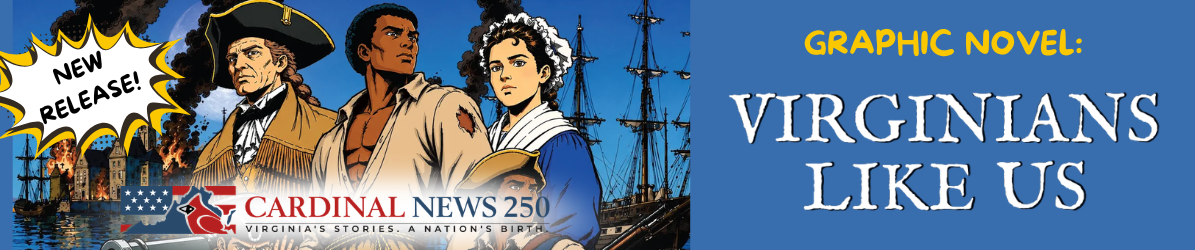
We’re now coming up on July 4, the formal 250th anniversary of American independence, and we have still more stories to tell. In 1776, July 4 was not the end of the story; it was merely the beginning. America’s 250th anniversary celebration will run through the 250th anniversary of the Battle of Yorktown. We’d like to keep telling those stories. We’re currently working on turning some of these stories into a graphic novel for Virginia fourth-graders that we’ll make available for free download on our site. We’re looking at revamping the Cardinal 250 portion of our website to make our stories easier to find — and to put them in the context of a map and a timeline. We also have a lot more stories to tell, and that’s where we ask for your help. If you like what we’ve been doing, please consider signing up as a Cardinal News member so that we can continue to commission writers to tell us all more about the history some of us were never taught in school.
You can sign up for our Cardinal 250 newsletter here: