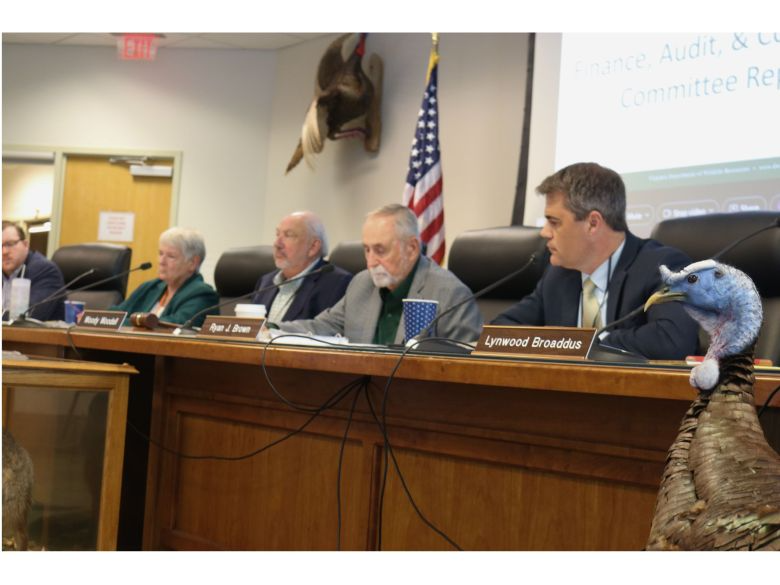
As Virginia reenters a multistate program designed to reduce greenhouse gas emissions, a state commission will discuss the possibility of putting money gained from the program toward rebates for electric utility customers.
The program, called the Regional Greenhouse Gas Initiative, sets a gradually decreasing cap on emissions from fossil fuel-fired power plants in participating states and requires those power plants to buy allowances at quarterly auctions based on how many tons of carbon dioxide they produce.
When Virginia participated in RGGI from 2021 to 2023, it put more than $780 million in proceeds from those auctions toward energy-efficiency and flood-preparedness programs. Any change in how the commonwealth uses RGGI money would require General Assembly approval.

But as Dominion Energy looks to increase the average residential customer’s bill by up to $13 per month as it recovers RGGI allowance costs from customers, lawmakers on the commission suggested Tuesday that it’s time to explore the options.
“I think it’s prudent to talk about ways to potentially mitigate that,” Senate Majority Leader Scott Surovell, D-Fairfax County, said during a meeting of the Commission on Electric Utility Regulation, of which he is the chair.
[Disclosure: Dominion is one of our donors, but donors have no say in news decisions; see our policy.]
In the coming months, the commission plans to study whether lawmakers should rebate some or all RGGI proceeds; how those rebates could be allocated among different customers, such as all customers, just residents or just low-income residents; and whether rebates could potentially offset RGGI-related bill increases.
The discussion mostly impacts customers of Dominion, not Appalachian Power. RGGI applies to power plants located in participating states, and most of Appalachian’s plants are in West Virginia, which is not in RGGI.
When Virginia was last in RGGI, the impact on the average Appalachian Power residential customer’s monthly bill was only about 2 or 3 cents.
“While we do not yet have an updated estimate tied to Virginia’s reentry, we expect to include any associated costs in our next environmental compliance filing later this year and will continue working to keep customer impact as low as possible,” Appalachian Power said in a statement to Cardinal News.

Dallas Burtraw, a senior fellow at the Washington, D.C.-based nonprofit Resources for the Future, told the commission on Tuesday that RGGI will bring hundreds of millions of dollars to Virginia, and rebates focused on Dominion’s residential customers could decrease monthly bills for households.
“It could reduce bills by more than Dominion’s recently requested increase in bills because of the cost of joining the RGGI program,” Burtraw said.
Sen. Mark Obenshain, R-Rockingham County, cautioned that giving rebates to residents but continuing to require commercial and industrial customers to bear the burden of RGGI’s costs could damage Virginia’s reputation among businesses.

“In every economic development presentation that I’ve ever heard, I’ve come to understand that the cost of energy is one of the top three drivers for businesses in deciding whether to locate in a particular location or remain in a particular location,” Obenshain said.
The Commission on Electric Utility Regulation, soon to be renamed the Energy Commission of Virginia, consists of state lawmakers, citizen members and an ex officio member from the state attorney general’s office. It monitors a variety of energy-related issues in Virginia and recommends bills to the General Assembly.
Its discussion about possible rebates is in the early stages, and no specifics were presented on Tuesday. The commission is required to make any recommendations by Nov. 30, ahead of lawmakers convening in January.
Dominion seeks bill increase to recover RGGI costs
When power plants in RGGI-participating states buy carbon allowances at auction, the states choose how to spend that money. Some, such as New Hampshire, already use RGGI proceeds to provide rebates to residents.
Virginia law allows electric utilities to pass the costs of these allowances on to ratepayers, which critics of RGGI say amounts to a regressive tax that doesn’t actually incentivize power plants to reduce emissions.
Supporters of RGGI say it helps the environment and helps pay for beneficial efforts such as flood relief in Southwest Virginia.
Dominion on Friday filed an application with Virginia’s State Corporation Commission to recover approximately $1.18 billion in RGGI allowance costs.
The utility estimates that it will incur these costs during the rate year from March 1, 2027, to Feb. 29, 2028, as well as during the prior eight-month period between July 1, 2026, when Virginia reenters RGGI, and the March 1 start of the rate year.
If the SCC permits Dominion to recover all of those costs during the rate year beginning March 1, the average residential customer’s monthly bill, which stands at about $172 today, would increase about $13, or about 8%.
An average Dominion customer uses 1,000 kilowatt-hours of electricity per month.
Dominion has proposed an alternative plan of spreading its RGGI costs over two years instead of one, which would increase the average bill by $10.36 instead.
Dominion said its estimates are based on quarterly RGGI auction prices of $37.04 to $38.32 per ton of carbon dioxide.
At the most recent auction earlier this month, the allowance price cleared $35 per ton, up from $19.63 the year before, a 78% increase.
RGGI has rocky history in Virginia
RGGI was announced in 2005 and launched in 2009. Today, it has 10 Eastern states participating, with Virginia set to become the 11th as it reenters the program next month.
Virginia first entered the program in 2021. The SCC allowed Dominion then to charge the average residential customer $2.39 per month to recover the costs of carbon allowances, which at the time were under $8 per ton.
In January 2022, newly inaugurated Republican Gov. Glenn Youngkin issued an executive order outlining Virginia’s intent to withdraw from RGGI.
In June 2022, the state’s Air Pollution Control Board voted to withdraw the commonwealth from RGGI. That same month, the SCC approved the suspension of Dominion’s RGGI charge on customer bills.
In July 2023, as the commonwealth prepared to leave RGGI at the end of that year, Dominion still had related costs to recover, so the SCC approved a charge of about $4.44 per month for a year on the average residential bill.
In November 2024, a Floyd County judge said that Youngkin’s withdrawal of Virginia from RGGI was unlawful and that only the General Assembly could decide the state’s participation.
Earlier this year, Virginia’s Democrat-majority General Assembly passed, and Democratic Gov. Abigail Spanberger signed, legislation to have the commonwealth rejoin RGGI.