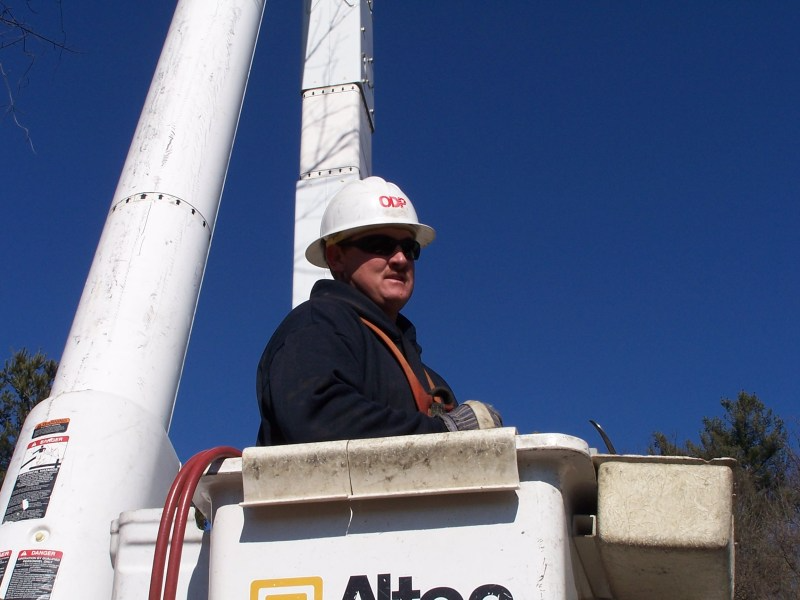
A dispute over the cost of utility pole replacement continues, with Comcast and Appalachian Power at odds over a crucial aspect of broadband deployment.
The Federal Communications Commission ruled in February that Appalachian cannot charge full price to replace poles that are not suitable for stringing new cable. Comcast said in a Monday filing with the FCC that the electric utility continues to charge between 20% and 100% of the full cost, which is about $8,000 average per pole.
Most of that expense pays the workers that Appalachian hires to replace poles, the document states, but Comcast says that it should be paying no more than $100 each, for the cost of the poles only. Appalachian, in a Tuesday statement, said that the difference between $100 and $8,000 would leave “electric customers to cover roughly 99% of the cost for work that does not benefit electric service.”
The disagreement between the United States’ largest broadband provider and a utility that provides power in multiple states dates to November 2025. Comcast claimed in an FCC complaint then that Appalachian was charging full price up front to replace poles that couldn’t be modified to carry new broadband cable to Virginians who lack access.
Comcast received $146.4 million from the federal Broadband Equity, Access and Deployment program to connect 24,343 locations in Virginia, including 2,080 locations in Montgomery County and 930 in Lynchburg.
Across the commonwealth, the condition of old poles or the lack thereof has stymied deployment, particularly in the post-pandemic years, when hundreds of millions of dollars in federal, state and private money have flowed, particularly in the post-pandemic era, when localities discovered they needed to connect residents in remote locations.
Comcast is among multiple ISPs in the commonwealth receiving federal dollars in that effort. Millions from the American Rescue Plan Act must be spent by the end of the year, or Washington will reclaim the funds.
The FCC, in its February order, said that both the Communications Act of 1934 and FCC rules prevent utilities from charging the full replacement price “when a pole already fails to comply with existing safety or engineering standards.”
However, Comcast argued in its Monday filing, “APCo continues to apply the methodology rejected by the Commission by charging Comcast a minimum of 20% of all pole replacement costs — and possibly much more, including up to 100% of the full cost of such pole replacement — which is squarely at odds with the express holdings of the Order and far in excess of the incremental costs permitted under the Commission’s rules and Order.”
The provider added: “More generally, if this issue is not resolved soon and other pole owners follow APCo’s lead, APCo’s policy will significantly increase the costs of, and delays to, broadband deployment across the country.”
Appalachian Power, in its statement, said it supports broadband expansion but “must ensure pole replacement costs are allocated fairly and consistent with FCC requirements. … APCo is reviewing the filing and will continue to advocate for a reasonable, balanced approach that supports broadband deployment without placing undue costs on electric customers for work that does not benefit electric service.”
Comcast’s document states that Appalachian Power provided Comcast with form letters that the utility’s contractors will use to send estimates for new poles, imposing “at least 20% of the entire cost,” about $1,600 per pole, on the provider. The utility later notified the ISP that its proposal is not a ceiling on Comcast’s responsibility, according to the filing.
The internet provider asked the FCC’s Rapid Broadband Assessment Team — established in 2024 to manage pole attachment complaint reviews, thereby speeding deployment — to schedule a status conference “as soon as possible” regarding the Feb. 5, 2025, order, the first of its kind.
“Comcast … has made significant attempts to negotiate resolution of the dispute with APCo and remains open to such resolution,” the filing reads. “However, APCo has rejected every reasonable effort to resolve this dispute.”
Comcast has agreed to pay the 20% allocation demand under protest and maintains the right to seek refunds under the FCC’s rules, to assure the work is done.