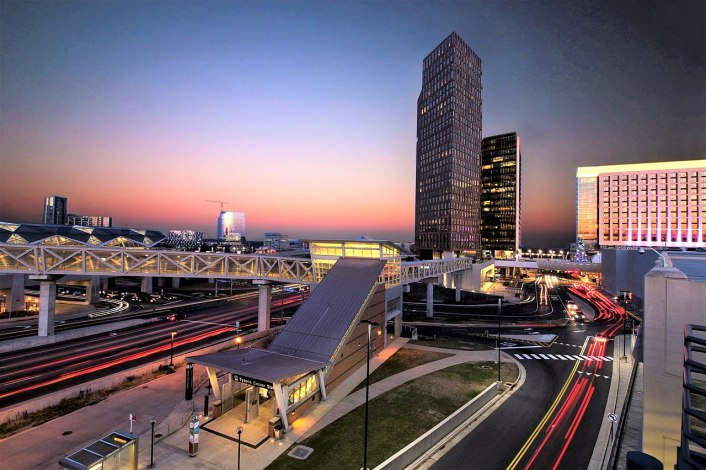


In 2014, Forbes magazine listed the top technology hubs in the country. So did Business Insider. So did New Geography. So did lots of publications that do such things.
They may have quibbled over who was in which place but they all agreed on one thing: The Washington, D.C., metro wasn’t on the list.
Today, lots of news sites still publish lists of the top technology hubs. They still quibble over who is in which place but they all agree on one thing: The Washington metro is somewhere on that list.
There are many reasons why the Washington metro, and particularly the Northern Virginia side of that Washington metro, has risen in the rankings, but one of those reasons is in Southwest Virginia, specifically Blacksburg: Virginia Tech. And even more specifically, Tim Sands, who on Thursday announced his impending retirement after 12 years as the school’s president.

There are many ways to measure Sands’ legacy, but his most lasting one may well be his role in Virginia’s elevation as a technology state. “His legacy is further establishing the link between higher education and economic development,” said Todd Haymore, a former state secretary of commerce and trade who worked with Sands on the state’s winning bid for Amazon HQ2, which was submitted in 2017.
Northern Virginia was already rising as a tech hub when Virginia put in its bid for the Amazon HQ2 headquarters. Still, Virginia was initially a dark horse in that high-profile search. Moody’s Analytics originally listed Austin, Texas, as the favorite. The New York Times ranked Denver as the leader. The Irish gambling site Paddy Power gave the best odds to Atlanta. Las Vegas bookies put Virginia below even the Canadian province of Nova Scotia, which is to say, it was considered among the longest of long shots.
In all, 238 communities from across North America submitted bids. The Atlanta suburb of Stonecrest offered to rename itself Amazon if the company chose a site there. The mayor of New York had prominent landmarks lit up in a promotional campaign. Fans at an Ottawa Senators hockey game were urged to “make noise” to get Amazon’s attention. Calgary sent people to Seattle to chalk messages in sidewalk graffiti. Tuscon, Arizona, sent a cactus.
Other places put together generous incentive packages; Maryland offered the most, $8.85 billion in tax breaks and infrastructure, topping New Jersey’s $7 billion bid.
Virginia did none of those things. It certainly offered incentives — described at the time as between $550 million and $750 million, mostly keyed to hiring targets — but Virginia did something other communities didn’t. It didn’t offer Amazon billions in tax breaks, or engage in flashy promotional gimmicks. Instead, Virginia did something that was almost boring — but critical. It promised to create a bigger talent pipeline so Amazon could always be assured that the company could find enough workers in Virginia.
Terry McAuliffe was governor then. He wanted one of Virginia’s colleges to take the lead on that workforce part of the bid. The administration contacted every Virginia college to gauge its interest. Administration officials split up the task; Haymore was delegated to talk with Sands. “He was the only person who not only said ‘yes,’ but ‘Let me know how else I can help,’” Haymore recalled Thursday.
The timing was fortuitous. “What I wasn’t fully aware of was that Virginia Tech, as part of its six-year plan, was contemplating a move into Northern Virginia,” Haymore said.
Virginia Tech ramped up those plans and became the lead educational partner for the Amazon deal. “We made Virginia Tech, in effect, just as important as the other incentives, just as important as the infrastructure to be developed,” Haymore said. “The role that higher ed was playing was just as significant as any other component of the package.”
By the time Amazon announced Virginia as the winner, Ralph Northam was governor. Northam’s memory of Sands’ role is the same as Haymore’s. “Of the college presidents, he was by far the leader of the pack,” Northam said. “He was ‘all in’ on the innovation campus” — as Tech’s proposed Alexandria campus was called.
The campus is no longer proposed; it’s there — and growing.

Amazon is only a small part of the Northern Virginia technology sector, but it has been the one that’s gotten the most attention. Here’s one way to measure its impact: In 2017, StartUp Genome, a San Francisco nonprofit that studies business ecosystems, didn’t rank the Washington area in its global Top 20. By 2019, the year after the Amazon announcement, it did.
Today, Virginia ranks eighth in the nation for venture capital investment — the first time it’s cracked the top 10, according to the National Venture Capital Association. It now leads the nation in cybersecurity employment and ranks fifth for net tech employment, according to Jason El Koubi, who heads the Virginia Economic Development Partnership.
And, of course, we’ve become the data center capital, not just of the country, but the world. That’s a title that’s been a mixed blessing when it comes to electricity demands and other concerns, but the point is that Virginia today is a very different state than it was when Sands took the helm of Virginia Tech in 2014. That also means that Sands’ successor, whoever he or she will be, will have different responsibilities than the ones Sands initially took on.
Some responsibilities, of course, don’t change. Money must be raised. Alumni expect a winning football team. Somebody is always going to complain that there’s not enough parking. However, the president of a major state research university isn’t just a college administrator, he or she is a key player in the state’s economy.
Not all college presidents have viewed the world that way. At a recent meeting of the James Madison University Board of Visitors’ Strategic Planning Committee, one board member (Nicole Wood) noted that the school’s former president had little interest in economic development. “I remember hearing complaints of industry coming to the former president and leadership and just being turned down, not even given a chance to come in and talk to them about where they could find new experiences where they could collaborate and problem-solve,” she said.
Sands had a different view of a university’s role in the economy, and the next president of Virginia Tech will need to, as well.
Virginia’s rise as a technology hub has not inoculated it against other economic challenges. Virginia’s biggest metro, Northern Virginia, has long been dependent on the federal government, perhaps too dependent. The state began a determined push about a decade ago to create more private-sector jobs there (the GO Virginia program) but that’s slow and other events have come on fast. The Trump administration, with its federal job cutbacks, has forced the region to rethink its economy — and the state, as well. A recent study by the Brookings Institution found that, of the nation’s 55 metro areas with populations of 1 million or more, the two with the biggest job losses, on a percentage basis, are in Virginia: Northern Virginia and Hampton Roads. Virginia, as a whole, is creating jobs at a much slower rate than its neighbor to the south, North Carolina.
These aren’t just regional problems, they are statewide problems, because the whole state depends on the tax revenues generated in those metros. Candidates for governor talk about solving these problems and, sometimes, once in office, they try to. The reality, though, is that governors serve for four years and are gone, while many economic problems can’t be solved that quickly.
That’s why whoever succeeds Sands won’t just matter in Blacksburg. He or she will matter all across Virginia.
Want more politics and analysis? Sign up for West of the Capital, our weekly political newsletter that goes out Friday afternoons:
