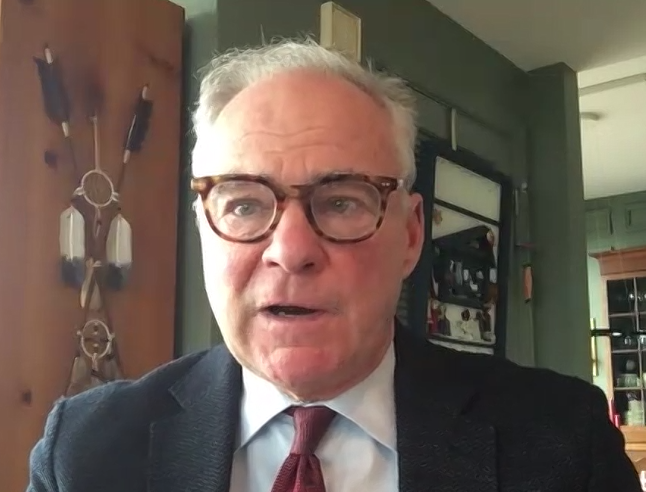


Former Del. Ford Quillen, a Democrat from Scott County who built a reputation for his attention to economic development in Southwest Virginia and served briefly as acting speaker of the House, died Sunday. He was 87.
Quillen spent 24 years in the House of Delegates, from 1970 to 1994, and later served as a circuit court judge. As word of his passing spread, tributes came in from both sides of the political aisle.
“Ford C. Quillen was one of the most consequential public servants this House has ever known,” said House Republican LeaderTerry Kilgore of Scott County, who succeeded to Quillen’s House seat and delivered a tribute to his predecessor on the House floor Monday.
“Ford was always affectionately referred to as the Dean of the Southwest Delegation,” former state Sen. William Wampler Jr., R-Bristol, said by email. “He was highly respected by legislative members from all corners of the Commonwealth.”
In talking to Quillen’s former colleagues, one of the themes running through the tributes was Quillen’s ability to build coalitions with Northern Virginia legislators to achieve gains for Southwest Virginia. First, though, he had to build coalitions within Southwest Virginia.
“He was always a fierce advocate that held the Southwest Delegation together and taught us how to band together for the betterment of the region,” Wampler said. “When other regions divided on issues, we stuck together.”
One of Quillen’s most lasting legacies is the creation of the Virginia Coalfield Economic Development Authority, a regional economic development authority.
“Ford was an innovative thinker, who looked for ways to make a major difference,” said former U.S. Rep. Rick Boucher, D-Abingdon, who previously served in the state legislature when Quillen did. As an example, Boucher sent this email about Quillen’s service. “He wasn’t shy about taking on big and politically difficult projects. For example, he assembled the support necessary to create the Virginia Coalfield Economic Development Authority in 1988, which was a major challenge for the time. Then, as today, the authority derived its funding largely from the coal severance tax (in later years the funding was extended to a severance tax on natural gas). It was necessary for Ford to persuade the coalfield localities, which previously received the lion’s share of the severance tax, to support allocating a significant portion of the tax to the regional authority, so that there could be coordination and a regional focus in making economic development decisions rather than the scattershot and often ineffective county by county efforts which were the earlier practice.
“The authority functions today as a major source of funding for economic development in the coal producing counties. Ford was farsighted and saw the need to create a future for the region beyond coal. The authority was the product of that vision. He assembled the support and was chief sponsor of the legislation that enabled its creation.”
Quillen was a strong supporter of the two institutions of higher education in his district, the University of Virginia’s College at Wise (formerly Clinch Valley College) and Mountain Empire Community College, where there is now a scholarship in his name.
“Ford was a thinker always seeking capital investment in southwestern Virginia’s education and bringing greater economic development in the region,” said Jack Kennedy, a former Democratic state legislator and later clerk of court in Wise County. “Ford Quillen supported women’s rights in his legislative service . . . He would have relished in the most recent inauguration of Abigail Spanberger.”
Land use lawyers remember Quillen in another way. In Virginia law there is now a concept known as “Quillen zoning,” which relates to a certain prohibition on downzoning land. That was a product of an alliance with a Northern Virginia legislator that proved useful to Northern Virginia legislators trying to curtail sprawl and useful to Southwest legislators who needed Northern Virginia support for some of their proposals.
Quillen briefly held the title of acting speaker of the House for about two months in 1991. Speaker A.L. Philpott stepped down due to ill health. Although the House was out of session, the duties went to Quillen as chairman of the House Privileges and Elections Committee, until Tom Moss was picked as the new speaker.
After Quillen retired from the General Assembly, he became a judge. “As a Judge, Ford would ‘hold court’ such that the parties felt like they ‘had their day in court,’” Wampler said.
Richmond lobbyist Alexander Macaulay, who was related to Quillen by marriage, told this story: “I once joined him for a ‘motions day’ in Lee County Circuit Court in Jonesville. When we drove up to the courthouse, prisoners were washing various vehicles. Ford said he always declined the perk because it was a conflict of interest. We then proceeded to the jury room where the judge, lawyers, deputy sheriffs, and clerks gathered around a big table chatting, smoking, and sipping coffee.”
Most remarkable of all, Macaulay said: “A few prisoners in shackles filtered through, and each one greeted Ford by first name.”
The family will receive friends from 11 a.m. until 1 p.m., Saturday, Jan. 24, at Gate City Funeral Home. Funeral Services will be conducted at 1 p.m. with the burial following at Holston View Cemetery, Weber City.