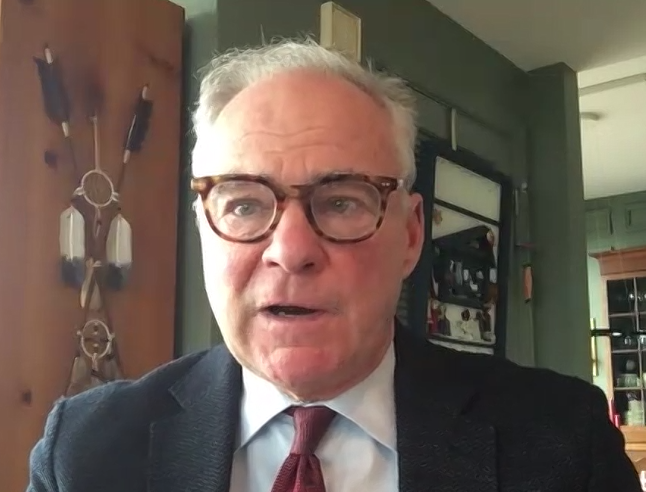


Gov. Glenn Youngkin reflected on his four years in office on a windy Friday afternoon with less than one month left in his term. He repeated the same word, “transformation,” throughout a recent sit-down interview with Cardinal News.
“Virginia was reeling when I came into office,” he said. “Remember 2021, we were in COVID, we were 47th in the nation in getting our schools back open, we were 46th in the nation in job recovery, we had 25,000 small businesses that had shut in 2021 alone and we had, for 9 years, more people who were moving away than were moving here, and you couple that with the fact that we had a 20-year high in murder rate and Virginia led the nation in learning loss in fourth grade reading and math.”
Those items, along with others, he called “basic failures of government.”
“We stepped into a moment where it was clear that big-time transformation was necessary in the commonwealth of Virginia,” he said.
Virginia’s schools had reopened for full-time in-person learning by September 2021, before Youngkin won his election. By 2022, Virginia had recovered to pre-pandemic job status, according to the Federal Reserve Bank of Richmond. By 2024, Virginia had begun to see more people moving to the commonwealth than out of the state, and, that same year, Virginia saw a 30% drop in the statewide murder rate over the previous year, according to the attorney general’s office.
In regard to learning, students showed increased proficiency across the five subjects tested for the Virginia Standards of Learning in 2025. Those gains, however, were modest and largely continue to lag behind pre-pandemic pass rates.
A newcomer to politics, Youngkin beat former Democratic Gov. Terry McAuliffe in 2021 in an upset fueled by the parental rights movement and frustrations surrounding the COVID-19 pandemic. Prior to Youngkin, a Republican had not won the governor’s seat since former Gov. Bob McDonnell in 2009.
Youngkin, a businessman, had worked for the Carlyle Group, an investment firm, prior to his election. He said he heard from a lot of people during his campaign and after who told him he would not like his new role as governor and that he “wouldn’t be able to get anything done.” But his experience was the exact opposite, he said. He found that his business background fit well into his role as chief executive of the commonwealth.
“So many of the basic principles that are essential to being successful in the business world, particularly running a company, are 100% transferable to this role. That was a very pleasant surprise,” he said. “We’ve been able to get an enormous amount done.”
He listed off, among his administration’s accomplishments, a change in how the state views economic development, which, he said, resulted in “$156 billion in economic wins,” job growth that translated into growth in revenue, which fueled tax relief and investments, along with other efforts.
On working with members of the opposite party

For the first half of Youngkin’s term, Republicans held control in the House of Delegates, and Democrats controlled the state Senate. After the 2023 elections, Democrats controlled both chambers of the General Assembly. Youngkin issued a record number of vetoes during his term, 399 total — three times the amount issued by former Democratic Gov. Terry McAuliffe, who held the record previously. Youngkin vetoed 33 bills in his first year, eight bills in his second, 201 his third year and 157 his fourth.
The outgoing governor also issued a handful of budget bills, including his final budget proposal for the biennium. He will have left office when the General Assembly reworks his spending proposal into a bill of its own, and it will be up to the incoming Democratic Gov. Abigail Spanberger to sign or line-item veto the legislation.
General Assembly Democratic leaders have signaled that they plan to rework much of Youngkin’s final budget proposal, which was presented to the joint money committees in mid-December.
“I think that would be a huge mistake,” Youngkin said in response. “We have, over the last four years, negotiated budgets where we have both disagreed on aspects of the budget and landed them for the good of the commonwealth.”
He said those previous budgets have included $9 billion in tax relief, investments in education, law enforcement, health care, behavioral health and supporting objectives to support the Chesapeake Bay, business-ready sites and workforce development.
“I have consistently warned that adopting anti-business practices, increasing tax burdens on Virginians and creating more bureaucracy when the reality is we need to create less… these are just fundamentally good things,” he said.
He added that he believes the commonwealth can drive economic growth and job creation through pro-business initiatives while deregulating and that the state can use the benefits of those efforts to invest in education and other critical needs.
“I’m sure they’ll make changes [to the budget proposal] because it’s their prerogative, but the basic building blocks of pro-business, reducing taxes and funding critical needs should be the basic building blocks of the next budget,” he said.
On making difficult decisions

Youngkin argued that there were no easy decisions made throughout his term as governor.
“Oftentimes, some of the ones that are most impactful that I might call hard are really 90/10 decisions; we know exactly what we need to do, but they’re just hard to execute.”
In those situations, his approach to those decisions or situations is to just do it — which he emphasized with a clap.
He pointed to a recent initiative, a roadmap to support child welfare in Virginia, which he unveiled mid-December, as an example. There were steps the administration had to take: the foster care system had to be transformed, then support for kinship care needed to be put into place and now the administration is working on child welfare. That was a 90/10 decision, he said, and the best way to tackle it was to just get it done.
Other decisions, which he called 51/49 decisions, have turned out to be “the right things to do,” he said. He cited an effort to raise expectations in K-12 education as an example.
“There was a lot of consternation on making the tests harder; there was a lot of consternation on the transparency that our new school assessment and support system has,” he said. “We have compromised a bit on my timeline. I’d like for us to go faster, but I think we worked with superintendents and a lot of stakeholders along the way, and I think the staged approach that we have taken will work.”
What’s next? And Youngkin offers some advice for Spanberger

Youngkin would have absolutely run for a second consecutive term if it were allowed in Virginia, he said. He chuckled when asked if he would run again for governor in 2029.
“The bottom line is I get one term and I’ve spent the last 1450 days focused on Virginia, I’m going to finish strong focusing on Virginia, I don’t get to run again and that’s just the truth, but Virginia is going to get 100% of my attention all the way up through the last minute that we’re here.”
In his immediate future, he said he is looking forward to taking his wife, Virginia’s first lady, Suzanne Youngkin, on a long vacation to a beach “somewhere.”
“We will find one, and we will order double sunscreen — I haven’t been outdoors much in the last four years, my golf game has suffered, I haven’t fished much, I haven’t been hunting much. … I’m looking forward to spending time with Suzanne; she’s been the most amazing first lady.”
He added that each first spouse gets to define their role in office, and pointed to her effort to raise awareness of the dangers of fentanyl and creating the Spirit of Virginia Awards to highlight the work of nonprofit organizations.
He said he will miss working with his team, his cabinet, and state department and agency heads. He acknowledged some shuffling among cabinet members during his term — there was turnover in the secretary of the commonwealth position, along with the secretary of commerce and trade, secretary of health and human resources, and the secretary of public safety positions — but Youngkin said he’s proud that most of the 12 cabinet members stayed throughout his term.
Youngkin said he is confident that his administration is handing over a strong state and that Virginia has the potential to be spectacular. Whether or not the commonwealth sees success will depend on the incoming administration and General Assembly, he added.
“The decisions that this next administration is going to have to make will be incredibly important to continue what we’ve done, and if they make them well, then Virginia should thrive, and if they make them poorly, then I think Virginia could be hurt.”
And his advice for the incoming governor? “Remember who we work for: 8.8 million Virginians, and not everybody always agrees with what we do in this administration,” he said.