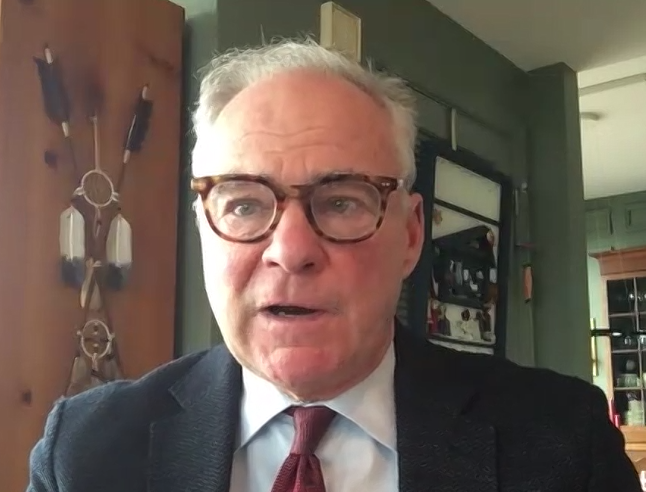


When Democrat Jay Jones takes over as attorney general from Republican Jason Miyares on Jan. 17, he will take over all the lawsuits and investigations initiated under Miyares.
Jones’ actions will be closely watched to see which ones he continues, which ones he drops and which new ones he might initiate.

Some of the legal matters that Miyares’ office has been involved in have particular application to the western part of the state. Among them:
Will Jones revisit the finding that Roanoke College violated the Virginia Human Rights Act? Miyares had found that Roanoke College discriminated against members of its women’s swim team by allowing a transgender student to participate and then retaliated against athletes who raised concerns.

Will Jones revisit Miyares’ ruling that Sweet Briar College’s admissions policy is in accordance with the will that created the college in 1901? That admissions policy, revised in 2024, says the women’s college in Amherst County admits only students who “confirm that her sex assigned at birth is female and that she consistently lives and identifies as a woman.” It also has stirred opposition among some alumnae who believe it makes the school less LGBTQ-friendly.
Will Jones find any new way to reconcile the estrangement between the New College Institute in Martinsville and the nonprofit foundation originally set up to support it?
The first two of those have a clear political dimension; the third could be rendered moot if New College Institute winds up merging with Patrick & Henry Community College, as has been discussed.
Then there’s a case with no obvious political element that has received national attention nonetheless: the case of the Natural Bridge Zoo and its missing giraffes.
Legally, this is a criminal case about allegations of animal abuse, and the attorney general’s office routinely deals with criminal matters. Other criminal cases, though, don’t deal with victims who are 14 feet or more tall and can’t speak — and whose plight has attracted the attention of Hollywood. Of all the cases that Jones will inherit from Miyares, this might be the most interesting one.
Let’s recap how we got here.
Miyares’ Democratic predecessor, Mark Herring, became the first (and so far only) state attorney general to set up an Animal Law Unit. Miyares thought that was a good idea when he took over and continued the unit. Jones said during the campaign that he would, too.

In December 2023, that unit initiated a raid at the Rockbridge County zoo, investigating allegations of animal abuse. Authorities seized 100 animals — 96 physically, four others stayed at the zoo, but the state laid legal claim to them. Those four were giraffes, who were deemed too tall to move without special arrangements. One curiosity about that raid: To avoid tipping off the zoo by swearing out the search warrant in Rockbridge County, the attorney general’s office did that in Powhatan County; that has become a point of legal contention as the case has gone on. No criminal charges have come out of that initial raid — yet. There is a grand jury, described by Miyares’ office as a “multijurisdictional” grand jury, that has been impaneled to consider the case.
In March 2024, a Rockbridge County jury awarded custody of most, but not all, of those animals to the state — including the four giraffes, who remained at the zoo while the state worked out a way to move them.
All the controversy, and legal wrangling, that has followed has essentially come about simply because giraffes are tall. If they were shorter and easier to haul, the attorney general’s office would have loaded them up and carted them away during the initial raid in 2023. Since they tower 14 feet or more (or more than the height of two NBA centers), those giraffes have proved to be both a physical and a legal complication.
The male giraffe, Jeffrey, was moved to a Georgia park in October 2024 amid such contentious circumstances that the zoo’s former owner, Karl Mogensen, and his daughter, Gretchen Mogensen, the zoo’s current manager, were later charged with, and found guilty of, contempt of court for allegedly attempting to hinder the move.
More specifically, a court filing said Karl Mogensen called one prominent giraffe transporter “and threatened to shoot him if he came on the property.” A Virginia State Police special agent then went to interview Mogenson to conduct a “threat assessment.” That agent reported “Karl admitted to making the statement that he would shoot anyone that came on the property but said he did not mean that seriously and was not going to harm anyone.” The agent went on to report: “Karl said ‘I will not hurt anyone, I will shoot the vets. I am kidding with you, I never planned to hurt anyone.’” Karl Mogensen said he called the giraffe transporters — the report is plural — “to scare them.”
The difficulties involved in moving Jeffrey meant that the other three giraffes couldn’t be moved until spring — it was considered unwise to put the giraffes in an unheated trailer for a long drive to Georgia during the winter.
At some point before Jeffrey was moved, it became known that two of the females were pregnant. Once it became clear that the females would have to spend the winter of 2024-25 at the zoo, the attorney general’s office ordered the zoo to notify it when the calves were born.
In April 2025, a surprise inspection by the attorney general’s office — which included a veterinarian — found that the two females were no longer pregnant and that afterbirth was present on one of them.
Since then, the whereabouts of the two baby giraffes have been a mystery — and also the subject of a criminal investigation.

In September 2025, Rockbridge County Circuit Judge Christopher Russell found Gretchen Mogensen in contempt of court and gave her until late October to either reveal the whereabouts of the missing baby giraffes or serve 100 days in jail. She chose jail.
Why?
We can only speculate. However, her father in the past has described the zoo as primarily a breeding facility. In the 10 years prior to the state’s raid, state records show that the Natural Bridge Zoo shipped out 14 baby giraffes — some as young as 2 weeks old, none older than 2 months. We don’t know for a fact that those animals were sold, but it seems reasonable to believe they were. Court records show that adult giraffes are worth about $250,000 apiece. Based on that, the prevailing assumption has been that the zoo sold the two baby giraffes soon after they were born — and that 100 days in jail may be worth whatever the Mogensens got for them.
Since then, two things have happened.

Actress Alicia Silverstone, who rose to fame through “Clueless,” has offered a $50,000 reward for information leading to the recovery of the baby giraffes.
More recently, Gretchen Mogensen has filed a federal lawsuit against the attorney general’s office, alleging multiple ways it has mishandled the case and violated her rights: “jurisdictional overreach, fabricated evidence, unlawful search and seizures, prosecutorial misconduct and suppression of protected speech.”
Many of these allegations had come up in state court and were dismissed. Curiously, though, this suit describes the baby giraffes as “non-existent.” Specifically, it noted that Gretchen Mogensen had been found guilty of contempt of court “with an impossible purge condition requiring delivery of non-existent giraffe offspring.” Her lawyer has not responded to an inquiry about what that means.
Did the baby giraffes die? Or is she alleging that the giraffes were never pregnant to begin with? If the latter, it’s curious that her defense team didn’t bring this up when Mogensen was on trial for contempt for not revealing the calves’ whereabouts. Or is this some legal styling intended to put the onus on the attorney general’s office to prove that the baby giraffes exist?
All this will soon become Jones’ responsibility.
Will that grand jury produce indictments? If so, who and when?
Will the criminal investigation into the baby giraffes produce any animals? (As an aside, how do you go about looking for baby giraffes? The attorney general’s office has access to investigatory tools that others don’t have — subpoenas and the like. Does it have access to phone records? To bank records? We do know this: If baby giraffes were found, they’d require DNA testing to verify they really are the offspring in question. Law enforcement routinely deals with DNA testing, but not DNA testing of giraffes.)
Another complication: One of the three females from Natural Bridge died en route to Georgia. A report released by Miyares’ office said Natural Bridge Zoo administered a particular drug to the animal before the move because it seemed sickly. A veterinarian for the state “saw no symptoms that would cause concern before she was loaded.” Nonetheless, Valentine died somewhere in South Carolina. A preliminary necropsy by the University of Georgia has ruled out stress from the move, according to the attorney general’s office. A toxicology test was ordered through Michigan State University, but the results haven’t been released because Valentine’s death is now also part of a criminal investigation.
That’s at least three separate lines of inquiry underway: the original allegations of abuse, the missing baby giraffes and what medicines were administered to the giraffe that later died.
I’m sure that before he leaves office, Miyares would love to announce that the baby giraffes have been found and indictments handed down. If they’re not, though, all the complications of this case will wind up on Jones’ desk — along with that countersuit.
Jones ran on “fighting for Virginia families.” In this case, one of those families is a family of giraffes.
Normally, I write about people, not giraffes. For more political news and insights, sign up for our weekly political newsletter, West of the Capital, that goes out Friday afternoons.