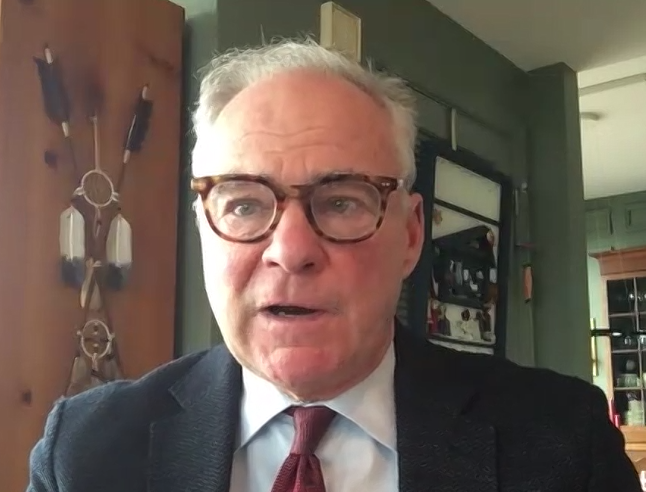


The big question going into Thursday night’s debate between the attorney general candidates was how Jay Jones would handle his now-infamous text messages in which he fantasized about shooting then-Speaker of the House Todd Gilbert.
We now have our answer.
He apologized — at least five times he said “sorry” — but said Jason Miyares’ record and support for President Donald Trump is worse.
None of that is surprising; it’s exactly what we expected, but that summary does frame how the rest of this campaign is going to go: The race is going to be texts vs. Trump.
The big question now is what voters make of this.
Here are my takeaways from the debate:
This was a real debate

Virginians who took the time to watch the debate — or want to take the time to watch the replay — saw a substantive debate that actually dealt with issues. Yes, there was plenty of showmanship on both sides. And, yes, both candidates avoided questions they didn’t want to answer. This is, after all, politics. However, they also respected the rules and conducted themselves with decorum — even as they strongly disputed back and forth. This was not the bizarre spectacle we saw in last week’s gubernatorial debate where Republican Winsome Earle-Sears spent the evening interrupting Democrat Abigail Spanberger. Virginians may not be proud of where one candidate or another stands, but they can be proud of how they conducted themselves.
Some of that credit belongs to the sponsor (the Virginia State Bar) and the moderator (Brett Marston of the Roanoke-based Gentry Locke firm and president of the State Bar). Marston admonished candidates to conduct themselves as they would in court, and they did. Unless we want debates to be the political equivalent of a pro wrestling match, this should be the standard.
The key quotes from both sides were about the text messages
Both candidates addressed Jones’ text messages in their opening statements.
Here’s what Jones said: “Tonight you’re going to hear about two very different visions for the future of this commonwealth. You’re also going to hear from my opponent about text messages in which I used language that I deeply regret. Let me be very clear. I am ashamed. I am embarrassed. And I am sorry. I am sorry to Speaker Gilbert. I’m sorry to his family, I’m sorry to my family, and I’m sorry to every single Virginian. I cannot take back what I said. But you have my word that I will always be accountable for my mistakes. And you also have my word that I will spend every waking moment fighting for you. Now, again, Jason is going to try to make this race about my mistakes. But this race has always been about more.”
Miyares returned to the subject several times. I thought his most compelling remarks came not in his opening statement but in a follow-up: “He keeps saying ‘sorry.’ Jay, if you were really sorry you wouldn’t be running. … You know Todd Gilbert. You’ve served with him. Jennifer [Gilbert’s wife] would come to the General Assembly. She would bring her children. We’d see them running in the hallway. They were 2- and 5- year-olds at the time. This wasn’t a hypothetical. This wasn’t some figure you know from far away. You actually know Todd. This was a flesh-and-blood real husband. This was a real mom. These are real kids.”
Jones said he was held accountable for driving 116 mph; Miyares said Jones “misled” the court
Jones’ conviction for doing 116 mph down Interstate 64 in New Kent County came up early but produced no new information. Jones said he was held accountable by paying a fine, taking a “very rigorous” driver improvement class and performing 1,000 hours of community service. Miyares suggested that Jones got a sweetheart deal because he’s a politician. Others in court that day for speeding at unusually high rates got active or suspended jail time; Jones didn’t. “We now know he misled the court,” Miyares said, because half that community service “wasn’t done for a charity; it was done for his political action committee.”
Jones could document what he actually did for his 1,000 hours of community service — at eight hours a day, five days a week, that’s 25 weeks of work — but he hasn’t. On the other hand, Miyares could have called on Jones to do so but didn’t. We may never find out what Jones did, or whether he really did any community service at all.
Jones leaned into the word “accountable” — and Trump

Jones said he had been held “accountable” for both his speeding and his text messages. He repeated that word multiple times and then always pivoted to say that Miyares has not held Trump accountable.
Here’s one of many examples: “Virginia deserves leaders who understand when they make mistakes and can be held accountable, but what we have here in Virginia right now is an attorney general who won’t hold the president accountable. For the last nine months Donald Trump has run roughshod over this commonwealth. Jason Miyares has had over 50 opportunities to sue the administration to protect our values.”
Another example: “They hang out at MAGA rallies. I will see Donald Trump in court to hold him accountable.”
Several times Jones called Miyares “a willing cheerleader” for Trump.
Jones’ approach was clear: Trump is worse than whatever I did and I’ll fight Trump.
Miyares leaned into calling Jones a politician

Whenever Jones went after Miyares for not suing the Trump administration, Miyares retorted that Jones wants to turn a legal office into a political one. “He wants to fight the fights in Washington,” Miyares said. “He’s running for the wrong office.”
It does seem true that Jones is eager to join other Democratic attorneys general in suing the Trump administration. However, when Joe Biden was president, Miyares joined in multiple suits against the Biden administration.
Miyares was apparently keeping track of how many times Jones cited Trump because about halfway through the debate he said Jones had referenced Trump 15 times. “We can do better than a left-wing politician trying to seek a promotion,” he said. (Update: A Republican reader who was keepng count says Jones mentioned Trump 41 times.)
Miyares’ approach was equally clear: Jones doesn’t care about crime victims; he’s more interested in showboating against Trump.
Here’s what we didn’t hear
We didn’t hear Jones offer a defense when Miyares accused him of being soft on crime, and cited multiple votes Jones had made in the General Assembly.
We likewise didn’t hear Miyares defend Trump or explain why he hasn’t sued the Trump administration over the federal cutbacks that Jones cited.
In that respect, we didn’t learn that much about either candidate’s worldview. When I said earlier that the debate dealt with issues, that’s true — but only in the sense that each candidate brought up certain issues. It doesn’t mean the other candidate addressed them. To a large extent, both candidates spent the evening talking past one another. That’s a hazard of debates; you can only follow up so much before it’s time to move onto the next question. In an actual interview, the interviewer can keep pressing, but, with the exception of Republican lieutenant governor candidate John Reid, the candidates this year have been notably reluctant to make themselves available for much questioning. Why did Jones vote the way he did on bills that Miyares says make him soft on crime? Why doesn’t Miyares see a legal case in some of Trump’s actions? We’ll just have to guess.
Did Jones save his candidacy?
We don’t know yet. There have been no public polls since the news about the text messages broke so we don’t know how bad the political damage has been — or how long-lasting it is. Sometime next week we’ll get a poll from Virginia Commonwealth University that will give us our first insight. It seems safe to say that Jones didn’t make things worse for himself. He had a well-rehearsed apology; now we’ll just have to see what Virginians make of it. I woke up Thursday morning to an email from one reader who said it didn’t matter what Jones said in his texts; that reader was so unhappy with Trump he didn’t care. That’s what Jones is banking on.
What happens next
This is it. The debates are done. The candidates for governor and attorney general have debated; there are no debates scheduled in the lieutenant governor’s race — Reid keeps pressing for one but Democrat Ghazala Hashmi has made it clear she’s not interested.
It’s now up to the voters. There will be lots more ads but, barring some new revelation, the big events of the campaign are now behind us. After today, we have two weeks of early voting left. Then, for anyone who hasn’t already voted, we have an old-fashioned Election Day on Nov. 4.
We’ll find out then what Virginians really think about Jones’ text messages — and how much they want an attorney general who will go to court against Trump.
For more on all the statewide candidates, see our Voter Guide. Want more political news and insights? Sign up for West of the Capital, our weekly political newsletter that comes out on Friday afternoons: