
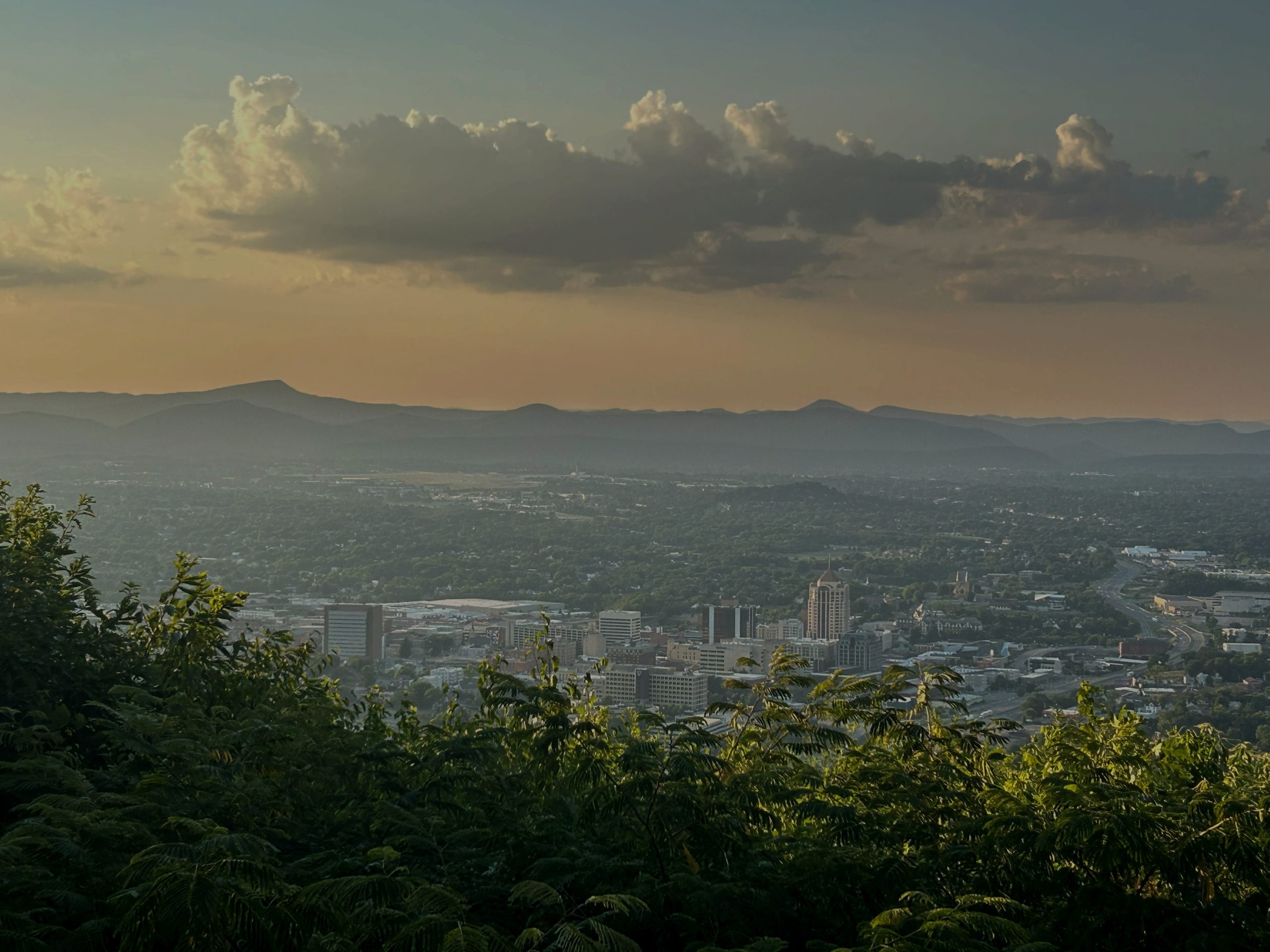


When Grover Cleveland returned to the White House for his second term in 1894, he named Detroit lawyer Henry Thurber as his private secretary, the equivalent to chief of staff today. In an era with no air conditioning, many people in Washington left the city during the summer to seek relatively cooler climates, and Thurber spent some of his time in the Shenandoah Valley. But that’s not what this is about.

In 1900, three years before some Ohio bicycle mechanics took flight at Kitty Hawk, the German aristocrat Count Ferdinand von Zeppelin invented a new type of blimp — the “rigid airship” that some called zeppelins after their inventor. He founded a company called Luftschiffbau Zeppelin that began producing these rigid airships that became the passenger airlines of their day, well before airplanes took on that duty. The German military took an interest in Zeppelin’s invention and ordered 95 rigid airships — we’ll just call them zeppelins from here on out, since that’s how they were known. During World War I, the German used these zeppelins to bomb Antwerp, Belgium and even Britain itself, decades before Hitler’s Lutwaffe and buzz bombs did the same in a second world war.
Seeing what the Germans had done, other militaries started ordering zeppelins (just not from the German company). The U.S. Navy wanted four of the airships for aerial reconnaissance, and the first one was built in 1922-23 at the Lakehurst Naval Air Station in New Jersey. One of the contracts went to an oil cloth company in New Jersey, which supplied the envelope that lined the inner shell of the craft. That company was T.R. Goodlatte and Sons Inc. Years later, T.R. Goodlatte’s great-grandson, Bob Goodlatte, became the congressman from Virginia’s 6th Congressional District. But that’s not what this is about.


It was the practice to commission these zeppelins just like ships. When the first one was ready in October 1923, the Navy sent the wife of President Calvin Coolidge’s secretary of the Navy to do the honors. Her name was Marion Thurber Denby; she was the daughter of Cleveland’s former private secretary and she named the Navy’s first zeppelin the USS Shenandoah, after the place where she had spent her childhood summers. But that’s not what this is about.
One of the Shenandoah’s first official flights was over its namesake, the Shenandoah Valley. The airship returned to New Jersey by flying over Washington and Baltimore, “where crowds gathered to see the new airship in the beams of searchlights,” according to the official U.S. Navy history of the ship. But that’s not what this is about.
The Navy was so excited about the Shenandoah that it talked about using the airship to explore the Arctic. This was three years before Winchester-born Richard Evelyn Byrd Jr. and Floyd Bennett claimed to have been the first to fly over the North Pole — a claim later disputed — but that’s not what this is about.

In early 1924, the Shenandoah was damaged by a winter storm that blew through New Jersey; the Arctic mission was shelved. That summer, the Navy sent the oil ship USS Patoka — which has been built in Newport News — to the Norfolk Naval Shipyard to be refitted as a tender ship to accompany the Shenandoah on oceanic missions. A mooring mast 125 feet tall was installed on the Patoka as well as accommodations for the Shenandoah crew when the airship wasn’t flying. That August the Shenandoah and the Patoka conducted test missions somewhere off the Virginia coast, and later flew on to the West Coast. But that’s not what this is about.

The Shenandoah and the Patoka operated together through much of 1925 as the Navy tested the ways that airships could be used. Sometimes the Shenandoah was joined by its sister airship, the Los Angeles. The Arctic mission for the Shenandoah was revived, with the idea that the Patoka would serve as the Shenandoah’s base for as far north as the ship could sail. First, though, the Shenandoah had a promotional tour.

On the afternoon of Sept. 2, 1925, the Shenandoah departed New Jersey for a flight over the Midwest that would take it over 40 cities and multiple state fairs. Think of this as the 1920s equivalent of a military flyover today. On board — in the “cars” attached to the bottom of the airship — were a crew of 41 and two passengers. Commanding the ship was Zachary Lansdowne, on what was supposed to be his last flight before his transfer to a coveted position at sea. Lansdowne had grown up in Ohio and knew that this time of year the Midwest was prone to violent storms blowing in off the Great Lakes. He pleaded with his superiors to delay the trip until later in the month. They refused. They’d advertised the tour and thought it important for public relations at a time when interest in the military was at a low ebb following World War I. The Shenandoah was something of a celebrity, dubbed “Empress of the Clouds.”

About 2 in the morning of Sept. 3, the Shenandoah passed over Wheeling, West Virginia. “Despite the late hour, the locals were awake and hoping to catch a glimpse of the famed airship in the night sky,” says an account in the Ohio History Connection. “The ship’s radio operator would note in his record that his airship was greeted with whistles and bells, and red flares that were set off atop a high hill.”
Those celebratory flares weren’t all the crew could see, either.
At 2:10 a.m., Lansdowne wrote in the ship’s log: “See lightning flashes directly ahead.”
The Shenandoah was about to fly into a storm.
At 2:30 a.m., the log entry reads: “Strike strong head winds and see storms both northwest and southwest in distance. Believe we can ride them without trouble.”
The skies grew rougher.
At 3:50 a.m., Lansdowne wrote: “Storm worst we have encountered to date.”
The Shenandoah kept heading west, as best it could. About an hour later, at 4:55 a.m., the crew was struggling to keep the airship “on an even keel,” Lansdowne recorded. “Lightning increasing in intensity. Hope to ride out storm soon. Pleasant City seen in distance … wind increasing in volume, get chance to …”
Lansdowne never finished that sentence. The Shenandoah hit a squall line near the town of Ava, Ohio, and a “violent updraft of warm air.” That pushed the Shenandoah up, far too fast. “The ship’s command center, which was in a steel gondola suspended below the hull by cables, was battered, tossing about its crew,” Ohio History Connection says. “At one point, witnesses said the nose of the Shenandoah inverted and pointed skyward as the airship began rising at an estimated 1,000 feet a minute, too quickly for the eight safety valves on the gas cells to release enough helium to help it lose buoyancy and regain control.”
At 6,200 feet in the air — about 3,000 feet higher than the ship’s normal cruising altitude — the winds gave out, and now the Shenandoah started to fall. “When halfway to the ground it was hit by another warm air current and began to rise rapidly once more, but then descended again,” the National Park Service history of the event says. “On the third ascent the ship was hit by a turbulent side wind, twisting the hull and breaking it.”
The Shenandoah was torn into three different pieces.
“The control car with Lansdowne and six other crewmen broke loose from its position below the bow and dropped to earth near the Andrew Gamary tenant farmhouse, killing all occupants,” the National Park Service says. “Seconds later six more crewmen, who were either in the hull at the point of break-up or in the gondolas toward the stern, plunged to their deaths in the fields below.”
Two more pieces remained aloft, but not for long.

“The stern section, over 400 feet long, glided to earth with 18 men aboard and hit the ground near the Gamary farm with the tail in the air, where it dragged along the ground near a treeline until it was momentarily snagged and four men were dumped out, “the National Park Service says. “The air then picked it up and lodged the stern against an opposite hillside.

“The 200-foot bow section, with seven crewmen, quickly rose to 10,000 feet, but was brought under control by venting helium from the intact gas bags and releasing gasoline from the fuel tanks. Fifty-three minutes later it floated down about six miles to the south of the initial break-up. As it approached the ground it brushed the Ernest Nichols farmhouse west of the crossroads of Sharon, tore out a post and a pole and scraped over the garage roof. Nichols grabbed a line thrown from the bow and secured it to a pair of trees. Finally grounded, the crew jumped out, borrowed a shotgun from Nichols and burst the gasbags before the bow was blown any further. The Lieutenant Commander who had guided the bow to earth, Captain [Charles] Rosendahl, used the Nichols’s telephone to call the telegraph office at Caldwell and inform naval officers of the disaster. Twenty-nine members of the crew survived the break-up, although some received serious injuries.”
By the time it was light, looters were already picking through the remains of the Shenandoah.

Two days later, Col. Billy Mitchell, the famed aviator who is credited with creating the U.S. Air Force, issued a statement blasting his military superiors of incompetence and “almost treasonable administration of the national defense” for their handling of the Shenandoah. Coolidge issued orders that Mitchell be court-martialed. Coolidge’s private secretary at the time was C. Bascom Slemp, a former congressman from Virginia’s Lee County, but that’s not what this is about.
In a seven-week trial that drew national attention, Mitchell was found guilty and left the service. He retired to Middleburg in Loudoun County. But that’s not what this is about, either.


The crash of the Shenandoah inspired two popular songs, “The Hand of Fate” by Eugene Spencer and Don Drew and “The Wreck of the Shenandoah” by Vernon Dalhart and Carson Robison. At the time Dalhart was just coming off a hit with his recording of “The Wreck of the Old 97,” about a famous wreck in Danville, so a song about another wreck was a natural follow-up, but that’s not what this is about. In the Ohio county where the crash occurred, the local school district memorialized the event by naming both its high school and elementary school Shenandoah, names that remain today. The nickname for Shenandoah High School’s sport teams are the “Zeps.” But that’s not what this is about.
One of the Shenandoah crew members who fell out of the sky that morning a century ago and survived was a 31-year-old officer from Minnesota named Walter Johnson. Were it not for the injuries he suffered that day, he might have continued on with his naval career. Instead, too disabled to return to active duty, he left the service and went to law school. He wound up in Virginia, in the Northern Neck county of Northumberland, where he eventually ran for commonwealth’s attorney as a rare creature in that era of Virginia — a Republican. Rarer still, Johnson won, not once but twice.
Johnson grated against the Virginia way of doing things. The custom at the time was that, to get paid, commonwealth’s attorneys had to submit a monthly voucher to the state government. Johnson thought that was silly; his pay was the same every month — so he sued the state. His court battle went on for four years, finally reaching the Virginia Supreme Court, which ruled against him. Johnson still thought it was a silly rule.
In 1949, Virginia was still essentially a one-party state and that one party wasn’t the Republican one. The party needed a candidate to go through the motions of running for governor. Democrats had a pivotal primary that year — the liberal outsider Francis Pickens Miller, who had grown up in Rockbridge County, came close to breaking the stranglehold that the party’s conservative leadership had on the party. Eventually, he lost the primary, so that fall campaign was between John Battle and Johnson. Johnson didn’t have much to say about Battle; many of his campaign ads that fall focused on “the completely socialistic ‘welfare state'” promoted by President Truman and congressional Democrats.

Frank Atkinson, in his history about the rise of the Republican Party in Virginia, “The Dynamic Dominion,” writes that “Johnson was extremely conservative even by Virginia standards and his campaign attracted little serious attention …” Johnson won just 27.4% of the vote. He carried just five counties, all in Southwest Virginia (Buchanan, Carroll, Floyd, Grayson and Scott).
It’s a dubious distinction, but Johnson’s campaign marked the end of an era: Republicans would not win the governorship for another 20 years, but never again would their nominee receive such a small share of the vote. Four years after Johnson’s quixotic campaign, Republican Ted Dalton threw a scare into Democrats and almost won, setting the stage for the Republican Party’s long rise in the state.
And that’s what this is about.
This column began as a historical blurb in West of the Capital, our weekly political newsletter, and then grew as readers shared more information. West of the Capital goes out on Friday afternoons. You can sign up for it here: