

A moment of accidental yet sublime comedic timing broke up the room at a broadband gathering on Wednesday.
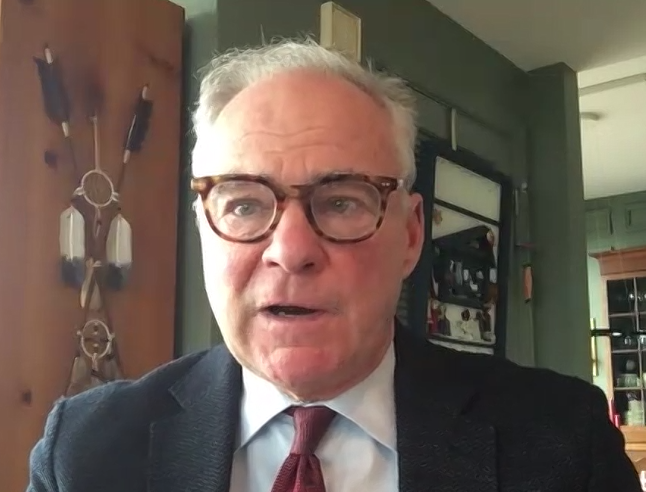
Sen. Mark Warner, talking to a group in Bedford County, was recalling his “third time is the charm” breakthrough business.
“Back in 1982, I came across what at that point was a really cool new idea called cellphones,” the Democratic lawmaker said.
Immediately, an obnoxious ring tone went off full blast, and the group responded with laughter.
“I am the only politician that says, even when I’m talking, ‘Leave your cellphones on,’’’ Warner said. “Because you hear that sound, but I hear ‘cha-ching, cha-ching.’”
Virginia’s senior senator — in town as part of a two-day swing to locations across much of the state — has a wireless bias, but when it comes to broadband deployment, he said that fiber-optic cable is preferable to low-earth orbit satellite or fixed wireless from cellular providers.
That difference has become an issue lately, as the commonwealth prepares to accept funds for the federal Broadband Equity, Access and Deployment program. The state Department of Housing and Community Development, in charge of broadband delivery, published its BEAD award recommendations on Aug 7.
The document proposes $613 million in federal funding, which upon the Department of Commerce’s approval would connect the final 133,500 Virginia residences, businesses and community buildings that high-speed internet has not yet reached, Gov. Glenn Youngkin’s office has said.
The document got an immediate response from Elon Musk’s SpaceX, which accused the department of treating it unfairly. SpaceX, which runs the Starlink low-earth orbit satellite business, demanded that the state redo the recommendations, or that Commerce should reject them.
Asked if he would share his thoughts about the letter, Warner responded, “Do I look completely crazy?” to wade into that issue, to more laughter.
He said that he supported Starlink’s pilot program, which in 2021 brought free internet to 45 Wise County families. In some places, such issues as topography make low-earth orbit satellite the better option for internet service.
“I think you’ve got to deliver the service that’s best suited,” he said. “But again, I’m a big wireless guy, proud of what I did in that field for 15, 20 years. But even as a wireless guy, it’s never going to beat fiber in terms of reliability and the possibilities of speed.”
Many of the couple dozen people in a conference room at the Bedford Area Welcome Center were likely to agree. They were from internet service providers ZiTtel, Shentel, RiverStreet Networks and Verizon, all of whom have been building fiber-optic networks in Bedford County, and are largely finished with projects using money from the Virginia Telecommunication Initiative.
That grant-making program, called VATI, has been flush with hundreds of millions of dollars, much of it funded via pandemic-era federal laws, along with money from the state and local governments and participating businesses.
Bedford County Administrator Robert Hiss, in opening remarks, said that his area learned two lessons in that process: “Fiber is king” and “Don’t put all your eggs in one basket” regarding ISPs, in case one or another can’t deliver.
Most of the VATI-funded work in Bedford County will be done this year, and when it’s over, the providers will have covered between 15,000 and 20,000 addresses, Hiss said. Those last 5,000 will come from locations not originally on the plans, but within proximity of the lines either strung on utility poles or buried underground.
“And that’s an awesome number,” Hiss said. “We would have never thought that a long time ago.”
Tamarah Holmes, director of the Department of Housing and Community Development’s Office of Broadband, said Bedford County’s deployment effort was the “little internet that could.”
As VATI work continues its wind-down, BEAD is ascendant, with 2,855 locations in line for service. ZiTel, a Moneta-based business, would get the lion’s share of that work, with 2,733 connections, according to the broadband office’s recommendations. DHCD recommends that SpaceX get 70 while another low-earth orbit satellite business, Amazon’s Project Kuiper, is in line for 11. RiverStreet Networks would serve one location.
As Warner finished his comments about the SpaceX letter to DHCD, ZiTel’s COO, Rodney Gray, asked to speak. He owned up to his fiber bias and said that SpaceX is “a great technology” with “an extremely advanced satellite” in Starlink, but said the company hasn’t proven to him that it can keep up with the unlimited gigabyte speed that fiber will deliver as the years go on.
Fox Business reported in June that SpaceX “has received at least $1 billion in government contracts, loans, subsidies and tax credits each year since 2016, and between $2 billion and $4 billion a year from 2021 to 2024.”
Gray said that to keep up with predicted upload, download and latency speeds, SpaceX would have to launch billions of dollars in new satellites and technology.
“Do we want to invest our tax dollars and be stewards of good governance by investing tax dollars in that technology when 10 years from now, it’s not going to work anymore?” Gray said. “But the fiber we’re putting in the ground is the same fiber they were using back in the `60s and `70s? All we’re doing is, and every two years, we change electronics out on the [ground] and get the necessary speeds.”
The housing department recommendations noted that satellite services can be negatively impacted by such issues as project area density and tree canopy. The BEAD proposal showed that it considered both when deciding whether to recommend awards for SpaceX and Kuiper. Rugged terrain and slope were factors, too, according to the proposal.
The burgeoning AI economy also will require faster speeds, particularly for the likes of telework and telehealth, where upload is exceptionally important, said onetime University of Virginia professor Christoper Ali, now a Penn State telecommunications professor and author, in a recent interview with Cardinal News.
“Theoretical speed caps have not been found on fiber yet,” Gray said. “And then continually, I mean, we’ll be providing 10, 20, 30, 40, 50 gig speeds to people’s homes in 10 or 15 years. So that’s why Virginia should stick with the play that they have in place, not just because I’m a recipient, but everything I said is factually true.”
Under the Biden administration, Virginia received a $1.48 billion award for BEAD. The housing department’s award document proposes $613 million in federal funding for the broadband projects. The state would like to use the remaining money to cover all its cellular dead spots. Chandler Vaughan, the broadband office’s associate director, said that 40,000 addresses have no cell coverage.
The Trump administration’s Commerce Department, under Howard Lutnick, has put a hold on any plans for using that money, and there is fear among broadband authorities that the administration will keep the money. At least two people in the audience on Wednesday expressed concern to Warner.
Steve Sandy, Franklin County’s deputy county administrator and broadband manager, said those funds are “critically important” in rural Virginia.
“Many times we’re going to find people who have broadband service in their home, then they go out on their driveway and can’t make a phone call,” said Sandy, whom Youngkin recently appointed to the state’s Broadband Advisory Council.
Warner said he intended to push Lutnick on the issue.
For now, though, Bedford has much to celebrate, Warner said. When the work is complete, “this will be one of the most successful [deliveries] of broadband anywhere in the commonwealth.”