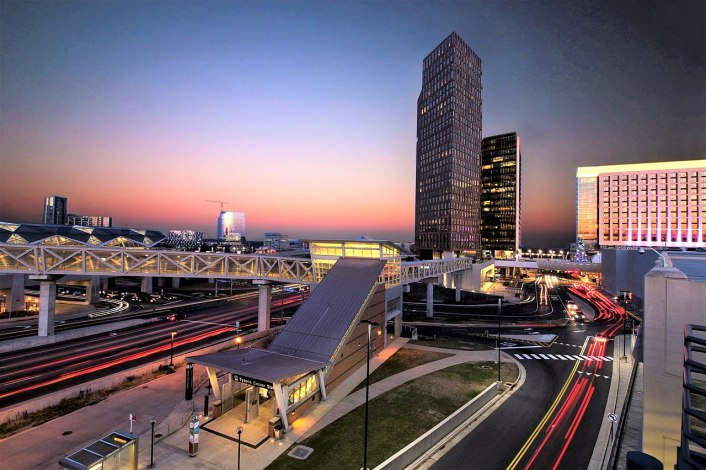


Northern Virginia is home to 35% of the world’s data centers. These massive warehouse-like buildings house computers and networking equipment that store and send data — and feed our ever-growing demand for apps, artificial intelligence and cloud storage.
Now they’re spreading to other parts of the state, bringing with them concerns about viewsheds, traffic, noise and energy capacity — but also the potential for transformational tax revenue and job creation.
Cardinal News reporters Grace Mamon and Tad Dickens talked with local officials, residents, energy providers, environmental experts and others about what communities in our region can expect as these developments spread southward.
Read all of our coverage here.
When it comes to data storage, consider the zettabyte.
This unit of digital measurement stands for 1 sextillion bytes of data (maybe calling it a “sextibyte” felt too randy to the geeks in charge of terminology). That’s 10 to the 21st power. It’s 1, followed by 21 zeros.
A lot of bytes.
It’s the way computer scientists measure the aggregate of data on the planet. We logged our first zettabyte of digital info in 2016, according to a blog item on the Cisco Systems website. Capacity has exploded since then. Current projections estimate 200 zettabytes of digital information stored globally, with about half of that in data centers, said Virginia Tech professor and researcher Dimitrios Nikolopoulos.

Both numbers — global data and percentage contained in data centers — are projected to keep growing rapidly, Nikolopoulos said.
All that brings us to Virginia, particularly Northern Virginia, which has seen an explosion in data center development. So many of the computer-server warehouses stand on campuses in Northern Virginia’s “Data Center Alley” that some residents, activists and elected officials are pushing back. Now developers are making inroads in Southwest and Southside Virginia.
Pittsylvania County officials approved one last year, but a second proposal failed after residents objected. Google just struck a deal to put a campus in Botetourt County, and Appomattox County will house one as well, with tenants as-yet unknown. They join an existing Microsoft development in Mecklenburg County.
In Northern Virginia, their energy use and impacts have become political issues. The Virginia General Assembly has, over the past couple of legislative sessions, attempted small steps at regulation, though most of them didn’t survive the governor’s pen. There’s more to come on that front, lawmakers say.
We know a lot about data centers. What they are: warehouse-style buildings ranging up to supercenter size. What they do: house computers, servers and networking equipment to store and transmit data. Where they are: in the commonwealth, mostly, where NoVa hosts an estimated 35% of all the planet’s data centers. And what they require: more power and water than most commercial structures to support nonstop operations.
That leaves this question: How much is stored in, for example, a campus? Let’s start with the basics.
Going from the ground up, the digital storage range begins with a bit — a single binary unit, that is, a 0 or a 1. A byte is 8 bits, enough to store one character.
We measure in thousands beyond that.
A kilobyte is about 1,000 bytes (1,024, to be exact). A megabyte is about 1,000 kilobytes. A gigabyte holds 1,000 megabytes. A terabyte is 1,000 gigabytes, and a petabyte is about 1,000 of those. Next up is an exabyte (1,000 petabytes), and the largest measure in use to date — the zettabyte — comprises a thousand exabytes.
Petabytes are the best way to measure what you’ll find in Virginia’s data centers, said Nikolopoulos, who researches system software, including operating systems and programming languages for data centers and supercomputers.
“One petabyte is equal to about 200,000 DVDs,” Nikolopoulos said, and one building in a large data system campus could house 100 petabytes of information. A campus with multiple buildings will house several hundred petabytes.
“It’s a number you could never count to, personally, if you had to sit and just count,” he said. “So if you think that a terabyte is your computer, more or less, let’s say you have a very powerful laptop. So it’s like half a million of these laptops.”
That’s just one campus, not unlike the Microsoft data center in Mecklenburg County.
And what kind of information fills those servers? Just about anything you can think of.

For many users, or one
Business data — customer records, financial records, communication records — fills data centers, Nikolopoulos said. They also store media, including video, audio, photos and other social media content, much of it user-generated.
Big data repositories exist for specific applications, such as information that a business would collect and analyze to determine its customer base or its most profitable products — data analytics to improve services and profits.
Many websites sitting among those petabytes hold potentially personal and sensitive data, including health care information, medical images, genomic data, biological data and clinical data, Nikolopoulos said. Governments store public sector data.
Another data class contains computer code used to run services and whatever else the centers need to make their systems work.
We generate plenty of it with our own devices.
Margaret Ashburn, associate director of media relations at Virginia Tech, has 128 gigabytes worth of storage on her phone and 200 GB more on the cloud.
The cloud, of course, is not in the sky. It’s in a data center. And in that cloud are likenesses, including her boy, who is almost 4, she said.
“It’s pretty much all kids or random work pictures or screenshots of things,” she said. “Dogs, dogs, screenshots.”
Ashburn has work and personal email set up on her phone, along with some news apps and a couple of social media accounts — she prefers Instagram. Again, lots of data that is ultimately stored in centers.
“I mean, we carry our lives on these, right?” she said. “And we rely on them to check our banking information, and we rely on them to listen to music, our podcasts, our credit card balance.”
All of that is hosted somewhere on a server, perhaps in Northern Virginia, perhaps at Microsoft’s Mecklenburg County campus. But like many data center operators in the commonwealth, the company is reticent to provide specific details about what it hosts and where.
“Microsoft datacenters power critical services worldwide, from mobile apps and virtual classrooms to AI-driven medical breakthroughs and cybersecurity programs,” a statement from the company read. “They operate around the clock, supporting essential needs like online banking, remote work, and everyday necessities such as online shopping and deliveries. Our global network spans 34 countries, connected by over 165,000 miles of fiber optic cables, forming the backbone of Microsoft’s Azure cloud platform.”
Nikolopoulos said that such companies err on the side of security when it comes to providing information. Many bad actors, both known and furtive, would take advantage of any opportunity to hack a cloud, he said.
Ashburn worries about data security, with news of cyberattacks, ransomware and phishing expeditions making the news regularly.
“We hear a lot about cloud storage being a prime target for data breaches,” she said.
Data ownership is another concern. Policies vary by company, and it isn’t always clear who owns it once it’s uploaded, she said.
“And of course, there’s always the worry about data loss,” Ashburn said. “Most providers seem to have robust backup systems, but I still have this lingering fear that one day all my photos and videos could just disappear. In an age where we don’t often keep physical photo albums or home videos, that would mean losing a lot of irreplaceable memories.”
Data centers, archaeology and philosophy
Ancient cave paintings in Europe. Hieroglyphs from ancient Egypt. Rock carvings in the American Southwest. The Dead Sea Scrolls.
Human information has survived millennia, according to archaeological finds.
What of those exabytes stored in data centers? Archaeologists deep into a future that could see a civilizational collapse or two may have no idea what they’ve found, and little to go on. Unless computer science navigates a way to preserve the information held in those buildings full of servers, it is likely to have deteriorated beyond clear understanding.
Servers have a life of between five and seven years, after which they must be replaced, Nikolopoulos said.
“We don’t have computers that can survive that long,” Nikolopoulos said. “I mean, we have made strides. Humanity has sent computers to space, and these computers are in a shuttle that goes and goes. It’s a very old computer. It’s a very primitive computer, but it still runs.”
Supercomputers and data centers, far more complex beasts, don’t have that lifespan, and scientists haven’t even figured out what to do with them after their “useful life,” Nikolopoulos added.
Jake Fox, an anthropology professor at Radford University, hands his entry-level students a reading from the David Macaulay book “Motel of the Mysteries.” In that book, an archeologist mistakes a seedy, 20th-century motel for a sacred burial site in North America. The idea is to show students the danger of making assumptions based on first impressions.

An explorer approaching groups of large, uniform buildings filled with stacks of metal, plastic and cables would likely be perplexed at first, Fox said.
“I think we would pretty quickly discover almost no detritus associated with human activity, you know what I mean?” he said. “Like these things would be virtually uninhabited. I mean, obviously, there’s some level of staffing there, but the place is probably kept immaculately clean.”
Even in a high-tech future, anthropologists would likely puzzle over their find, he said. A completed data center only has a few in-house employees, and those are typically security guards. That’s similar to prehistoric sacred spaces, which showed little evidence of contemporary human activity, Fox said. Data centers lack the artistic details of ancient shrines, though.
“We pieced these things together over time,” he said. “So cuneiform tablets didn’t make a lot of sense for a long time, but we pieced together bits and pieces from different things.
“And so if you imagine archaeologists, not just working at the data center, but hundreds of archaeologists working around the world … eventually the picture comes together, but it can take a while. These things could be quite mysterious or even grossly misinterpreted for quite a while.”
Explorers would clock a huge material investment, however. Maybe magnetic residue would reveal the binary bits, decayed over time but maybe decipherable, he said. Reading it would be a challenge, as there would unlikely be any printed document of code lying around.
“Would they be able to, assuming some data was preserved, figure out the way to actually extract the patterns from the ones and zeros that would make it readable?” he pondered. “And could you build that information by discovering old punch card sets and things like that, where the data really is preserved in punch cards, and could you track, with enough work, the evolution of computer development such that maybe you could actually begin to pull information off those servers, assuming some of the magnetic information remained?”
He added: “Over time, presumably we could figure it out, based on written records we recover from other locations, and things like that would give reference to help us understand, and as we track the electrical connections between it and power plants and … fiber-optics … that would actually be trackable and mappable.”
However they may look in the future, data centers are chock full of usable information now — and plenty of junk, as well, Nikolopoulos said. In the old days, people would toss out reams of paper that held useless information. But with construction continuing to grow capacity, we seem to be rejecting that gatekeeper aspect of information-gathering, he said.
“So this is a nonsustainable thing,” Nikopolous said. “And I can tell you, as a researcher, that I have been talking about or listening about sustainability of data centers and large-scale computing facilities for more than 20 years. … None of this research managed to slow down the carbon emissions or the space footprint or any of these metrics or measurements that indicate the sustainability of a data center.
“If anything, they have grown in size, they have grown in numbers, they have grown in locations, they have grown in everything, how many machines they host, how many people they serve.”
Nikolopoulos said he thinks that humanity was good at filtering information before the computing evolution. Folks kept the good ideas and tossed the rest, saved the important news and tossed the rest.
“You know, since computers came along, we just get this bulk of information which is not in any way sorted or sifted or qualified in any way,” he said. “And then we just have it around, and you know, some of it is useful, but a lot of it is useless.”
It’s a modern version of hoarding trash, in a sense. And that might mean something in the future, if it’s decipherable.
“Honestly, most of what we know about humans in the past comes from garbage,” Fox said. “And you can certainly learn a lot about people from their garbage.”
