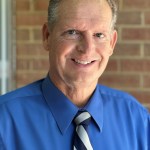
For over 30 years, I’ve had one goal: to work in public television. It’s where the best equipment meets the best storytelling — and where the community always comes first. I’ve always loved history. There’s nothing more rewarding than helping viewers experience what it felt like to live through the stories that shaped us.
Before public media, I worked in commercial TV in Columbia, South Carolina. But chasing daily stories of fires, crime and division wasn’t for me. That changed in 1994 when I joined South Carolina ETV. In public television, I saw the power of being the only station that showed up to highlight the good things happening in rural towns. Public TV belonged to everyone.
Fourteen years later, I came to Southwest Virginia to lead Blue Ridge PBS. Just weeks into the job, I was sent to D.C. to attend a meeting called by then-Congressman Eric Cantor. When I introduced myself as Roanoke’s PBS representative, he looked me over and said, “Oh, you’re PBS. I don’t need to talk to you. Go sit over there.” He didn’t shake my hand or ask a question. He dismissed me entirely.
I grew up in a proud Reagan Republican household. That moment stung — but it clarified something: many people don’t understand what local public television actually does.
That day, I made a quiet promise. My team wouldn’t just represent PBS — we’d represent Southwest Virginia. We’d focus on education, culture and community.
Public broadcasting has two jobs: the national work and the local work. The local part — what we do daily in Roanoke and Bristol — is personal and often invisible. And we’ve faced enormous challenges. Under Gov. McDonnell, we lost all state funding. Ironically, I was interviewing his family for a documentary on the Executive Mansion while the cuts were happening. Our staff shrank to 13.
But we kept going. When I became president and CEO in 2019, the BRPTV Governing Board of Directors and I made rebuilding relationships with state legislators a priority. That effort paid off. Some legislators became champions — and even friends.
Then COVID hit. Schools went virtual. Malls shut down. But with restored state funding, our team didn’t stop. We partnered with the Virginia Department of Education to produce educational content for students across the state. Education isn’t just part of what we do — it’s who we are.
That November, I realized something: Christmas was coming, but hope wasn’t. No mall Santas. No magic for kids. So, I pulled the staff into a Zoom call and said, “We’re going to bring Santa to them.”
We transformed our parking lot into Santa’s Winter Wonderland — a free, contactless drive-through. Families stayed in their cars, tuned to a special FM frequency and Santa greeted their kids by name. For many, it was the only way they saw Santa that year. With community partners and students from Virginia Western Community College, we’ve brought that joy back every year since. Seeing a child light up when they see Daniel Tiger, Clifford or Pippy Pinewood is a reminder of what public media really is: connection, kindness, creativity.
On June 10, 2023, we pushed boundaries again. We launched PBS Appalachia — the first all-digital public media station in the nation, created to serve far Southwest Virginia with meaningful, homegrown content. In March 2024, we opened a new studio inside Hard Rock Hotel & Casino in Bristol, Virginia.
And in June, our work was recognized. PBS Appalachia won the Capital Region Emmy for Overall Station Excellence — beating every major commercial station in Washington, D.C., Maryland, and Virginia. In just two years, PBSA has earned 18 Emmys — all for content created by and for Southwest Virginia.
So yes, it was frustrating when Congress narrowly passed President Trump’s plan to rescind our federal funding. But what hurt more was the email I got afterward. It simply said: “Good.”
I sat with that word for a long time.
Did it mean, “Good — we don’t need your work in our community”?
“Good — we don’t want our children learning kindness and cooperation”?
“Good — someone told me defunding PBS is good, so I believe it”?
If “Good” means, “The government shouldn’t fund the PBS News Hour,” that person misunderstands. The News Hour will be fine. PBS made that clear.
What’s not fine is what this recission actually does — it guts funding for small stations like ours. Stations that serve, preserve and uplift local communities in ways no other media outlet does.
When people ask if our content leans left or right, I invite them to watch any of our local stories. What you’ll see are honest reflections of our culture and values — stories that make us proud to call this region home.
In some ways, the national PBS system has forgotten its roots. Small rural stations like ours aren’t side characters — we’re the reason public broadcasting was created. While PBS has said rural stations will be hurt by the funding cut, no one at the network asked me directly how it will affect us. That silence speaks volumes.
So, if you don’t like what you see on PBS News Hour, here’s my advice: Turn it off. Then tune in at 7 p.m. and watch what we make right here in Southwest Virginia. You’ll see stories that matter to you.
Despite the loss of federal support, Blue Ridge PBS and PBS Appalachia are not going anywhere. We remain committed to serving this region. That commitment is backed by partners who believe in us — The Commonwealth of Virginia, The Tobacco Commission, The Anne and Gene Worrell Foundation, The Wellspring Foundation and Hard Rock Bristol, among others.
I believe in Southwest Virginia. I believe you will support us through this. You know what we stand for. You learned cooperation from Sesame Street, kindness from Mister Rogers and still remember Rita Moreno shouting, “Hey, you guys!” Your parents made sure you had access to those lessons.
Now it’s our turn. Despite this narrow-minded recission bill, we need your help to continue that legacy.
Support us today at www.blueridgepbs.org and www.pbsavirginia.org.
We may look a little different moving forward — but we’re still here. And with your help, we’re not going anywhere.
William Anderson is president and CEO of Blue Ridge Public Television, Inc., overseeing Blue Ridge PBS, based in Roanoke, and PBS Appalachia, based in Bristol. He is a member of the National Academy of Television Arts and Sciences Silver Circle Society and produced shows and documentaries that have won 10 regional Emmy Awards.