
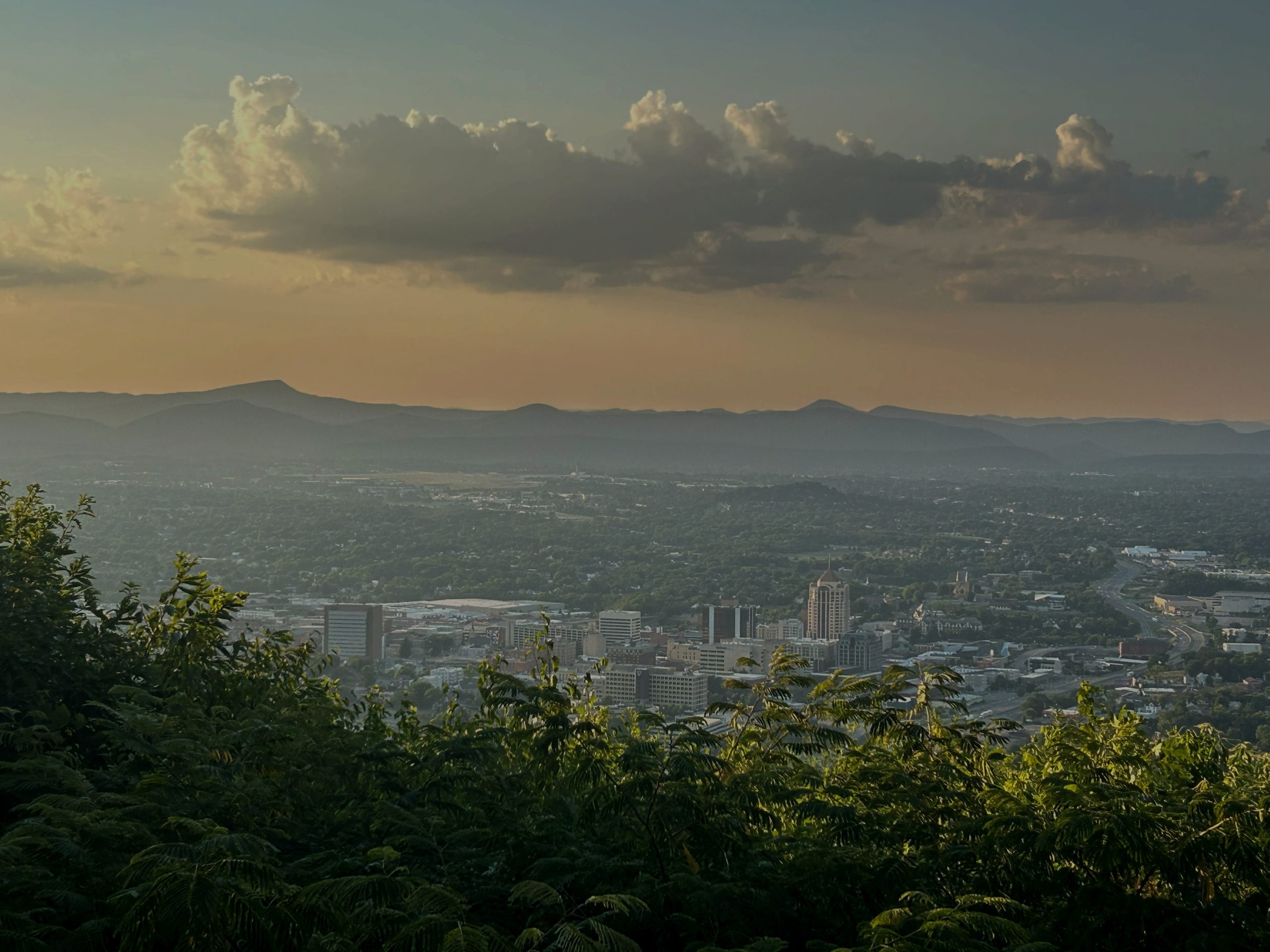


The biggest news last week was that Google has bought 312 acres in Botetourt County for a potential data center complex. While “potential” is an important qualifier, this does not appear to be a speculative project. The timeline for “Project Raspberry,” as it’s called in some government circles, is for the project to break ground in early January, shortly before Gov. Glenn Youngkin leaves office.
It didn’t take long after the Google project was announced that it drew raspberries of a different sort online.
It’s hard to know how widespread those complaints are — the “no” voices to anything always sound louder online. That’s the nature of social media, one reason why it’s a poor venue for actual civic debate, but these are the times we live in.
It’s not my desire to be a cheerleader, but I do feel tempted to blow a referee’s whistle on some of the comments I’ve read — because some simply aren’t based on facts. If the facts lead you to oppose the project, have at it, but let’s do try to stick to the facts. Here’s some context important for all to understand. Some of this is specific to the Botetourt project, but some of it applies more broadly to other types of economic development projects anywhere.
Complaint: This project is out of keeping with the county’s rural character, and therefore people should have voted on this.

Context: They did vote on this — back in 1994. That’s when Botetourt voters approved a $19.7 million bond referendum that included money to buy land for industrial parks. The county bought the 923 acres that included the 750 acres that became the Botetourt Center at Greenfield the following year. That’s why the Google-to-Greenfield project is fundamentally different from some data centers projects elsewhere — this is going into an industrial park, not taking up farmland or something else. This land was always going to be developed for some kind of industry. Voters had their say on that 31 years ago. If they didn’t want more industrial parks in Botetourt, they shouldn’t have passed that referendum.
Yes, that vote predates when many Botetourt residents today were living in the county — or, in some cases, even born. That’s the nature of government, though. It makes decisions that have long-term consequences. In this case it was Botetourt voters in 1994 who made the decision to develop some of the county for industry; it was their elected representatives who the following year made the decision to acquire this particular piece of property.
Let’s also remember that the choice then was not between Greenfield staying a farm and Greenfield becoming an industrial park. The Greenfield land was going to be sold, regardless. The practical choice was between Greenfield becoming a residential development full of houses whose residents would require services and an industrial park that would generate tax revenue to pay for services elsewhere in the county. Botetourt voters in 1994 said they wanted more industrial parks, so that’s what their supervisors did.
Complaint: Data centers use a lot of power, and this will strain the grid.
Context: Yes, they do use a lot of power. Because of the growth of data centers, primarily in Northern Virginia, we’re seeing Virginia’s electricity usage spike. The General Assembly’s research arm, the Joint Legislative Audit and Review Commission, has warned that if data center growth stays at the same pace, our power demands will triple over the next 15 years. However, that’s because of the concentration of data centers in the state. How many data centers we want, or can handle, is a matter of state policy — and the legislature has so far resisted most efforts to slow their growth. Put another way, state policy has been to encourage data centers. The question for Botetourt is this one particular data center — so how does the power demand of one data center compare to the power demands of other industries? Let’s take a look.
The first challenge is that we don’t know yet how big this data center will be; those details are still being developed. There were references at the announcement to this being a “hyperscale” data center, so let’s go with the figures for a typical hyperscale data center — “hyperscale” being fancy industry lingo for “large.” (It’s like going to Starbucks; you can’t order small, medium or large; you have to order “tall,” “grande” or “venti.” I don’t want “grande,” I just want a medium. But don’t get me started.)
Data Center Knowledge reports that a hyperscale data center can consume 20 megawatts to more than 100 megawatts of power. (I’m guessing they mean megawatt hours, which is the standard measure, but often the ‘hours’ gets lost.) The commercial property giant JLL, which specializes in land for data centers, says that hyperscalers want 500 to 800 acres. The Google purchase in Botetourt is 312 acres and not all of the site can be developed — so maybe this will be “hyperscale,” but if so, it sounds as if it will be on the smaller end of that scale, so let’s go with Data Center Knowledge’s estimate of 20 megawatts.
How does that compare to the demands of some other industry that might have bought that site? Because, as noted above, this site was always going to be developed by something.
I’d love to know the power demands for specific companies in the Roanoke Valley, starting with the Eldor auto parts plant that will be next door to Google in Greenfield. All that’s proprietary, though, so we have to make some guesses.
Steel-making is very power-intensive, and the Roanoke Valley has a steel plant in Steel Dynamics, which years ago used to be known as Roanoke Electric Steel. Steel Dynamics has five plants across the country and says their total output is 4.4 million tons of steel per year. If those plants are all roughly the same size, that would put the output of the Roanoke Valley plant at somewhere south of 1 million tons per year.
The website Climate Now puts the power demands for a steel plant making 1 million tons per year at 500 megawatts — that’s five times bigger than even the biggest hyperscale data centers and 25 times bigger than the smallest.
A steel plant is obviously on the high side of things demandwise, but it does offer some context. Many industrial users consume a lot of power. In that context, a data center is simply a data factory — one that has gotten a deserved reputation as a power-guzzler, although other industries may consume as much or more electricity. The challenge with data centers is a collective one, not a singular one; we’d have many of the same challenges if we had hundreds of steel factories popping up, too. An individual one, maybe not so much, even though each single data center does place some additional demand to the grid just as any other business does. Again, we have to go back to the original decision to make Greenfield an industrial park — the decision to recruit power-using tenants was made back then. If this weren’t a data center, it would be something else.
Complaint: Data centers use a lot of water, and this will strain the water supply.

Context: Data centers do use a lot of water but, as with electricity, some context is in order. Interestingly, the Google complex will be across the road from an obvious big water-consumer — the Constellation Brands brewery. That facility began life as Ballast Point. When Ballast Point first arrived, it was announced that the brewer would produce 2.5 million barrels of beer a year. A barrel is about 31 gallons, so that works out to 77.5 million gallons of beer a year. Beer is mostly water, usually somewhere between 90% and 96%. Let’s err on the low side and call it 90% — that’s 69.75 million gallons of water a year going through the brewery. To make our math simpler, let’s call it 70 million gallons a year.
In 2022, Google said its data centers used an average of 450,000 gallons of water a day. Math: That’s 164,250,000 gallons of water per year — so that’s a little more than two breweries’ worth.
The Roanoke Valley was once very excited about the prospect of getting a Deschutes brewery, which never materialized. If that had happened, we’d have a second. We don’t, so we’re back to the math above: The water demands at one data center appear to be about the same as at two breweries.
The real question, though, is what that does to the Roanoke Valley’s water supply. Here’s where it really matters that Botetourt County does not have its own water system; it’s part of the regionwide Western Virginia Water Authority. I saw someone ask if Google meant we’d have to put in pipes to the Carvins Cove reservoir. No, because those pipes are already in the ground.
In fiscal year 2024, the authority averaged 19.75 million gallons per day, up from the 19.19 million gallons it averaged in 2022. That’s an increase of 560,000 gallons per day over two years. If we use that Google figure above, then a data center might need 450,000 gallons per year. There are two ways to look at this: A single data center would equal almost a two-year increase in demand, or would be less than what the normal increase was anyway. Take your pick.
Here’s the context that really matters, though: The authority says in its annual report that its capacity is 58 million gallons per day, so the system right now is running at just 34% capacity. It has a lot of room for more water users — data centers, breweries, what have you. This was one of the selling points to both Deschutes and Ballast Point a decade ago. By building the Spring Hollow reservoir in the 1990s, forming the regional water authority in 2004 and adding a water treatment plant to draw from Smith Mountain Lake in 2017, the Roanoke Valley has made itself a water-rich region. There may well be good reasons to oppose Google, but its water demand doesn’t seem to be one of them.
Complaint: We don’t know where Google’s power will come from.

Context: This is true. All we know is that the Google location will be on the Appalachian Power grid. This is part of the disconnect we’re facing with data centers: Localities are in charge of finding tax revenues but they’re not in charge of finding energy sources, so we have localities approving data centers that require extra power without regard for where that power will come from. As noted above, a single data center’s power demands may be no different, or even less, than a power-intensive factory but power is still power — and it’s got to come from somewhere. That doesn’t necessarily mean Google’s power supply would be in Botetourt; power moves all over the grid. Amazon has 19 solar farms across Virginia to help power its operations in Northern Virginia, for instance. Washington & Lee University in Lexington gets its power from a solar project in North Carolina.
Primarily because of data centers, Virginia now imports more power than any other state. There are probably a lot of electrons moving through the Appalachian Power substation in Cloverdale bound for data centers in Northern Virginia right now. In any case, this is a key question as Google’s plans develop — and that’s why those outside Botetourt should pay attention. Some solar farms in Southside might get switched on to power Google in Botetourt.
Update: On June 30, Google announced a deal with the proposed nuclear fusion plant in Chesterfield County to buy half the facility’s power for its data centers. While we can’t draw a straight line between the Botetourt project and the Chesterfield deal (Google has many data centers), this is an indiction of how things work, and it’s entirely possible that if that fusion plant comes online, that’s where the power would come from.
Complaint: Nobody voted for this.
Context: Umm, actually you did, you just didn’t realize it. Last fall, 71.87% of the voters in Botetourt County cast ballots for Donald Trump. One of his policy positions has been to increase the use of artificial intelligence, which requires more data centers — and also uses a lot more power. A simple ChatGPT query is said to use 10 times more electricity than a regular Google search. We don’t know to what extent this data center will be tied to AI, and we certainly can’t draw a straight line from Greenfield to the White House on this one. However, as a matter of policy, Trump wants more AI, which means more data centers. Blue Ridge District Supervisor Walt Michael even cited Trump in his recent opinion piece in favor of the data center. Should we slow down AI? Maybe regulate it? My Republican-voting neighbors in Botetourt should be careful about answering “yes” to that. Democrats are the ones pushing regulation; Trump wants to ban state regulation of AI. You can’t really have a “Trump/Vance” sticker on your car and complain about the Google data center — not and be consistent anyway.
If you’re not a Trump fan, you’re not off the hook, either: Kamala Harris wanted more AI, too.
Complaint: This won’t create more affordable housing in Botetourt.
Context: That’s right. Government also doesn’t create housing, at least not in a free-market system. Housing prices are simply a function of supply and demand. Right now, demand is high and supply is low. To fix that, we need to build more houses. While there are lots of ways and places to do this, the marketplace is always going to push to get more land rezoned for development. If the complaint here is that there’s too much development in Botetourt (and that is one of the complaints), then stopping or slowing down that development is not going to reduce housing prices — it will only increase prices for the existing housing. We’d have more housing in Botetourt if we’d let Greenfield get turned into a housing development instead of an industrial park — but then we’d be wondering where to find the tax dollars to help educate all the kids living in that housing development. There’s no easy solution to any of this — unless, perhaps, we want to adopt socialism. Then we could have the government build cheap housing blocks and tax the rich to pay for them, but I don’t hear much enthusiasm for that. Not even many of the countries that have tried that in the past seem much in favor of it now.
Complaint: This won’t provide many jobs.
Context: That’s probably so. Data centers are not big employers. IBIS World says the average employment at a hyperscale data center is 36.2. They do, though, pay very well. A study by the General Assembly’s research arm found that “on average, data center employees and contractors earn about $100,000 per year, varying based on job role and area of the state.” If we were to measure economic development by the amount of income injected into a community, then 36 employees at an average of $100,000 per year is the same as 72 employees at $50,000. The real reason that data centers are valued by local governments is the tax revenue. That brings us to …
Complaint: We don’t need the extra tax revenue because we don’t want more services.
Context: The $14 million purchase price will go toward paying for three new fire trucks, three new ambulances, two new deputies’ vehicles, body cameras for deputies, library renovations in Buchanan, lights on the county’s soccer fields and a start on building a fire station in the Daleville area, among other things. Are these things “big government”? Is there anyone who wants to run for office on a platform of giving those things back? Or doing without them? Or, if not, finding a way to pay for them out of existing revenue while we keep part of the industrial park rural? Botetourt’s governing body is all-Republican; I have a hard time seeing the board as a collection of big government types.
It looks to me as if the county just sold some land in its industrial park for an industrial use to help broaden the county’s tax base so it’s not so dependent on taxing people’s homes, which is what the voters intended three decades ago. That sounds to me like a promise kept. However, if anyone wishes to disagree, the figures above are the relevant ones on power and water use.
Want more politics? Sign up for West of the Capital, our political newsletter that goes out Friday afternoons (although this week, because of the holiday, we’ll send it out on Thursday). You can sign up here: