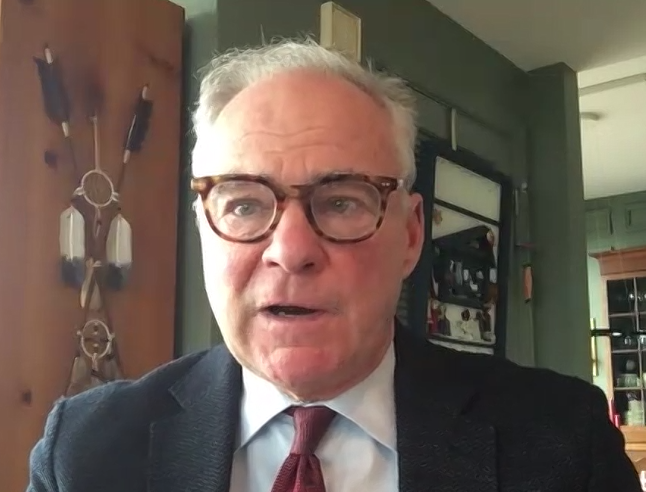


Virginia is now officially embarked on a historic governor’s race.
With Abigail Spanberger and Winsome Earle-Sears now confirmed as the Democratic and Republican nominees, we can now say that Virginia will elect its first female governor in November. Virginia is well behind the nation on that score: Thirty-two states have had a woman as chief executive. Arizona has had five female governors.
If Earle-Sears wins, she would be the first Black woman elected governor in any state.
If she wins, this would also mark the first time that Virginia has elected back-to-back Republican governors since Jim Gilmore was elected to succeed George Allen in 1997.
Here are some other things to know about this year’s governor’s race — some of them historic, some maybe not.
1. Spanberger starts out ahead in the polls
The early polls consistently show Spanberger with a lead of varying sizes. The key word there is “early” — if you’re reading this column, you’re a lot more engaged in the race than most people are at this time of year. Go ask your neighbors if they know who’s running and let me know what they say.
A trio of polls in January — from Christopher Newport University, Virginia Commonwealth University and Emerson College — showed Spanberger’s lead anywhere from 1 percentage point (Emerson) to 5 percentage points (CNU) to 10 percentage points (VCU). A Roanoke College poll in February put Spanberger up by 15 percentage points. I’m generally skeptical of any poll from a pollster with a partisan affiliation, but one Republican-aligned pollster also put Spanberger up by 6 percentage points.
Democrats are supremely confident that they will win this year, but I must point out that in 2021, polls as late as mid-September showed Democrat Terry McAuliffe with a lead of 7 percentage points. Those polls probably were right at the time, but the whole point of campaigns is persuasion, and by the end of the campaign, voters were persuaded otherwise. We still have seven months to go. That’s a lot of time for things to change, if voters are so inclined.
2. Spanberger is ahead in money, too.
Spanberger began the year having raised almost $9.6 million, Earle-Sears $2.5 million. The official campaign finance reports for the first quarter won’t come out until next week but, as noted above, Spanberger says she’s raised another $6.7 million, Earle-Sears says she’s picked up $3.1 million.
Earle-Sears says that’s more than any other Republican candidate for governor has ever raised in the first quarter in Virginia; Spanberger says her total is a record, period.
By my math, that puts Spanberger at $16.3 million total, Earle-Sears at $5.6 million.
There are plenty of examples in political history that show the candidate with the most money doesn’t always win, but that’s still a pretty big imbalance. Republicans can rightly point out that Earle-Sears was at a disadvantage because, as lieutenant governor, she was forbidden from raising money during the General Assembly session while Spanberger, who is out of office, could. Because of that, I’d urge readers not to jump to conclusions; we need to see how this fundraising plays out in the next quarter to get a better sense of things. I’d be shocked if the fundraising disparity continues at that rate.
However, at the moment, Spanberger has raised more than twice as much as Earle-Sears. I looked back through state records (available on the Virginia Public Access Project) at the final fundraising figures for every governor’s race back to 1997, and there’s never been an election where one candidate raised more than twice as much as the other — although some have come close. In 2013, McAuliffe raised almost twice as much as Republican Ken Cuccinelli. Despite the fundraising imbalance, McAuliffe won by just 2.5 percentage points. Once again, the money doesn’t need to be even.
One thing to look for in next week’s campaign finance reports: How much money do both candidates actually have on hand?
3. Our first $100 million gubernatorial candidate? Our first $200 million campaign?
This year’s governor’s race is on track to be Virginia’s most expensive one ever. That’s a record we set almost every election cycle — 2009 was the last time the spending went down from the previous election — so that’s not a big surprise, although the total amounts spent in Virginia this year might be.
Here’s a quick comparison: The $6.7 million that Spanberger says she’s raised in the first quarter tops the $4.2 million that McAuliffe raised in the first quarter four years ago. He went on to spend almost $69.4 million during the 2021 campaign, slightly more than Glenn Youngkin’s $68.1 million.
Those amounts represent a major escalation in spending from the 2017 cycle. That year, the Democratic candidate raised $36.7 million while the Republican candidate raised $29.3 million — so McAuliffe four years ago nearly doubled the 2017 Democratic total while Youngkin more than doubled the Republican side. Based on that rate of growth, it seems possible that Virginia this year will have a gubernatorial race where one, or possibly both, candidates raise and spend more than $100 million.
So, more history.
This is also where I make one of my periodic reminders that Cardinal operates on a much smaller budget than any of these statewide candidates, so if you want to help make sure someone is keeping tabs on all these people, you can help support independent journalism by becoming a Cardinal member. Here’s how. I used to say we won’t even ask you to display a bumper sticker, and we still won’t ask. However, if you’re willing, you can buy one (and some other cool stuff) in our merch store. And now, back to politics.
4. This is a state race, but one with national implications.
Whether coincidence or contrarianism, Virginia almost always elects a governor from the party that’s out of power at the presidential level. That’s been the trend since 1977 and has been interrupted just once — in 2013, when McAuliffe won with Barack Obama in the White House, although McAuliffe failed to muster a majority in a three-way race and almost saw the race slip away from him at the end.
In 2017, when Trump was in the White House, Virginia Democrats saw a big surge — bigger than even they expected. In 2021, once Trump was out and Joe Biden was in, Republicans won again. Democrats are counting on another big “Trump bump” this year and hope to harness the energy behind the protests taking place across the state. I wish I could remember who I heard say this because this isn’t an original line: Virginia Democrats this year will run against Trump, Virginia Republicans will run with Youngkin. That struck me as a clever, and accurate, formulation.
Here’s what we don’t know but will matter a lot: How much national money flows into Virginia because of its potential implications? Democrats are desperately looking for races to win and don’t have many races, period, in this off-year to choose from. Republicans won’t want a loss in Virginia to be read as a rejection of Trump, even though he’s never won Virginia. Flipped around the other way, a Republican win in Virginia might be seen as a major embrace of Trump and Trumpism, even if it gets decided on other grounds.
5. Down-ballot races matter.
While the governor’s race is always the marquee race, Virginia also will also be electing all 100 members of the House of Delegates — where Democrats holdest the narrowest of margins, 51-49. One of the most fiercely contested will be in Roanoke and Montgomery counties, in House District 41. Two years ago, Republican Chris Obenshain defeated Democrat Lily Franklin by just 183 votes. This year, there’s a rematch that will surely be more expensive than the first time around. Two years ago, many Democratic donors stiffed Franklin — she said it was because they didn’t think a Democrat west of the Blue Ridge could win. Given her close showing, I expect those wallets will be more open this time, which means Republican wallets better be more open for Obenshain, too.
Here’s one potentially important trend so far: Democrats are fielding more candidates than Republicans. It looks like 97 of the 100 districts will have Democratic candidates, but only 65 will have Republican candidates. There are two schools of thought at play: One is that a party shouldn’t waste resources on candidates in unwinnable districts, the other is that you should run everywhere to build up the party over time. One argument for the latter is that even a losing Democratic candidate in a bright red district can serve as an organizing point to boost the party’s turnout — which won’t help that House candidate but could help add some votes to the statewide ticket.
6. We’ll have more primaries than usual.
If it feels to you that we’re having more than in the past, you’re right. Thank (or blame) a 2021 state law (which just took effect last year) which all but requires primaries as the method of nomination for a political party. Some legal interpretations have removed the “all but” and concluded that parties must hold primaries. Lynchburg Republicans have this week filed suit to challenge that law. For this year, though, we’re seeing primaries in places we usually don’t. Botetourt County has two Republican primaries for county supervisor; Carroll County and Craig County have one apiece.
Next week the State Board of Elections will release the full list of candidates in primaries across the state, and we’ll be able to update our Voter Guide. (We’ve been updating it as we find out things, but we know it’s not complete yet.)
7. More history could be made down ballot.
We already know which candidates have qualified for statewide primaries. While Spanberger and Earle-Sears have their nominations in hand, as the only candidates who filed, both parties will have primaries for lieutenant governor, and Democrats will also have a primary for attorney general. Republican Attorney General Jason Miyares is seeking reelection and has his nomination in hand.
There are lots of configurations possible, but here are some intriguing ones. If state Sen. Ghazala Hashmi of Richmond and Henrico County Commonwealth’s Attorney Shannon Taylor win their respective Democratic primaries for lieutenant governor and attorney general, Democrats would have an all-female ticket.
Depending on who wins the Democratic nomination for lieutenant governor, it’s possible that Democrats will nominate a ticket without a white man for the first time ever. If Hashmi wins that race, she’d be the first Muslim nominated for a statewide office in Virginia.
If Republicans nominate Richmond talk show host John Reid for lieutenant governor, they will have nominated the first openly gay candidate for statewide office.
Every day, we make history of some sort. This year, Virginians will make even more.
What if the Lynchburg Republican lawsuit succeeds?
Lynchburg Republicans have gone to court to challenge that state law that requires (or seems to require) that political parties use primaries to nominate their candidates. In this week’s West of the Capital, our weekly political newsletter, I’ll look at some of the implications if the suit is successful. You can sign up for any of our free newsletters here: