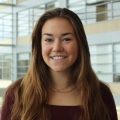
Sara is enthusiastic to use English to tell her life story. She’s been studying English for almost two years now, and is insistent on speaking her new language, even when given the option to use her native Spanish.
Sitting in the downtown Roanoke office of Blue Ridge Literacy on a recent afternoon, she doesn’t talk about her past in a mournful way. She’s more excited to talk about how her life has recently changed, and what’s next for herself and her family — her husband, her 9-year-old daughter, her 14-year-old son.
She owned a small grocery store for seven years in her home country, Colombia. She said gang members began robbing businesses like hers, killing owners who couldn’t pay.
She and her family fled. They spent a year in Ecuador, where a neighbor told Sara about a program that would allow her family to come to the U.S. legally. They applied and were accepted after a lengthy vetting process, and they landed in Roanoke almost two years ago. Cardinal is not using her real name because of the threats faced by her family.
Though she misses the rest of her family in Colombia, she said, she’s happy to have her children and her husband with her, and she likes being in Roanoke. She feels safe here.
She wants to own property in the city one day and would like to work for the Virginia Department of Social Services.
Sara and her family are among the 885 legal refugees who have been resettled in the Roanoke area over the last six years through Commonwealth Catholic Charities. CCC started its resettlement work 15 years ago; for nearly three decades before that, the Catholic Diocese of Richmond provided similar aid.
Restoring Hope Roanoke, which provides support to refugee families, says that more than 2,000 refugees have been settled in the region over the last two decades.
Roanoke was the first Virginia city to be named a “Welcoming City” by the nonprofit Welcoming America, thanks to the high level of support and resources available to immigrants and refugees through organizations such as Blue Ridge Literacy and CCC.
The CCC’s resettlement work came to an abrupt end earlier this year, when the Trump administration suspended the U.S. Refugee Admissions Program and ended contracts with organizations like CCC to support refugees who have arrived in the U.S. within the past 90 days.
CCC, which has several offices across Virginia, laid off 26 employees — 15% of its workforce, said Katie Dillon, the organization’s communications manager. Nine of those employees were in its Roanoke office. Those who remain are doing their best to support their clients without federal backing.
Refugees in the U.S. go through a long process of screening and background checks before being approved by the federal government.
“There are still so many people within these communities who are entitled to rights and services and are here through a very well-vetted and established immigration path,” said Ahoo Salem, executive director of Blue Ridge Literacy, which works with many CCC clients. “That is something that could be easily forgotten.”

Suspension of federal refugee program creates local financial challenges
Trump’s Jan. 20 executive order upended established refugee resettlement programs and ended the acceptance of refugees into the U.S. The administration said it would reconsider the order in 90 days. In the meantime, refugees can be admitted on a case-by-case basis, and legal challenges to the order continue to make their way through the courts.
Before Trump’s order, newly arrived refugees were granted three months of financial and social support while they found a place to live, started to learn English, enrolled their children in school and found work.
In the Roanoke area, that help came from CCC.
Between October and January, 96 refugees were referred to CCC for resettlement in Roanoke, Dillon said.
Fifteen families in Roanoke are currently within the 90-day window of intense support, but CCC has lost all federal funding to support them. Statewide, CCC has spent $750,000 on rental assistance, staffing and other expenses that it’s now unlikely to be reimbursed for, Dillon said.
The most critical challenge without federal funding is housing, she said.
Through donations, CCC has been able to provide housing for all 15 families through the end of this month. According to the organization’s website, it needed to raise $27,773.85 to continue to cover housing costs in April and May. Donations can be made here. Dillon said CCC has almost reached its goal.
“CCC remains committed to fulfilling this promise, despite the United States’ refusal to uphold its part of the agreement,” she said.
“We have had so much support from churches, parishes, community groups, individuals, just all across the board, lots and lots of people who have really rallied around and welcomed people into the community.”
CCC also continues to support refugees through the five-year process of becoming a U.S. citizen; this work is funded through the Virginia Department of Social Services. These longer-term services include employment services, medical support, school support, cultural orientation, English classes and women’s empowerment classes, Dillon said. CCC also offers permanent housing services.
Currently, 633 people are receiving this longer-term support through CCC, Dillon said.
“The United States has always been a welcoming place for refugees, and so I would hope that we can continue with that,” she said.

Questions, confusion within Roanoke’s refugee and immigrant communities
Blue Ridge Literacy, where Sara studies, is about halfway through its spring semester of classes.
During a break in a recent advanced English class, students spoke about their experiences with CCC’s caseworkers. Most of the students said they’d always been able to get in touch with their caseworkers quickly, within a few hours to a day.
They said their caseworkers have helped them get to the hospital and job interviews and have found job openings for them, as well as helping with child care.
Salem said she and her staff are having to answer more questions from the community they serve in the absence of the CCC caseworkers who would normally field those concerns.
“The massive amount of shifts in our immigration policy is something we are concerned about but also trying to be well-prepared for,” Salem said. “We will need to work harder to strengthen our partnerships with the existing service providers to make sure our learners who are refugees are still using and connected to the services they’re entitled to, but are not familiar with how to access and how to navigate.”
She said the organization is staying well-connected with other nonprofits and immigration attorneys to stay up to date with quickly changing policies.
Samjana Dahal, refugee resettlement program supervisor for CCC in Roanoke, was once a refugee herself, arriving in the U.S. with her family from Nepal in 2011. It took them 10 years to become citizens.
“It’s really devastating, because when we came here, the situation was different,” she said. CCC was fully staffed, and the resources available were easier to access, she said.
“There was a real sense of hope and openness towards newcomers, and the support for refugees was much stronger,” Dahal said.
Dahal used to do case work with CCC, which starts with picking up the families at the airport upon their arrival into the country. She said families are starting to question their status when they see these federal changes in the news.
“Our clients are vetted and they go through an intensive process to come to America and they’re legal here, but there’s definitely a ‘what’s going to happen to me’ type of thing out there.” She said there is confusion surrounding the different levels of statuses for immigrants and refugees.
“People don’t become refugees because they want to, they do because of their circumstances. Because they fear for their lives.”
CCC’s website says that 75% of the refugees in the world come from Afghanistan, Syrian Arab Republic, Venezuela, Ukraine and South Sudan. The organization supports refugees from these countries as well as from Burundi, Colombia, Democratic Republic of the Congo, El Salvador, Guatemala, Iran, Mali, Nicaragua, Pakistan and more.
Dahal said she thinks Roanoke remains a welcoming place for immigrants and refugees. “People in our community are amazing, always willing to help and step in,” she said. “Even for me, wherever I go, Roanoke is my home.”