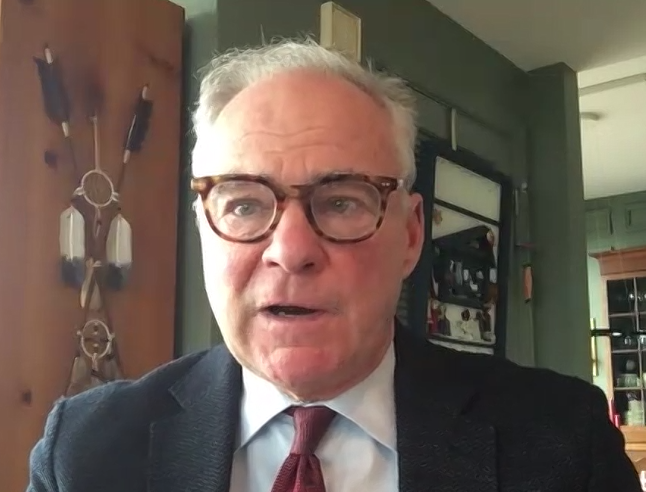


Uncertainty clouds the Virginia Tech research community as a Trump administration directive cutting National Institutes of Health funding awaits a federal court hearing.
The issue is not just about money, according to Virginia Tech’s president. It is about lives and the nation’s ability to compete in the global technology environment.
Virginia Tech President Tim Sands, in an open message to the university community, said the funding changes could have a $13 million, or 4.2%, impact on the university’s annual research budget.
Roanoke-based Fralin Biomedical Research Institute at VTC receives the majority of Virginia Tech’s NIH funding. The fallout wouldn’t affect only Virginia Tech but all universities conducting medical research, Sands wrote Monday afternoon.

“Lives will be lost due to the corresponding reduction in the pace of biomedical research,” Sands wrote. “It will degrade the nation’s ability to compete in a global technology environment, threaten our national security, and impact the economies of the states and localities that host these institutions.”
Sands wasn’t available for follow-up questions, and a university spokesman declined further comment on the situation.
A notice the NIH posted on Friday would cap payments at 15% for “indirect costs,” particularly facilities and administration, in research funding. The notice listed such “overhead expenses” as equipment and capital improvements, general administration and personnel.
The decision and its ramifications sit with a federal judge, for now. Entities including the Association of American Medical Colleges and the American Association of Colleges of Pharmacy filed suit on Monday in U.S. District Court, as did the attorneys general for 22 states.
U.S. District Judge Angel Kelley later that day placed a temporary restraining order on the NIH, effective nationwide, preventing the body from implementing the 15% cap.
Direct vs. indirect costs
According to the federal lawsuits, direct costs — which would not be affected by this cap — include salaries and supplies specific to research.
The target of the cap, indirect costs — also called facility and administrative costs — include research laboratory maintenance, high-speed data processing, data storage and security, lab equipment, radiation safety, hazardous waste disposal and support staff for administrative and regulatory compliance work.
Research institutes have for about 70 years negotiated the percentage rate with the federal government, Science.org editor H. Holden Thorp wrote on Tuesday. In recent years, the rate has ranged from 50% to 70%, Thorp wrote.
A negotiation agreement between Virginia Tech and the Navy’s Office of Naval Research, which takes part in research funding, shows that its facility and administrative costs for on-campus research are 60% and 63% as recently as 2024. For every dollar granted, about 60 cents more would be added for overhead.
NIH spent more than $35 billion in the 2023 fiscal year on about 50,000 grants to universities, medical schools and other research facilities. About $26 billion went to direct costs for research, while $9 billion went to overhead via the indirect cost rate, the notice read.
The aim of Trump’s directive is to save $4 billion, according to an NIH post on X, formerly Twitter.
At Fralin Biomedical, where most grants are multiyear awards, the NIH’s portfolio is $163 million, which accounts for about 68% of all outside funding to FBRI, according to the university.
The research institute, on South Jefferson Street, near Carilion Clinic’s Roanoke Memorial Hospital, specializes in neuroscience, cardiovascular science, cancer research, addiction recovery, children’s health and infectious disease science.
Sands, in his Monday message, wrote that in fiscal year 2024, the university’s total federally sponsored research expenditures were more than $308 million. That included direct expenditures of $235 million and facilities and administration reimbursement of $73 million.
The university used other sources to fund another $18 million in unreimbursed indirect expenses for federally funded projects.
Indirect costs are “very real,” Sands wrote, “and include regulatory compliance required by the federal government (e.g., safeguarding human subjects); the costs to build, operate, and maintain research facilities; and the administrative costs required to manage the grants and contracts.”
If the NIH’s indirect costs reimbursement reduction were extended to all federal agencies, it would cost the university more than $55 million annually, he wrote.
“We are following the situation closely and reaching out to our congressional representatives in Washington, D.C., to express our deep concern about this decision and its potential effect on our university and our nation’s long-term viability as a science and technology leader,” he wrote.
“We will continue to advocate for the value and importance of our research mission and make the strongest possible case for reconsideration or revision of this decision.”
Virginia lawmakers’ responses played out along political lines.
“Virginia — home to some of the nation’s top research institutes and universities — stands to lose tremendously from this illegal and incredibly shortsighted maneuver,” Sen. Mark Warner, D-Virginia, said in a prepared statement. “Trump’s attempt to slash funding will decrease the kind of research that leads to medical cures and scientific breakthroughs. It will devastate a major research ecosystem in Virginia, eliminate 21st century jobs, and hurt countless American families who have been touched by cancer and other devastating diseases. Now is not the time to cede American R&D leadership to China, which is why I’ll be fighting to oppose these cuts.”
Gov. Glenn Youngkin’s spokesman, Christian Martinez, said in an email exchange that it is “common sense” to make sure taxpayer-funded grants apply to research and not administrative overhead.
U.S. Rep. Morgan Griffith, R-Salem, said in a statement that he does not believe that a 15% cap to indirect cost rates “will significantly impact NIH-funded institutions in the Ninth District.”
Griffith echoed the NIH’s assertion that the government shouldn’t be paying more for overhead costs than private foundations do. The NIH notice included a table that listed such rates as between 10% and 15% from nonprofits including the Gates Foundation, the Carnegie Corporation of New York and the Rockefeller Foundation.
“I am a big proponent of scientific research,” he said in a statement that his spokesman provided. “But it is hard to argue that the federal government should be paying a much larger sum” than what private foundations pay.
Heywood Fralin, the Roanoke businessman and philanthropist whose family name is on the research institute, said in a phone call last week that he would be surprised if the new presidential administration cut funding to medical research. He did not reply this week to a question about his reaction to the NIH notice.
A hearing on the federal cases is set for Feb. 21. Among the issues that Kelley will have to consider is a law that Congress passed the last time Donald Trump was president. In 2017, Trump wanted to reduce the rate to 10%, as part of a wider NIH cut. The next year and since then, Congress forbade NIH from implementing changes to the facilities and administration cost rate program, the motions argue.
Regardless of future rulings, the university is dealing with the possibility of deeply slashed funding, according to a message from Executive Vice President and Provost Cyril Clarke and Executive Vice President and Chief Operating Officer Amy Sebring. That message, posted to Virginia Tech’s website on Tuesday, encouraged researcher leaders to limit such overhead costs until they had a better understanding of how to “manage this challenging situation.”
They wrote: “A rate of 15% is substantially lower than the previously negotiated rate, and university leadership is in the process of assessing the potential impact of this change, which would be significant, particularly if other federal agencies follow suit.”
Comments are closed.