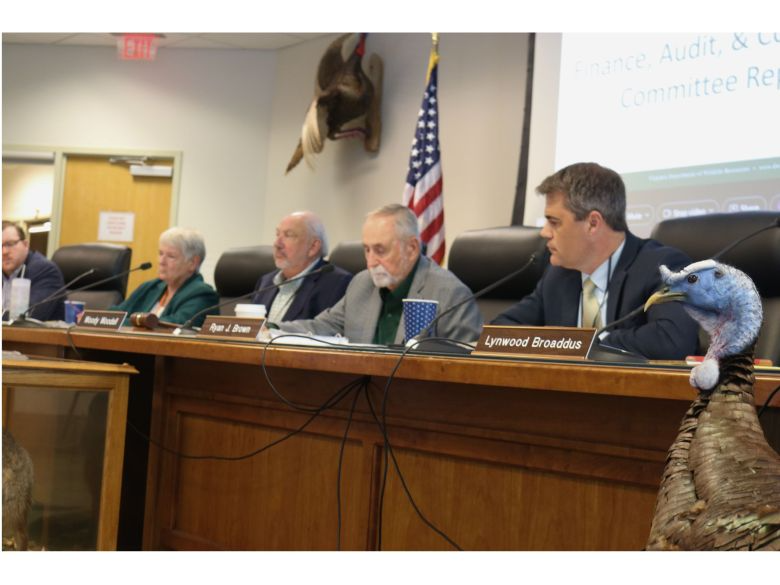
State Sen. Travis Hackworth, R-Tazewell County, sponsored legislation earlier this year that set in motion a study on ways to help the most economically distressed localities in the state.
That study is now back, and it’s a revealing document.

At first glance, this study would seem to be of pretty limited interest: Just 11 localities in the state meet the official criteria for suffering a triple whammy of challenges: a high unemployment rate, a high poverty rate and the highest rates of population decline since 2013.
Most of those are in Southwest Virginia: Bland County, Buchanan County, Brunswick County, Charles City County, Dickenson County, Lee County, Russell County, Smyth County, Sussex County, Tazewell County and Wise County.
However, some of the questions raised by this report are statewide in nature.
Hackworth began with a single question: Should residents in these most distressed localities qualify for some kind of income tax break? Would that help attract more residents and/or more employers? Tinkering with the income tax, even in fewer than a dozen localities, is the sort of thing that tends to raise eyebrows on both sides of the aisle, although perhaps for different reasons.
Spoiler alert: This study by the Department of Taxation did not come back with a conclusive answer.
“Study participants were generally supportive of a potential income tax incentive targeted to the localities in question,” the report said, although this isn’t a surprise since the participants were generally from the localities that would benefit. More importantly, the report found that an income tax break would be helpful but “would not be a comprehensive solution to ending or reversing population loss in those localities.” However, a tax break could be “an important
tool in those counties’ economic development toolbox.”
Hackworth found that encouraging enough that he’s put in a budget request for $8.76 million to offset an income tax subtraction of $5,000 per resident in each of the most distressed localities. We’ll see how that fares. I can see fellow Republicans thinking that with a projected budget surplus of $3.2 billion over the next two fiscal years, maybe everybody should get a tax break; I can see Democrats thinking that what we need to do is use that surplus to make investments and that what these counties really need is more spending on (insert project here) and not individual tax cuts. We’ll get to those political arguments soon enough. Before we get there, let’s look at what this study actually says.
Some localities didn’t participate
The goal was to focus on 10 localities, and all were invited to take part. Over the course of the study, it was found that an 11th locality, Bland, also met the criteria. Of the original 10, seven sent representatives to take part in the study. Who didn’t? Brunswick, Buchanan and Russell. This seems like a missed opportunity for those localities, but let’s move on.
The minimum wage increases in Virginia are having an unintended consequence
This is what really caught my eye: The state’s minimum wage went from $7.25 to $9.50 in 2021 and then rose again to $11 in 2022 and $12 in 2023 and is set to keep rising until it reaches $15 per hour in 2026. Tazewell’s county administrator, Eric Young, told the study group that these increases are hurting, not helping, the economy in his border county. The report says he told the study group: “By causing wage compression and forcing employers to pay higher wages to their workers, the increases in the minimum wage [have] eliminated the region’s historical lower labor costs advantage over West Virginia. This has led to fewer companies locating in Virginia and more existing companies relocating across the border in West Virginia.”
In a letter to the Department of Taxation, Young elaborated on the competitive realities Tazewell faces. He begins by pointing out that there are two Bluefields — one in Virginia, one in West Virginia. Bluefield, Virginia, is in Tazewell County. “Driving through town one would hardly know whether you were in the Commonwealth or the Mountain State on any given street,” he wrote. “But the employers know. In large part Bluefield, Virginia’s manufacturing economy is premised on making mining machines for West Virginia mines or West Virginian mining companies. Interstate 77 located five miles to the east is a conduit for our county’s manufacturing exports. Any day of the week convoys can be seen hauling machinery north. However, once our wages par West Virginia’s, I-77 will haul Bluefield’s businesses north once and forever. At some point they will not be able to overcome the transportation cost difference of operating in Tazewell County, if there is no longer a wage advantage. There will be a day when it makes more sense for them to locate closer to their market.”
I sure don’t want to be the guy who argues against raising the minimum wage, but I am curious what the legislators who voted for a minimum wage increase would have to say to Tazewell County about this predicament.
For Young, this economic reality of trying to compete with West Virginia leads him to support Hackworth’s proposal for an income tax break. It is “not a magic bullet to solve our economic ills,” Young wrote. “However, it can add to other local incentives and just may tip the balance in our favor and keep these businesses in Tazewell County. A reduction in the state income tax would ease the wage pressure on our key businesses and hopefully keep them in the Commonwealth. If the employee nets more take-home pay, they will be more satisfied with their current wage and less likely to relocate elsewhere for higher pay. This means the employer pays less to keep employees and can charge less for her product. We can recover some of our competitive advantage.”
Southwest Virginia faces a competitor other parts of Virginia don’t: Tennessee
We’re accustomed to hearing North Carolina described as Virginia’s biggest economic competitor. If you go far enough west, though, the competitor becomes not North Carolina but Tennessee. I hear about this almost anytime I talk to someone in the westernmost corner of Virginia. Tennessee’s economic advantage is that it doesn’t have a state income tax (although it does have the nation’s highest sales tax to make up for that, so pick your economic poison). That gets into another philosophical argument: Which is more fair, a progressive income tax or a regressive sales tax? Whatever the philosophy, here’s some of the reality, as documented in the report:
The Lee County representative “suggested that the rise of telework or remote work contributed to population loss and shared a personal anecdote about how his daughters who work from home had moved to Tennessee to avoid income tax because, as remote workers, they are taxed where they live, and Tennessee does not have an individual income tax.”
Migration data from the Internal Revenue Service bears this out: Of the people who move out of Lee County, the ones making the most money tend to move to Tennessee, where that higher income isn’t subject to income tax. In 2022, the people moving into Lee County made an average of $41,904. Those who moved out of the county to other parts of Virginia made an average of $37,805 — but those moving to Tennessee averaged $83,501. That’s a lot of lost disposable income for Lee County.
Bristol, Russell County, Scott County, Washington County and Wise County weren’t part of this study, but their IRS migration data shows the same trends: More affluent residents leaving those localities tended to move to Tennessee.
No other part of Virginia faces the same competitive pressure — sharing a border with a state that doesn’t have an income tax. It would be interesting to see a larger study on what impact that has on Southwest Virginia. If that part of Virginia faces a very different competitive environment, should there be separate tax rates that apply?
Until then we’re left with this written comment from Smyth County’s administrator, Shawn Utt: “Localities in Southwest Virginia are at a critical disadvantage due to our proximity to the surrounding states of West Virginia, Kentucky, Tennessee and North Carolina, all of which have more favorable financial conditions than what Virginia provides/requires.” Read that again. When a government official includes Kentucky and West Virginia in a list of states with “more favorable financial conditions,” maybe we ought to pay attention. He also backed Hackworth’s proposal: “This selective income tax reduction should serve as a strategic investment in the long-term economic stability of our region and the Commonwealth as a whole.”
Kansas has tried this, with mixed results
One state has tried something like this: Kansas. A state study in 2021 found it hadn’t done much to stem population decline in rural Kansas.
That state’s Rural Opportunity Zone program now covers 95 of the state’s 105 counties (pretty much anything that’s not Kansas City, Wichita or Manhattan). It offers a state tax credit and assistance in repaying student loans; the goal is to persuade young adults to stay in rural Kansas, or to move there. The Kansas study estimated the program was able to only offset about 5% of the population outflows from rural Kansas. However, that’s an overall figure. The study found some counties did benefit significantly from the program — 15 counties saw their population losses reduced by 10% or more thanks to the program. Two counties gained population (slightly) as a result of the program, and two others saw population increases grow faster because of it. As is often the case with real estate, the key is “location, location, location.”
Maybe the Kansas program is too broad? Or maybe it’s simply inadequate to the challenge of preventing population outflows from some hard-case counties? We don’t know.
Most of rural Virginia is seeing a renaissance of newcomers. Some places aren’t, though.

One of the big demographic stories in recent years has been a dramatic switch in migration trends. Instead of more people moving out of Virginia than moving in, we now see more in-migration. That’s definitely the case in rural Virginia.
However, some counties have escaped that trend, including eight of the 11 that would be covered by this tax plan: Buchanan County, Brunswick County, Charles City County, Dickenson County, Russell County, Sussex County, Tazewell County and Wise County. They’re still losing population two ways, both through the hearse and the moving van.
Only Bland, Lee and Smyth are now seeing more people move in than move out. They’re still losing population because, with aging populations, deaths outnumber both births and the net in-migration.
The question not asked
No report (or column, for that matter) can cover everything, so I’ll take it upon myself to ask the question this report couldn’t: If this proposed income tax reduction isn’t the right solution, what is?
There are more election numbers we haven’t looked at yet
This year’s election has produced a veritable feast of election data. I’ll look at more numbers and what they mean in this week’s edition of West of the Capital, our weekly political newsletter that goes out every Friday afternoon. You can sign up for that or any of our other free newsletters right here: