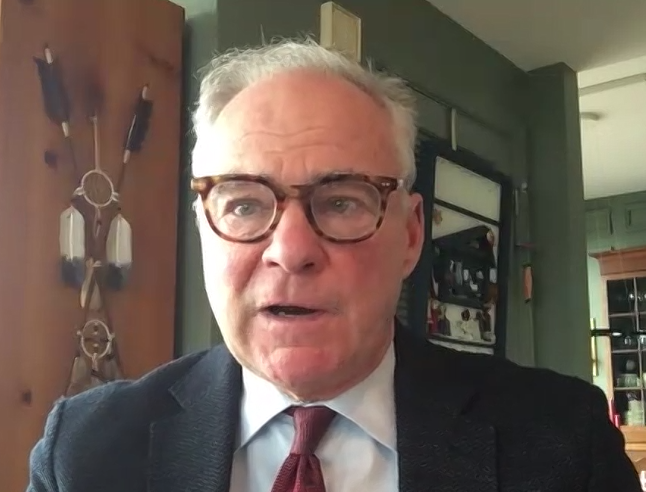


A circuit court judge has ruled that Gov. Glenn Youngkin’s removal of Virginia from the Regional Greenhouse Gas Initiative was unlawful.
Virginia had entered into RGGI, and was the first Southern state to do so, after a law passed by the Democratic-controlled General Assembly in 2020 required the commonwealth’s participation. The initiative is a multistate effort aimed at reducing carbon dioxide emissions from power plants. Eleven Eastern states, including Virginia, joined the program.
In 2022, Youngkin issued an executive order to reevaluate Virginia’s participation in the program, with the intent of ending it. The State Air Pollution Control Board repealed Virginia’s participation in RGGI in 2023. The program was not included in the 2024 budget, solidifying the commonwealth’s departure from the initiative.
Floyd County Circuit Judge Randall Lowe, in his decision handed down Wednesday, said that the governor lacked the statutory authority to repeal the RGGI regulation.
“The only body with the authority to repeal the RGGI Regulation would be the General Assembly. This is because a statute, the RGGI Act, requires the RGGI Regulation to exist,” Lowe wrote in his opinion.
Youngkin’s office said the administration plans to pursue an appeal.
“We respectfully disagree with the judge’s decision,” said Christian Martinez, press secretary for Youngkin, in a statement Wednesday. “Governor Youngkin remains committed to lowering the cost of living for Virginians by continuing to oppose [RGGI], which fails to effectively incentivize emission reductions in the commonwealth. Instead it functions as a regressive tax, hidden in utility bills, passed on to all Virginians.”
Lee Francis, deputy director of the Virginia League of Conservation Voters, which has supported the commonwealth’s participation in the program, pushed back against the characterization of the fee associated with RGGI as a “tax” by Youngkin’s office.
“They’ve kind of mischaracterized this all along,” Francis said in a phone call Wednesday.
He argued that the roughly 0.44 cents per kilowatt-hour added to consumers’ electric bills in connection to RGGI is an environmental compliance fee, not a “tax.” The per-month cost of that compliance fee to consumers depends on how much energy they use. Francis, for example, said he saw about $1.50 to $2 per month in RGGI-related compliance fees on his electric bill.
“You can look at your electric bill and point to any number of riders, or line items, and they’re not calling those ‘taxes,’ they’re just calling this a tax because it’s rhetoric that they’re trying to spin onto the citizens of Virginia.”
RGGI participation netted millions in Virginia for flood mitigation
The Virginia League of Conservation Voters noted that participation in RGGI created $830 million in dedicated revenue to combat flooding.
That revenue stemmed primarily from regional carbon dioxide allowance auctions, the proceeds from which are returned to RGGI states. The League of Conservation Voters noted that Virginia has been without a dedicated funding source for flood prevention and energy-efficiency programs since the state left the program.
Matt Allenbaugh, campaign coordinator for Appalachian Voices Virginia, said Wednesday that his organization is pleased with the court’s decision.
“A significant portion of RGGI proceeds were allocated by the General Assembly to the Community Flood Preparedness Fund to help communities prepare for and prevent catastrophic flooding,” Allenbaugh said in a statement. “Getting back into RGGI as quickly as possible will help communities across the state prepare for, and hopefully prevent, damaging flooding from the next storm.”
He said that the flooding associated with Hurricane Helene demonstrated the importance of the efforts supported by RGGI and that nearly half of the revenue from the program was meant to pay for projects and planning to mitigate similar natural disasters.
Helene damaged hundreds of homes in Virginia, including dozens of houses that were completely destroyed. Many businesses were also damaged or destroyed, and two lives were lost.
Democratic leaders applaud court decision
Democratic leaders in Virginia’s General Assembly took to social media on Wednesday to issue their support for the court’s decision.
House of Delegates Speaker Don Scott, D-Portsmouth, called the court’s decision a win not only for Virginians who have faced severe flooding but for the wallets of residents across the commonwealth.
“Today’s decision saves hardworking Virginians money by ensuring the resources generated by RGGI are used to protect our communities,” he said in a statement.
Senate Majority Leader Scott Surovell, D-Fairfax County, said that Youngkin acted illegally in removing Virginia from RGGI and that Attorney General Jason Miyares, who argued in support of the governor’s action, did not interpret the law correctly.
“Unfortunately, his decision has now cost Virginians $200 million of funds that could have been appropriated in the last two years to protect the commonwealth against flood damage like what just happened in Southwest Virginia because of Hurricane Helene,” he said in a post on X.