Cardinal News: Then & Now takes a look back at the stories we brought you over the last 12 months. Every day through the end of the year, we’ll share an update on some of the people and issues that made news in 2023.
A broadband project in Pittsylvania, the largest county in the state by square mileage and one of the most underserved in terms of internet access, is expected to bring 17,000 locations online by the time it’s complete in 2025. Since construction began in early 2023, this project has so far made service available to about 1,500 locations.
Expanding broadband access into rural areas is usually more challenging and expensive than in more densely populated regions, because greater distance between homes means more cable that needs to be laid.
In Pittsylvania, about 60% of residents do not have adequate broadband access, according to census data and information obtained by RiverStreet networks, the company behind the project.
RiverStreet Networks has laid about 246 of an anticipated 1,200 miles of fiber cable in the county. This is the largest broadband initiative in the county.

The project initially aimed to connect 14,000 locations, and about 10% of those original locations have been connected so far. Around 63% of county residents should have improved broadband access by the time the project is done.
However, the number of locations within the scope of the project has already increased from 14,000 to 17,000, and might continue to expand as time goes on — especially if more funding comes in from the state.
The project received a $39.1 million grant from the Virginia Communications Initiative in 2021, and another $3.5 million in VATI funds in 2023.
“If we get more funding for 2024, we will be looking at potentially another almost 100 miles of fiber and 3,600 more locations in Pittsylvania County,” said Rob Taylor, director of business development and government affairs for RiverStreet Networks, a North-Carolina based network provider that has expanded operations to Virginia.
In addition to the VATI funding, both Pittsylvania County and RiverStreet Networks have also put money toward this project. Total funds for the project so far come to just over $81 million.
Pittsylvania County Administrator Dave Arnold said that even though the project is countywide, there are certain requirements for locations when it comes to grant funding.
“In order to be eligible for the federal and state grant funding, the location must be recognized as unserved,” Arnold said.
This means that high-speed internet service, excluding a satellite-based connection, isn’t available, he said.
“Unserved locations typically are in more rural, less densely populated areas,” Arnold said.
Often, the question of who should put up the initial funds for a broadband infrastructure is a big barrier to getting a project started.
Should it be the broadband providers themselves? Should it be a locality, treating broadband almost like a public utility? Or should it be the responsibility of the consumer?
The Pittsylvania project took a unique approach to answering this question, with initial funding coming from a three-way partnership between the county board of supervisors, school board and RiverStreet Networks.
It was also beneficial to join these three groups together because of the scale of the project and the amount of initial funding needed.
Expanding broadband in the county is part of the board of supervisors’ comprehensive plan, and it became a vital objective of the school board as well when the pandemic forced students to learn from home — something that was challenging for those who lived in areas of the county with limited, or no, internet access.
“Right now, it’s not costing the residents anything,” Taylor said. “Even the funding that we got from the county wasn’t tax funds that the county had assessed against people. It was funding that had come down from the federal government during COVID.”
As the number of locations to receive broadband grows, so does the construction and labor involved.
“When we first started the project, we only had two main contractors and each one might have had three or four crews working,” Taylor said.
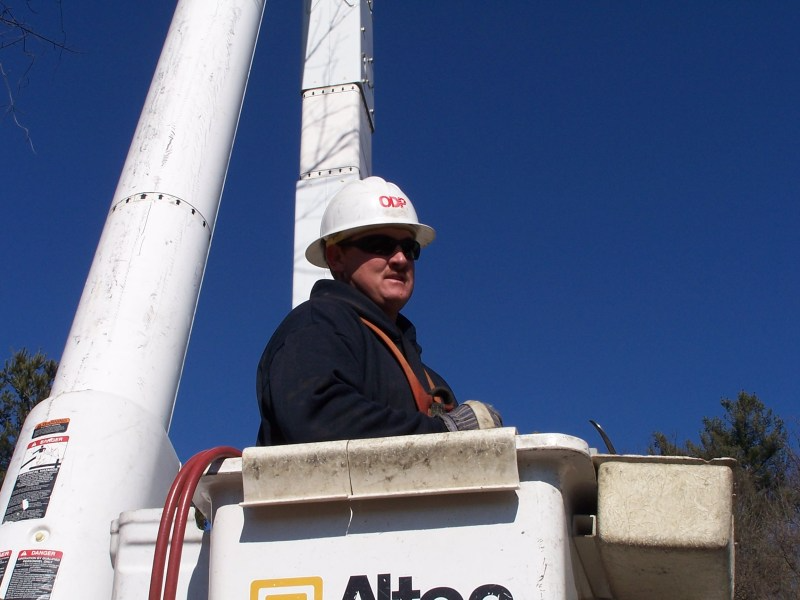
Now, RiverStreet Networks has 25 crews working on this project, which is about 101 people, he said. And there are four additional crews doing splicing, or joining two fiber-optic cables together, and 22 field engineers.

A map on RiverStreet Networks’ website shows where in Pittsylvania fiber service is available now and where it’s under construction. In parts of the county where fiber service is available, residents just need to call RiverStreet and sign up, Taylor said.
The company first focused on the northern portion of the county, he said, which was contiguous with RiverStreet’s established business from the purchase of a Gretna telephone company in 2018.
“We’re building from the top down both sides of the county, and then we’ll come back up the middle and finish at the very top at the end,” Taylor said.
The company is providing well above the minimum download and upload speeds required for a broadband service provider, which are 100 megabits per second download and 3 megabits per second upload. This minimum was increased last year, from 25 megabits per second download and 3 megabits per second upload.
That’s because the world is becoming increasingly reliant on internet access, especially after the pandemic, Taylor said.
Most locations in Pittsylvania County that already had broadband service only had these minimum speeds. Anything faster than that, and hardly any of the county was covered.
But RiverStreet is offering 100 megabits per second download and upload speeds as its minimum service, Taylor said.
The project is still on track to be finished in 2025, he said, though factors like weather and supply chain shortages could cause slow-downs.
Another obstacle has been keeping existing infrastructure safe while beginning new construction, Taylor said, adding that this has been a learning experience all over the country.
“As you start to put all of these resources into expanding broadband, it stresses some of the existing infrastructure out there,” he said.
Existing water lines, gas lines, electrical lines and copper phone lines must be marked so that new digging doesn’t damage them. But now that the project is underway, hundreds more utilities need to be marked on a weekly basis.
“You go from one person being able to do this to now, needing 10 people, and there’s just not enough people,” Taylor said. “What ends up happening, instead of getting your utilities marked within a few days, it might take a few months. There are programs out there to try and improve this, but it continues to be a stressor for everyone.”
Still, this project has progressed a lot in 2023, and Arnold said that residents are excited about it.
They’re “very interested in obtaining access to reliable high-speed internet and want to make sure their home is part of the project,” Arnold said. “If it is, then the next question is, ‘When will I be able to be connected?’”
A broadband glossary
Rob Taylor of RiverStreet Networks explains technical terms involved in this “fiber to the home” project.
What is fiber?
Fiber is thin strands of glass, close to the diameter of a piece of hair, that allow massive amounts of data transmitted across them at the speed of light using lasers.
What does fiber to the home mean?
Fiber to the home (FTTH) or fiber to the premise (FTTP) are industry terms that mean each location (home and/or business) is passed by the network will have the ability to have a fiber strand connected to their home or business. This fiber is then spliced and cross-connected across the network via fiber switches to a location that provides access to the Internet.
How is that different from wireless internet access?
Wireless internet access is typically shared bandwidth between multiple point to multipoint users/subscribers (PMP). The sharing of this bandwidth is typically done at the radio on the tower or at a switch at the base of the tower. Since the sharing point is so close to the subscriber, their internet speeds can suffer when multiple users on that tower are online at the same time. Fiber extends the need to share that bandwidth out much further, thereby eliminating the drop in bandwidth levels when multiple users are online at the same time.